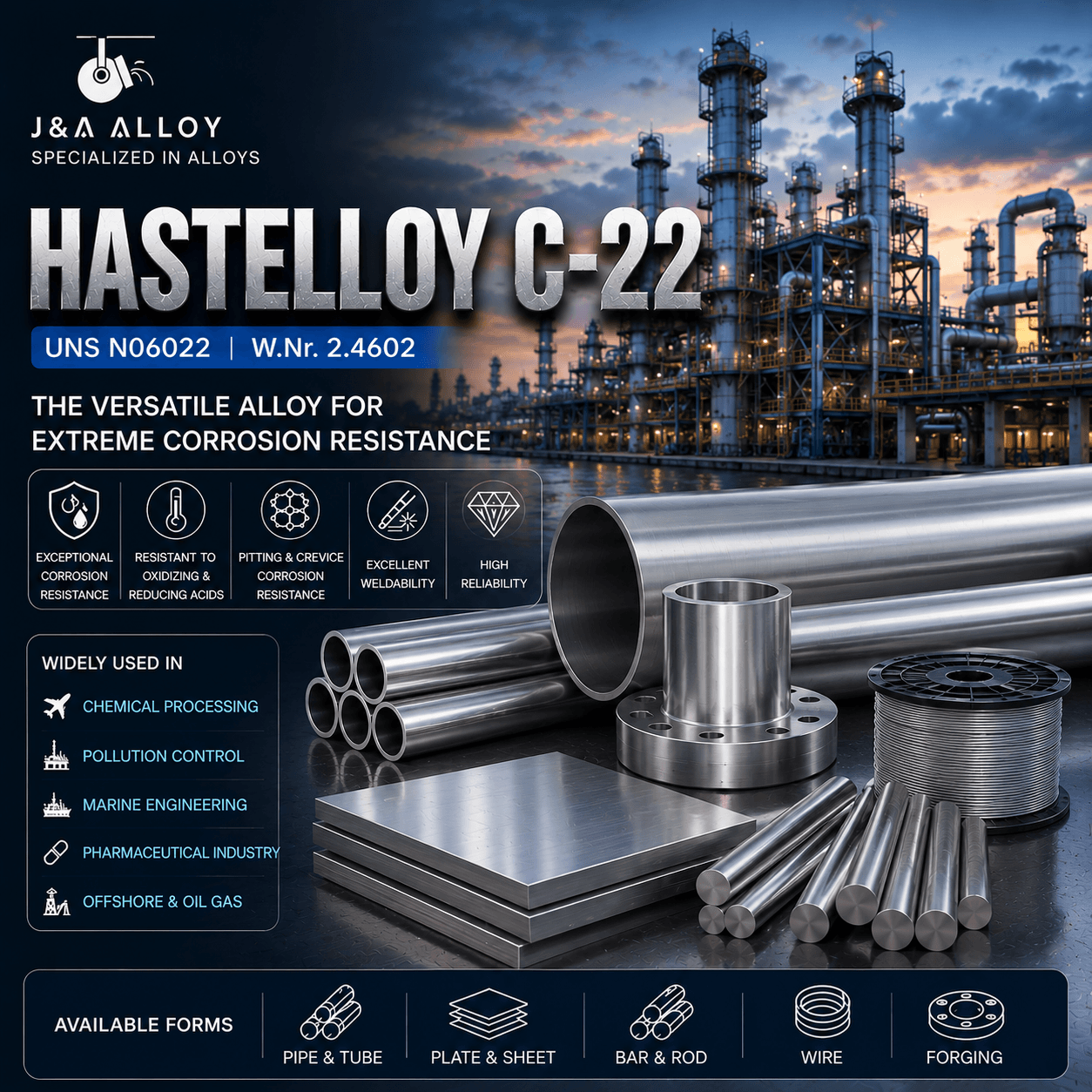
Hastelloy C-22丨UNS N06022
Hastelloy C-22 (UNS N06022) is a versatile nickel-chromium-molybdenum-tungsten alloy with outstanding resistance to pitting, crevice corrosion, and aggressive oxidizing or reducing environments. Widely used in chemical processing, marine engineering, pollution control, and pharmaceutical industries. Available in pipe, plate, sheet, bar, wire, and forging forms.
✔ ASTM / ASME Standards ✔ Fast Delivery
✔ Global Export ✔ Custom Sizes
✔ Mill Test Certificate ✔ OEM Processing
Quick Answer: Hastelloy C-22 (UNS N06022) is a nickel-chromium-molybdenum-tungsten alloy selected for mixed oxidizing/reducing chemicals, wet chlorine, chlorides, localized corrosion and demanding welded equipment. It is commonly compared with Hastelloy C-276; final selection requires the medium, concentration, temperature, contaminants, crevice conditions and fabrication route.
Hastelloy C-22 Supplier & Manufacturer
Hastelloy C-22 (UNS N06022 / W.Nr. 2.4602) is a versatile nickel-chromium-molybdenum-tungsten alloy with exceptional resistance to oxidizing and reducing corrosive environments. The alloy is widely recognized for its outstanding resistance to pitting, crevice corrosion and stress corrosion cracking in aggressive chemical processing applications.
Due to its superior corrosion resistance and excellent fabrication properties, Hastelloy C-22 is extensively used in chemical processing, marine engineering, pharmaceutical equipment, pollution control systems and offshore industries.
JA Alloy supplies high-quality Hastelloy C-22 products in various forms including pipe, tube, plate, sheet, bar, wire, flange and forgings according to ASTM, ASME and international standards.
Key Features of Hastelloy C-22
- Excellent resistance to oxidizing and reducing acids
- Outstanding pitting and crevice corrosion resistance
- Superior resistance to wet chlorine and chloride environments
- Excellent weldability and fabrication performance
- Strong resistance to stress corrosion cracking
- High reliability in severe chemical processing conditions
- Excellent performance in mixed acid environments
- Suitable for highly corrosive industrial applications
Chemical Composition of Hastelloy C-22
| Element | Composition (%) |
|---|---|
| Nickel (Ni) | Balance |
| Chromium (Cr) | 20.0 – 22.5 |
| Molybdenum (Mo) | 12.5 – 14.5 |
| Tungsten (W) | 2.5 – 3.5 |
| Iron (Fe) | 2.0 – 6.0 |
| Cobalt (Co) | 2.5 max |
| Carbon (C) | 0.015 max |
| Manganese (Mn) | 0.50 max |
| Silicon (Si) | 0.08 max |
Mechanical Properties of Hastelloy C-22
| Property | Value |
|---|---|
| Tensile Strength | 690 MPa min |
| Yield Strength | 310 MPa min |
| Elongation | 45% min |
| Hardness | ≤ 100 HRB |
| Density | 8.69 g/cm³ |
| Melting Range | 1325 – 1370°C |
Corrosion Resistance
Hastelloy C-22 offers exceptional resistance to a wide range of aggressive chemical environments including oxidizing acids, reducing acids, wet chlorine and mixed acid systems.
The alloy performs exceptionally well in:
- Hydrochloric acid environments
- Sulfuric acid systems
- Wet chlorine applications
- Chloride-containing environments
- Flue gas desulfurization systems
- Chemical reactors and scrubbers
Its versatility makes Hastelloy C-22 one of the most reliable corrosion-resistant nickel alloys for chemical processing industries.
Hastelloy C-22 Corrosion Resistance by Medium
No corrosion alloy is universally immune. Use this table as a screening guide and verify the actual chemistry, temperature, pressure, aeration, solids and crevice geometry before specification.
| Service medium | Why C-22 is considered | Information needed |
|---|---|---|
| Hydrochloric and mixed acids | Broad resistance across many reducing and mixed-acid conditions | Acid concentration, temperature, oxidizing contaminants and velocity. |
| Wet chlorine, hypochlorite and oxidizing chlorides | High chromium supports oxidizing-media resistance | Available chlorine/oxidizer, pH, temperature and shutdown conditions. |
| Chloride process streams | Strong resistance to pitting, crevice corrosion and chloride SCC | Chloride level, temperature, crevices, deposits and stagnation. |
| FGD scrubber service | Candidate for chloride-acid slurry and pollution-control equipment | pH, chloride, temperature, solids, abrasion and weld details. |
| Seawater and offshore service | Useful localized-corrosion margin in severe marine conditions | Temperature, chlorination, flow, crevice and galvanic conditions. |
Applications of Hastelloy C-22
Chemical Processing
Used in reactors, heat exchangers, piping systems and pressure vessels handling aggressive chemicals and acids.
Pollution Control
Widely used in flue gas desulfurization systems, scrubbers and waste treatment equipment.
Pharmaceutical Industry
Suitable for highly corrosive pharmaceutical processing environments requiring superior corrosion resistance.
Marine & Offshore
Applied in offshore systems exposed to chloride-rich seawater environments.
Hastelloy C-22 vs Hastelloy C276
| Property | Hastelloy C-22 | Hastelloy C276 |
|---|---|---|
| UNS Number | N06022 | N10276 |
| Main Composition | Ni-Cr-Mo-W | Ni-Mo-Cr-W |
| Oxidizing Environment Resistance | Excellent | Very Good |
| Reducing Acid Resistance | Excellent | Excellent |
| Pitting & Crevice Corrosion Resistance | Excellent | Very Good |
| Weldability | Excellent | Good |
| Typical Applications | Chemical Processing, Pollution Control | Chemical Industry, Marine Engineering |
| Best For | Mixed oxidizing and reducing acids | Severe corrosive environments |
Hastelloy C-22 vs C-276 vs C-2000
| Alloy | Selection emphasis | When to compare |
|---|---|---|
| Hastelloy C-22 / N06022 | Mixed oxidizing/reducing service and localized-corrosion resistance | Wet chlorine, oxidizing chlorides, mixed acids and demanding weldments. |
| Hastelloy C-276 / N10276 | Broad severe-corrosion service with extensive industrial experience | Compare C-22 and C-276 for FGD, acids and crevice conditions. |
| Hastelloy C-2000 / N06200 | Chromium-molybdenum alloy with copper addition | Review C-2000 vs C-276 when sulfuric or mixed-acid economics matter. |
Hastelloy C-22 Welding and Fabrication
ERNiCrMo-10 wire and ENiCrMo-10 covered electrodes are common matching consumables for C-22, subject to the qualified welding procedure and service environment. Use dedicated clean tools, remove iron and sulfur contamination, control heat input and interpass temperature, and remove heat tint or oxide when the finished surface will face severe corrosion.
For dissimilar joints, filler selection must account for dilution, the less-alloyed side, service chemistry and construction code. Send the base materials, joint design, WPS/PQR requirement and post-fabrication cleaning method with the inquiry.
Hastelloy C-22 Product Forms and ASTM/ASME Standards
| Product form | Common starting standard | RFQ information |
|---|---|---|
| Bar, rod and wire | ASTM B574 / ASME SB-574 | Diameter, length, condition, tolerance and testing. |
| Plate, sheet and strip | ASTM B575 / ASME SB-575 | Thickness, width, length, surface and cutting. |
| Seamless pipe and tube | ASTM B622 / ASME SB-622 | OD/NPS, wall or schedule, length and test scope. |
| Welded pipe | ASTM B619 / ASME SB-619 | Dimensions, construction route, weld tests and code. |
| Welded tube | ASTM B626 / ASME SB-626 | OD, wall, length, heat treatment and examination. |
| Forgings, flanges and fittings | ASTM B564 / ASME SB-564 | Drawing, pressure class, machining and inspection. |
Standards & Equivalent Grades
ASTM Standards
- ASTM B574
- ASTM B575
- ASTM B622
Equivalent Grades
- UNS N06022
- W.Nr. 2.4602
- Alloy C22
Hastelloy C-22 RFQ Checklist
- Service: medium, concentration, contaminants, chloride/oxidizer level, temperature and pressure.
- Material: UNS N06022, product form, ASTM/ASME standard and material condition.
- Dimensions: size, wall or thickness, length, tolerance, drawing and quantity.
- Fabrication: welding, forming, machining allowance, surface cleaning and passivation requirements.
- Inspection: EN 10204 3.1 MTC, PMI, UT/NDT, corrosion testing or third-party inspection.
Frequently Asked Questions
What is Hastelloy C-22 used for?
Hastelloy C-22 is widely used in chemical processing, pollution control, pharmaceutical equipment and offshore applications requiring exceptional corrosion resistance.
Is Hastelloy C-22 resistant to hydrochloric acid?
Yes. Hastelloy C-22 provides excellent resistance to hydrochloric acid and mixed acid environments.
What is the difference between Hastelloy C-22 and C276?
Hastelloy C-22 generally offers better resistance to oxidizing environments, while Hastelloy C276 is widely used for severe reducing acid applications.
Is Hastelloy C-22 suitable for seawater applications?
Yes. Hastelloy C-22 performs very well in chloride-rich marine and offshore environments.
Why Choose J&A Alloy as Your Hastelloy C-22 Supplier?
- Professional nickel alloy supplier and exporter
- Strict quality inspection and PMI testing
- ASTM / ASME compliant materials
- Global export experience
- Competitive pricing and fast delivery
- Custom processing services available
- Technical support for material selection
For pricing, technical support or custom specifications, please contact J&A Alloy for a quotation.