
Nickel Alloy Pipe Flanges for Corrosive and High-Temperature Piping
Select forged nickel alloy and super stainless steel flanges by type, material standard, dimensional system, pressure rating, facing, bore and inspection requirement.
Common Pipe Flange Types
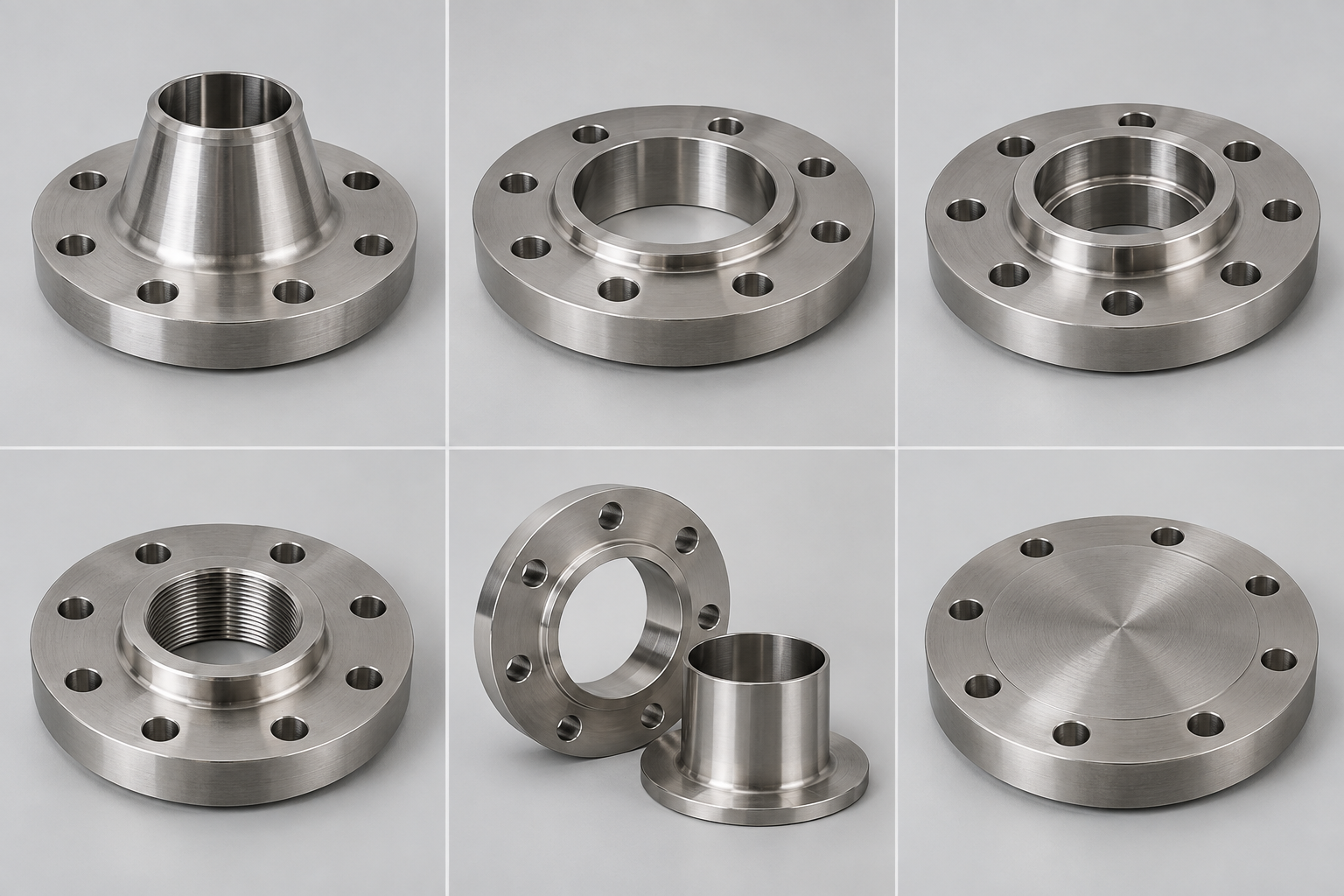
Weld Neck Flange (WN)
Tapered hub and butt-weld end provide a smoother stress transition. Common for high-pressure, high-temperature, cyclic or critical service when permitted by the piping design.
Slip-On Flange (SO)
Slides over the pipe and is typically attached with fillet welds. Often considered for lower-demand fabrication, but pressure, fatigue, corrosion allowance and welding details must be reviewed.
Socket Weld Flange (SW)
Pipe seats in a recessed socket before fillet welding. Used mainly on smaller-bore piping; the internal crevice and corrosion or cleanliness implications require engineering review.
Threaded Flange
Connects without welding using a specified pipe thread such as NPT where the standard permits. Thread compatibility, sealing method, vibration and corrosion risks must be defined.
Lap Joint Flange
Used with a stub end so the backing flange can rotate for bolt-hole alignment. Useful where alignment or separation of wetted and backing materials matters; specify both components.
Blind Flange (BL)
Closes a pipe, nozzle or valve end. Blind thickness, facing, pressure class, bolting and loading must follow the selected standard; it is not the same as a line blank.
Long Weld Neck Flange
Extended neck provides a transition to a vessel or nozzle connection. Supply is normally drawing- and design-code-driven, including neck length, bore, wall and reinforcement details.
Orifice, Reducing and Custom Flanges
Orifice tapping, reduced bore, nonstandard drilling, instrument connections and custom profiles can be reviewed against the applicable standard and controlled drawing.
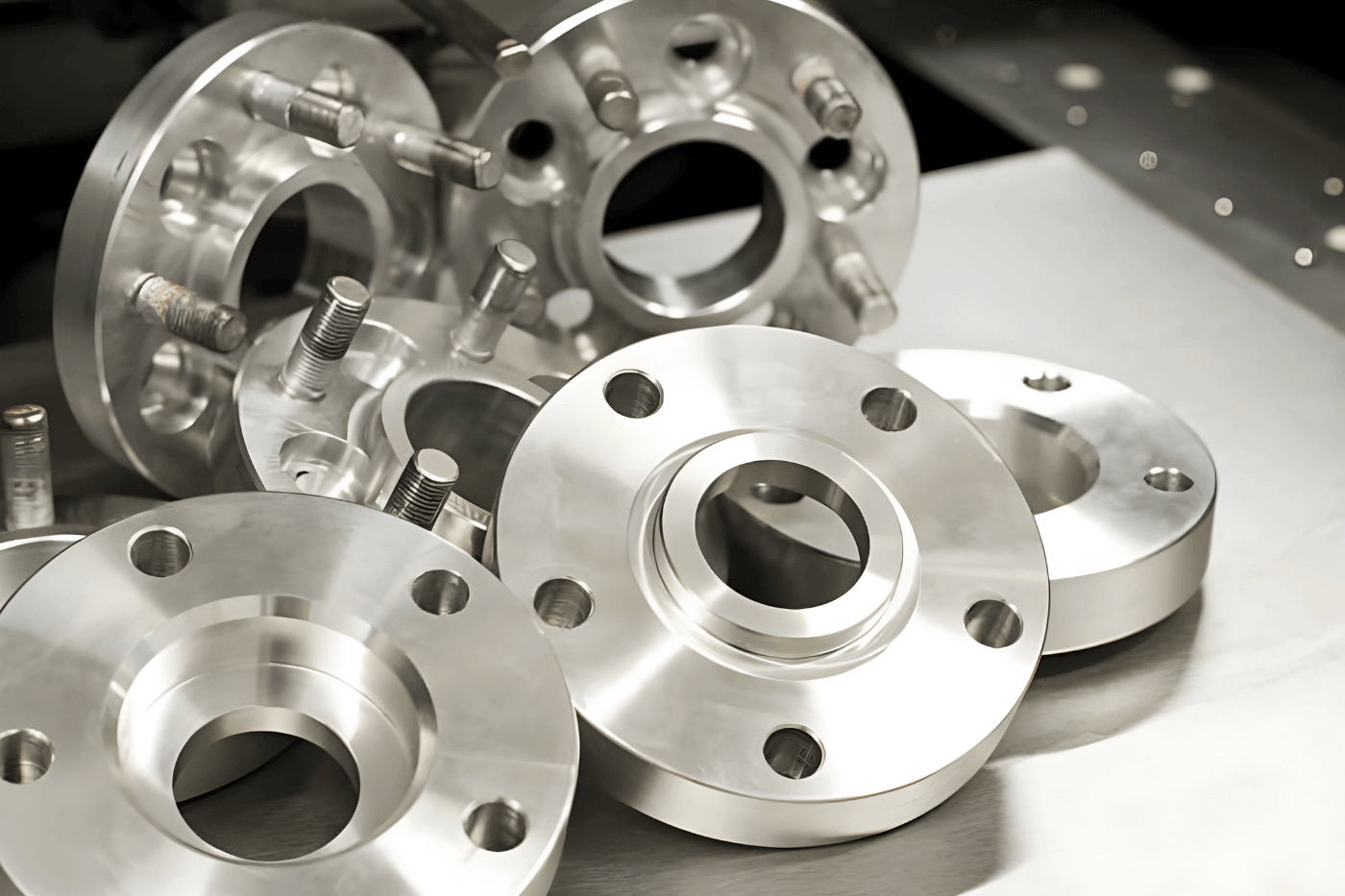
Flange Facing, Bore and Joint Details
Raised Face (RF)
Common process-piping facing. State the required standard, pressure class/PN, surface finish and gasket system.
Flat Face (FF)
Often associated with full-face gaskets or mating equipment requirements. Do not convert RF to FF without design approval.
Ring-Type Joint (RTJ)
Uses a machined ring groove and metallic gasket for selected high-pressure/high-temperature services. Groove number and ring material must match.
Tongue-and-Groove / Male-and-Female
Special facing pairs used in selected process systems. Specify both mating faces and gasket dimensions.
Bore and Pipe Schedule
Weld-neck bore should be coordinated with pipe outside diameter and wall/schedule to achieve the intended transition.
Drilling and Bolting
Bolt circle, hole diameter, number of holes and orientation must follow the selected ASME, EN, ISO or project standard.
Nickel Alloy and Super Stainless Steel Flange Materials
| Material | Why It Is Considered | Typical Applications | Material Specification Note |
|---|---|---|---|
| Inconel 625 UNS N06625 | Chloride, seawater and general corrosion resistance | Marine, offshore, chemical processing and pollution-control piping | ASTM B564 / ASME SB-564 where grade and product coverage apply |
| Incoloy 825 UNS N08825 | Sulfuric and phosphoric acid resistance with useful chloride performance | Acid processing, tanks, heat exchangers and process piping | Confirm current material standard coverage, heat treatment and corrosion environment |
| Hastelloy C-276 UNS N10276 | Broad severe-corrosion resistance in many mixed chemical environments | Reactors, scrubbers, chemical transfer and aggressive process systems | ASTM B462 is a common flange and forged-component material reference |
| Hastelloy C-22 UNS N06022 | Resistance to oxidizing and reducing media, chlorides and localized corrosion | Chemical processing and high-purity corrosive systems | Verify grade, condition and current ASTM B462 requirements |
| Monel 400 UNS N04400 | Nickel-copper performance in selected marine and chemical media | Seawater systems, pumps, valves and process equipment | ASTM B564 coverage and galvanic compatibility should be confirmed |
| Nickel 200 / 201 | Caustic alkali resistance and high nickel purity | Alkali processing and special chemical equipment | Select 200 or lower-carbon 201 according to temperature and fabrication route |
| Duplex 2205 / 2507 | High strength with chloride stress-corrosion and pitting resistance | Seawater, oil and gas, desalination and chemical piping | ASTM A182 F51/F53/F55 as applicable; control heat treatment and ferrite balance |
| 254SMO / 904L | Super-austenitic corrosion resistance for selected chloride and acid service | Process piping, flue-gas cleaning and seawater systems | Use the applicable ASTM A182 grade and project corrosion limits |
The material standard and dimensional standard perform different jobs. Verify that the exact alloy grade is listed in the current material specification and that the piping design code permits the required pressure-temperature rating.
American Flange Standards: ASME and ASTM
| Standard | Scope | RFQ Guidance |
|---|---|---|
| ASME B16.5 | Pipe flanges and flanged fittings, NPS 1/2 through NPS 24 | Classes 150, 300, 400, 600, 900, 1500 and 2500 as covered; specify type, bore/schedule, facing and edition |
| ASME B16.47 | Large-diameter flanges, NPS 26 through NPS 60 | Series A or B and applicable Classes 75 through 900; series are not interchangeable |
| ASME B16.36 | Orifice flanges | State flange type, pressure class, tapping arrangement, bore and meter-run requirements |
| ASME B16.48 | Line blanks, spectacle blinds, spades and spacers | Use for operational line blanks rather than treating a blind flange as the same component |
| MSS SP-44 | Steel pipeline flanges where specified | Confirm project adoption, size, class, material and dimensional compatibility |
| ASME B16.20 / B16.21 | Metallic and nonmetallic flange gaskets | Coordinate facing, gasket dimensions and pressure class with the mating flange system |
Material Standards Commonly Paired with ASME Dimensions
- ASTM B564 / ASME SB-564 for covered nickel alloy forgings
- ASTM B462 / ASME SB-462 for covered corrosion-resistant nickel alloy flanges and forged parts
- ASTM A182/A182M / ASME SA-182 for covered stainless, duplex and alloy-steel forgings
- State the current material and dimensional standard editions separately
- Confirm heat treatment, mechanical properties and supplementary requirements
- Do not assume every trade-name alloy is covered by every material specification
European Flange Standards: EN, DIN EN and PED
| Standard | Scope | RFQ Guidance |
|---|---|---|
| EN 1092-1 | PN-designated circular steel flanges for pipes, valves, fittings and accessories | State flange Type, DN, PN, facing, material, bore or pipe wall, edition and any national adoption such as DIN EN or BS EN |
| EN 1514 series | Gasket dimensions for PN-designated flanges | Match gasket material, type, dimensions and surface finish to the flange facing and service |
| EN 1515-1 / EN 1515-2 | Bolting selection and material classification for PN flange joints | Define bolting material, temperature range, corrosion conditions and pressure system |
| EN 10204 | Inspection documents Type 2.2, 3.1 or 3.2 | State the document type and validation route in the purchase order |
| PED 2014/68/EU | European pressure-equipment conformity framework | Equipment manufacturer must define category, material route/PMA, notified-body scope and traceability |
EN 1092-1 uses a PN-designated system. PN and ASME Class values are not direct equivalents; dimensions, pressure-temperature ratings, materials, facings and drilling must be verified in the selected system.
International and Oil & Gas Flange Standards
| Standard | Scope | RFQ Guidance |
|---|---|---|
| ISO 7005-1:2011 | Steel flanges for industrial and general service piping systems | International base specification; purchaser remains responsible for selecting the flange series |
| ISO 15590-3:2022 | Factory-made flanges for pipeline transportation systems | Use where the pipeline project invokes ISO 15590-3 and coordinate with ISO 3183 pipe requirements |
| ISO 10423:2022 / API 6A | Wellhead and tree equipment, including specified flanged and end connections | Not a general process-piping flange substitute; specify PSL, PR, material class and equipment requirements |
ISO 10423/API 6A wellhead connections and ISO 15590-3 pipeline flanges are project-specific systems, not substitutes for general ASME B16.5 or EN 1092-1 process-piping flanges.
Choose Flange Materials by Application
| Application | Common Starting Materials | Critical Selection Inputs |
|---|---|---|
| Chemical Processing | C-276, C-22, Incoloy 825, Inconel 625, Nickel 200/201 | Medium, concentration, temperature, contaminants, cleaning cycle and crevice risk |
| Oil & Gas / Sour Service | Inconel 625, 725, 825, duplex and super duplex | Design code, API/ISO specification, sour-service limits, pressure, temperature and traceability |
| Marine & Offshore | Inconel 625, Monel 400, 2507, F55 | Chloride level, seawater velocity, crevice geometry, galvanic couple and cathodic protection |
| Power Generation | Inconel 625, high-temperature nickel alloys and stainless grades | Pressure-temperature rating, oxidation, thermal cycling, gasket and bolting relaxation |
| Industrial Furnaces | Heat-resistant nickel alloys | Oxidation, carburization, thermal expansion, flange load and maintenance cycle |
Quality, Inspection and Traceability
Documentation and Testing
- EN 10204 3.1 or 3.2 inspection documents as specified
- Heat and lot traceability from forging stock to finished flange
- Chemical composition, tensile properties and heat-treatment records
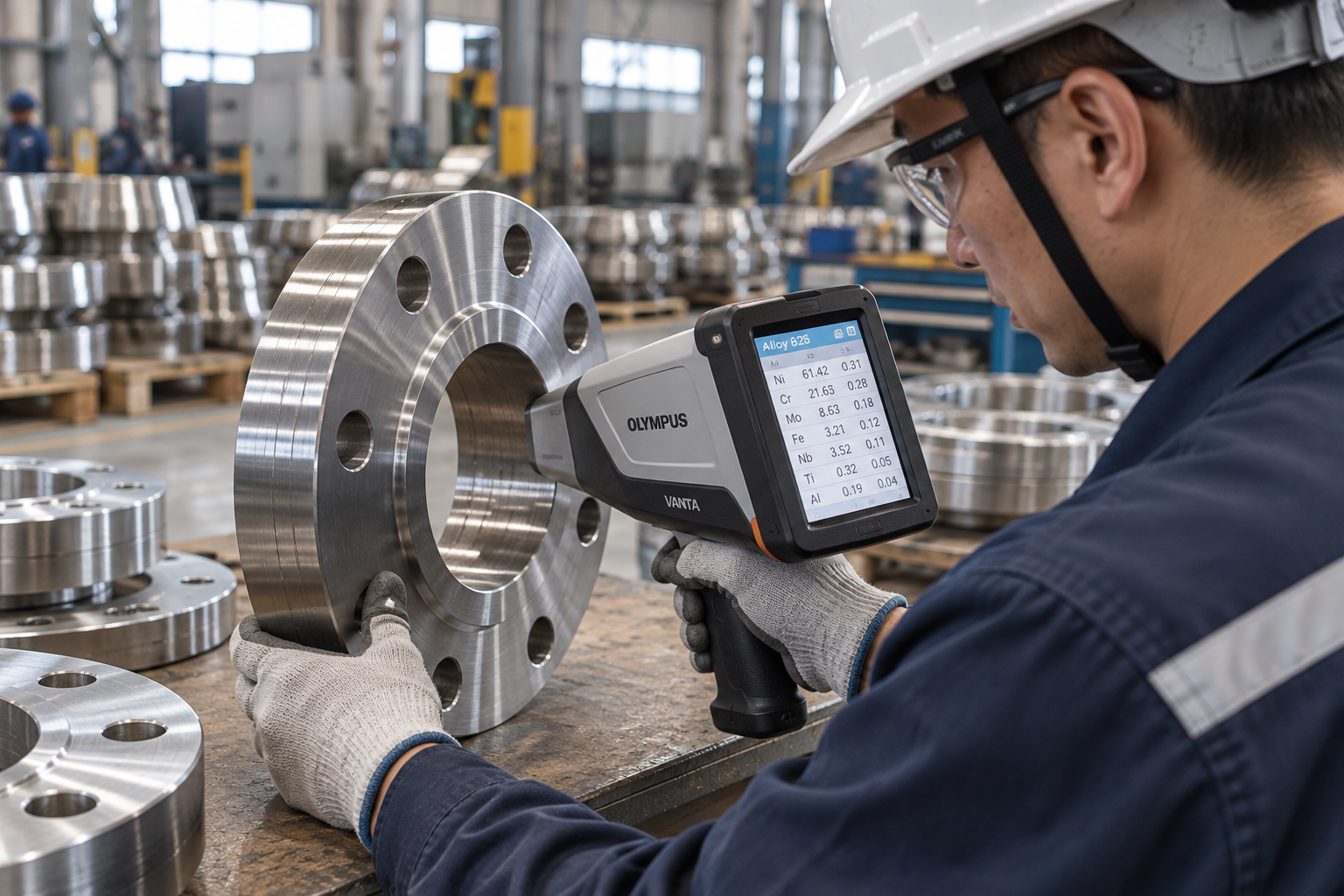
- PMI, hardness, dimensional and visual inspection reports
- UT/PT or other NDE to the specified acceptance criteria
Dimensional and Surface Checks
- Outside diameter, thickness, hub, bore and pipe schedule
- Bolt circle, hole count, hole diameter and orientation
- Facing type, gasket contact dimensions and surface finish
- Marking, edge condition, cleanliness and protective packaging
- Third-party or notified-body witness points under an agreed ITP
Related Materials, Product Forms and Applications
Nickel Alloy Flange FAQ
What is the difference between a weld neck and slip-on flange?
A weld neck flange has a tapered hub and a butt-weld end that provides a smoother stress transition for demanding pressure, temperature and cyclic service. A slip-on flange slides over the pipe and is normally fillet welded; it may be economical for less demanding service but is not an automatic substitute for a weld neck design.
Which standard covers ASME pipe flanges?
ASME B16.5 covers pipe flanges and flanged fittings from NPS 1/2 through NPS 24, while ASME B16.47 covers large-diameter steel flanges from NPS 26 through NPS 60. The purchase order must also identify the alloy material specification, pressure class, facing, bore, schedule and standard edition.
What is the European standard for steel flanges?
EN 1092-1 is the principal European standard for PN-designated circular steel flanges for pipes, valves, fittings and accessories. A European enquiry should state the flange type, DN, PN rating, facing, material designation, bore or pipe wall, inspection document and PED requirements where applicable.
Is ISO 7005-1 the same as ASME B16.5 or EN 1092-1?
No. ISO 7005-1 is an international base specification for steel pipe flanges, but ASME Class and EN PN systems are not interchangeable merely because nominal sizes appear similar. Bolt circles, facing details, pressure-temperature ratings, materials and dimensions must be checked against the selected standard series.
Which material standard applies to nickel alloy flanges?
The answer depends on the alloy. ASTM B564 covers a range of nickel alloy forgings, while ASTM B462 covers specified nickel alloy pipe flanges, forged fittings and valve parts for corrosive high-temperature service. Duplex and stainless grades commonly use ASTM A182/A182M. Always verify grade coverage in the current edition instead of choosing a material standard by product name alone.
What flange facing should be specified?
Raised face, flat face and ring-type joint are common starting options, with tongue-and-groove or male-and-female arrangements used on selected systems. The facing must match the mating flange, gasket, pressure class, standard and surface-finish requirement; the supplier should not infer it from the alloy grade.
Can nickel alloy flanges be supplied with EN 10204 3.1 documentation?
Yes, EN 10204 3.1 inspection documents, heat and lot traceability, chemical and mechanical results, PMI, dimensional reports and NDE can be reviewed when specified. EN 10204 3.2 or PED-related inspection requires the purchaser to define the validation and notified-body scope.
What information is needed for a nickel alloy flange RFQ?
Provide alloy and UNS or EN designation, material standard, flange dimensional standard and edition, type, NPS or DN, Class or PN, facing, bore or pipe schedule, quantity, testing, inspection document, marking, destination and any drawing or PED/API project requirements.
Request a Nickel Alloy Flange Quote
Send the complete material and dimensional designation. A request such as “4-inch nickel alloy flange” is not enough to establish interchangeability or pressure suitability.
- Alloy grade, UNS/EN designation and material specification
- ASME, EN, ISO, API or drawing standard and edition
- Flange type, NPS/DN, Class/PN and quantity
- Facing, bore or pipe schedule, gasket and mating-flange details
- Heat treatment, NDE, PMI, inspection document and marking
- PED category/PMA/notified-body or API/ISO project requirements where applicable