Haynes 230 | UNS N06230
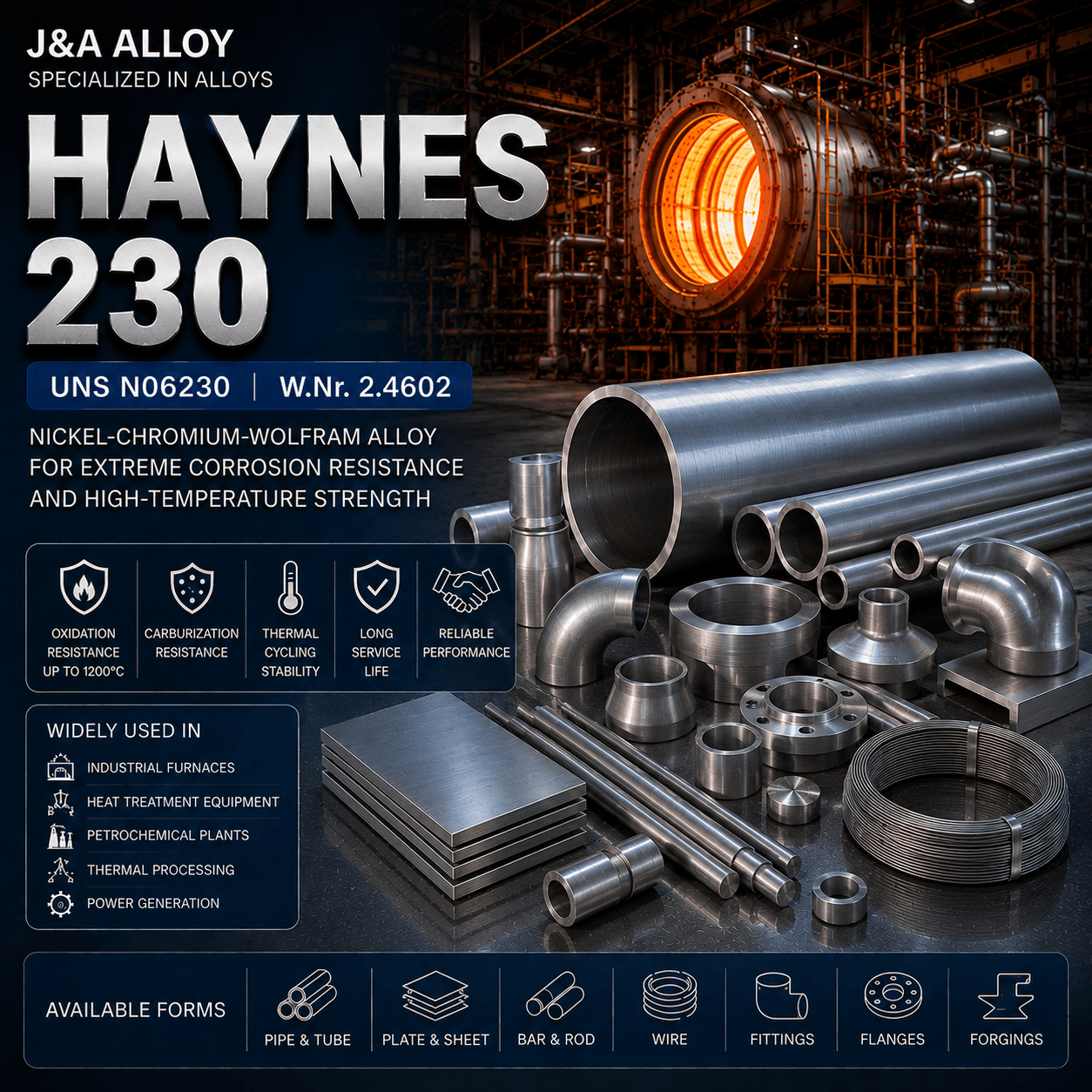
Haynes 230 is a nickel-chromium-tungsten alloy designed for extreme high-temperature service requiring exceptional oxidation resistance, thermal stability and creep strength.
J&A Alloy supplies Haynes 230 pipe, tube, plate, sheet, bar, wire and forgings for aerospace, gas turbine, petrochemical and industrial furnace applications.
✔ Excellent oxidation resistance
✔ Outstanding creep strength
✔ Superior thermal stability
✔ Excellent fabrication and weldability
Haynes 230 Supplier & Manufacturer
Haynes 230 (UNS N06230, W.Nr. 2.4733) is a nickel-chromium-tungsten-molybdenum alloy specifically developed for extreme high-temperature service. The alloy combines exceptional oxidation resistance, outstanding creep strength, and excellent long-term thermal stability, making it one of the most widely used materials for industrial furnaces, gas turbines, and aerospace combustion systems.
Compared with traditional high-temperature alloys, Haynes 230 provides superior resistance to thermal fatigue, carburization, and nitriding atmospheres while maintaining excellent fabrication and welding characteristics.
J&A Alloy supplies Haynes 230 pipe, tube, plate, sheet, bar, wire, flanges, fittings, and forgings with full traceability and international certifications.
Key Features of Haynes 230
Outstanding High-Temperature Strength
Maintains excellent creep and stress rupture properties up to 1149°C (2100°F).
Exceptional Oxidation Resistance
Forms a stable chromium-rich oxide layer for long-term protection.
Excellent Thermal Stability
Resists grain growth and embrittlement during prolonged exposure.
Superior Thermal Fatigue Resistance
Suitable for repeated heating and cooling cycles.
Excellent Fabricability
Can be formed, machined, and welded using conventional methods.
Long Service Life
Ideal for critical high-temperature applications requiring reliability.
Chemical Composition of Haynes 230
| Element | Content (%) |
|---|---|
| Nickel (Ni) | Balance |
| Chromium (Cr) | 20.0 – 24.0 |
| Tungsten (W) | 13.0 – 15.0 |
| Molybdenum (Mo) | 1.0 – 3.0 |
| Cobalt (Co) | ≤5.0 |
| Iron (Fe) | ≤3.0 |
| Manganese (Mn) | ≤0.50 |
| Silicon (Si) | 0.25 – 0.75 |
| Carbon (C) | 0.05 – 0.15 |
| Lanthanum (La) | 0.005 – 0.05 |
Mechanical Properties of Haynes 230
| Property | Typical Value |
|---|---|
| Tensile Strength | ≥ 760 MPa |
| Yield Strength (0.2%) | ≥ 325 MPa |
| Elongation | ≥ 40% |
| Hardness | ≈ 95 HRB |
| Density | 8.97 g/cm³ |
| Melting Range | 1301 – 1380°C |
Corrosion Resistance
Haynes 230 provides excellent resistance to:
- High-temperature oxidation
- Carburization
- Nitriding atmospheres
- Sulfidation
- Hot corrosion
- Thermal fatigue degradation
- Industrial furnace environments
The alloy performs exceptionally well in long-term oxidizing conditions where conventional stainless steels rapidly degrade.
High Temperature Performance
Typical Service Characteristics
- Continuous service up to 1149°C (2100°F)
- Excellent creep rupture strength
- Outstanding thermal fatigue resistance
- Superior oxidation resistance
- Exceptional microstructural stability
- Long-term dimensional stability
Haynes 230 is often selected for applications where both high mechanical strength and oxidation resistance are required simultaneously.
Available Forms
J&A Alloy supplies Haynes 230 in:
- Pipe
- Tube
- Plate
- Sheet
- Coil
- Strip
- Round Bar
- Rod
- Wire
- Flanges
- Fittings
- Forgings
Custom dimensions available.
Applications of Haynes 230
Aerospace Industry
- Combustion chambers
- Exhaust systems
- Turbine components
Industrial Furnaces
- Radiant tubes
- Furnace fixtures
- Retorts
Power Generation
- Gas turbine parts
- Heat recovery systems
Petrochemical Industry
- High-temperature reactors
- Process heaters
Thermal Processing Equipment
- Kilns
- Heat treatment systems
Haynes 230 vs Hastelloy X
| Property | Haynes 230 | Hastelloy X |
|---|---|---|
| UNS | N06230 | N06002 |
| Main Alloy System | Ni-Cr-W-Mo | Ni-Cr-Fe-Mo |
| Maximum Service Temperature | 1149°C | 1175°C |
| Oxidation Resistance | Excellent | Very Good |
| Creep Strength | Superior | Good |
| Thermal Stability | Excellent | Very Good |
| Typical Applications | Turbines & Furnaces | Combustion Components |
Welding & Fabrication
Haynes 230 offers excellent fabrication characteristics.
Recommended Welding Methods
- GTAW (TIG)
- GMAW (MIG)
- SMAW
Fabrication Notes
- Excellent hot working properties
- Good cold forming capability
- Suitable for complex fabrications
- Matching Haynes 230 filler metals recommended
Standards & Equivalent Grades
| Standard | Grade |
|---|---|
| UNS | N06230 |
| Werkstoff | 2.4733 |
| ASTM | B435 (Plate, Sheet, Strip) |
| ASTM | B572 (Bar) |
| ASTM | B622 (Tube) |
| ASME | SB435 / SB572 / SB622 |
| Trade Name | Haynes® 230 |
Frequently Asked Questions
What is Haynes 230 used for?
Haynes 230 is widely used in gas turbines, industrial furnaces, aerospace engines, and high-temperature processing equipment.
What temperature can Haynes 230 withstand?
The alloy can provide excellent oxidation resistance and mechanical stability up to approximately 1149°C (2100°F).
Is Haynes 230 better than Hastelloy X?
Haynes 230 generally offers superior creep strength and thermal stability, while Hastelloy X is widely used in combustion and aerospace applications.
Can Haynes 230 be welded?
Yes. Haynes 230 has excellent weldability using standard nickel alloy welding techniques.
Is Haynes 230 resistant to carburization?
Yes. It performs exceptionally well in carburizing and oxidizing furnace atmospheres.
What forms are available?
Pipe, tube, plate, sheet, bar, wire, flanges, fittings, and forgings.
Why Choose J&A Alloy
✔ ASTM / ASME certified materials
✔ EN 10204 3.1 certification
✔ PMI and third-party inspection
✔ OEM machining capability
✔ Global export experience
✔ Fast delivery
✔ Competitive pricing
✔ Full traceability