Nickel Alloy GH4698
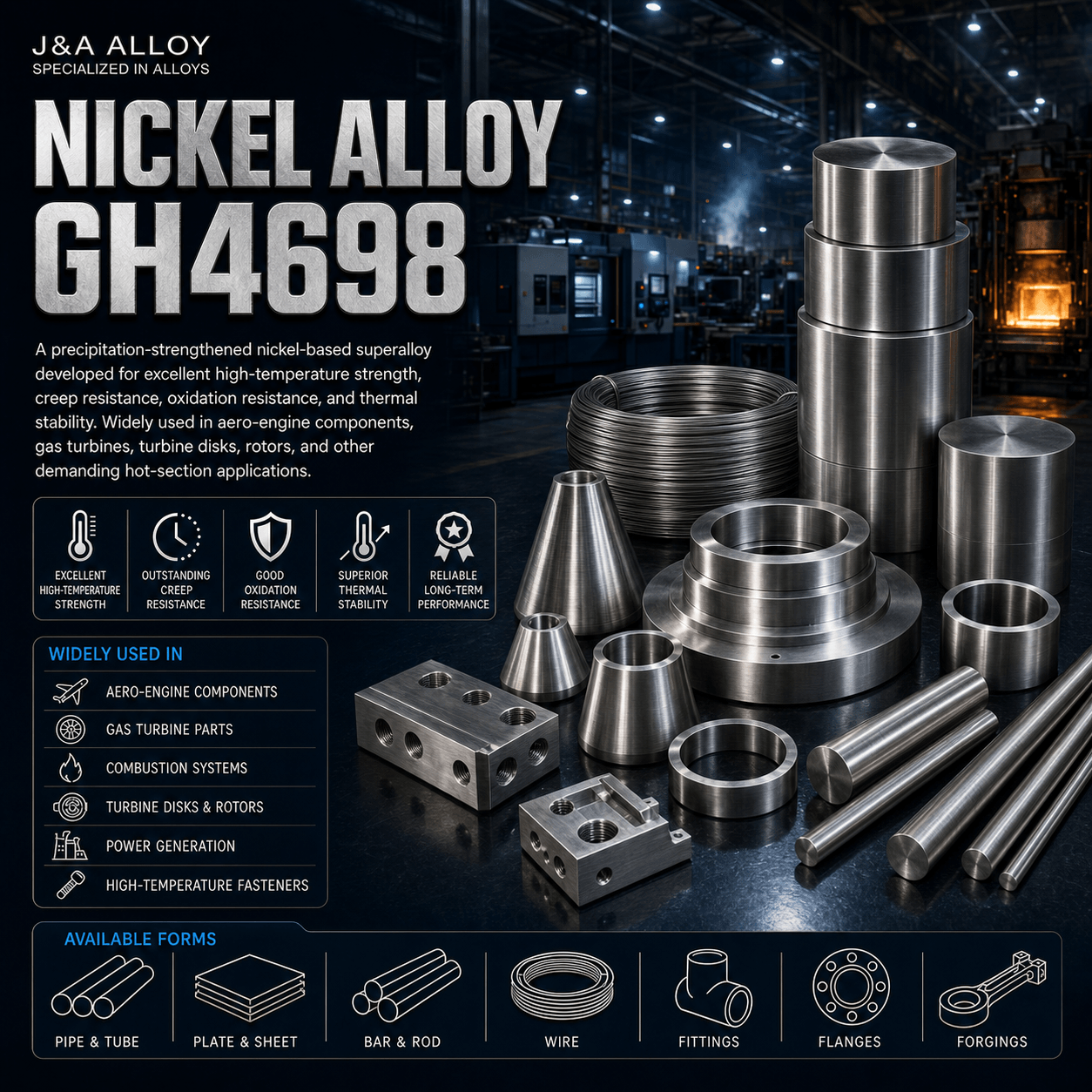
Nickel Alloy GH4698, also known as GH698, is a precipitation-hardenable nickel-chromium-based wrought superalloy designed for high strength, creep resistance, fatigue resistance and structural stability at elevated temperatures. Strengthened by γ′ precipitation and solid-solution alloying, GH4698 is widely used for aerospace engine turbine discs, compressor discs, bearing rings, load-bearing rings, high-temperature fasteners, gas turbine components and other critical hot-section parts operating in the 550–800°C range.
Nickel Alloy GH4698
Nickel Alloy GH4698 is a Ni-Cr-based precipitation-hardening wrought superalloy developed for high-temperature, high-stress engineering applications. It is also commonly referred to as GH698 in Chinese superalloy systems. The alloy was developed from the GH4033 alloy family through additional alloying and optimization, with higher aluminum, titanium and niobium additions to improve age-hardening response and high-temperature mechanical performance.
GH4698 is strengthened mainly by γ′ precipitates formed by aluminum, titanium and niobium. Chromium and molybdenum provide solid-solution strengthening and support oxidation resistance, while nickel forms the stable high-temperature matrix. The alloy offers high rupture strength, high tensile strength, good ductility, fatigue resistance and stable microstructure during long-term service at elevated temperatures.
Compared with many stainless steels and non-age-hardenable nickel alloys, GH4698 provides much higher strength retention at elevated temperatures. Compared with GH4033, GH4698 is more highly alloyed and better suited for high-stress hot-section components. Compared with general corrosion-resistant nickel alloys such as Alloy 625, GH4698 is selected primarily for high-temperature load-bearing performance rather than severe wet corrosion resistance.
J&A Alloy supplies Nickel Alloy GH4698 in bar, rod, plate, sheet, wire, forgings, rings, discs, billets, fastener blanks and custom machined components for aerospace, gas turbine, power generation and high-performance industrial applications.
GH4698 At a Glance
| Key Attribute | Value |
|---|---|
| Material | Nickel Alloy GH4698 / GH698 |
| UNS | No direct universal UNS equivalent commonly used |
| EN / W.Nr. | No direct universal EN / W.Nr. equivalent commonly used |
| Material Type | Ni-Cr-Based Precipitation-Hardening Wrought Superalloy |
| Density | Approx. 8.32 g/cm³ |
| PREN | Not typically used for nickel-based superalloys |
| Main Advantage | High Strength, Creep Resistance, Fatigue Resistance and Structural Stability at Elevated Temperatures |
| Typical Service Temperature | Commonly used in the 550–800°C range depending on stress, exposure time and component design |
| Main Industries | Aerospace Engines, Gas Turbines, Power Generation, High-Temperature Fasteners, Industrial Turbomachinery |
| Comparable Grades | GH4033, GH4738, Alloy 718, Alloy 625, Inconel X-750, A-286 |
Features of GH4698
- Ni-Cr-based precipitation-hardening wrought superalloy for high-temperature load-bearing applications.
- Excellent tensile strength and rupture strength in the 550–800°C temperature range.
- γ′ precipitation strengthening provides high hardness and stable mechanical performance.
- Good creep resistance for turbine discs, compressor discs, rings and hot-section components.
- Good fatigue resistance under cyclic thermal and mechanical loading.
- Stable microstructure during long-term elevated-temperature service.
- Chromium and molybdenum additions support oxidation resistance and solid-solution strengthening.
- Suitable for forged discs, rings, bars, fastener blanks and precision machined components.
- Used in aerospace engines, gas turbines, power generation and high-performance machinery.
- Available with quality documentation, heat treatment support and custom processing from J&A Alloy.
Chemical Composition of GH4698
| Element | Content (%) |
|---|---|
| Nickel (Ni) | Balance |
| Chromium (Cr) | 13.00–16.00 |
| Molybdenum (Mo) | 2.80–3.20 |
| Aluminum (Al) | 1.30–1.70 |
| Titanium (Ti) | 2.35–2.75 |
| Niobium (Nb) | 1.80–2.20 |
| Iron (Fe) | ≤ 2.00 |
| Carbon (C) | ≤ 0.08 |
| Silicon (Si) | ≤ 0.60 |
| Manganese (Mn) | ≤ 0.40 |
| Phosphorus (P) | ≤ 0.015 |
| Sulfur (S) | ≤ 0.007 |
| Boron (B) | ≤ 0.005 |
| Zirconium (Zr) | ≤ 0.050 |
| Magnesium (Mg) | ≤ 0.008 |
| Cerium (Ce) | ≤ 0.005 |
Physical Properties of GH4698
| Property | Typical Value |
|---|---|
| Density | Approx. 8.32 g/cm³ / 0.301 lb/in³ |
| Melting Range | Approx. 1340–1365°C / 2444–2489°F |
| Electrical Resistivity | Approx. 1.15–1.30 μΩ·m |
| Thermal Conductivity | Approx. 10–13 W/m·K at room temperature |
| Specific Heat Capacity | Approx. 430–470 J/kg·K |
| Modulus of Elasticity | Approx. 200–215 GPa / 29.0–31.2 × 10⁶ psi |
Mechanical Properties of GH4698
Mechanical properties of Nickel Alloy GH4698 depend on product form, forging ratio, heat treatment, section size and test temperature. The following values are typical reference values for solution-treated and aged material. Final acceptance values should be confirmed according to the applicable standard, drawing or customer specification.
| Condition | Tensile Strength | Yield Strength | Elongation | Hardness |
|---|---|---|---|---|
| Solution Treated + Aged, Room Temperature | ≥ 1120 MPa / ≥ 162 ksi | ≥ 705 MPa / ≥ 102 ksi | ≥ 17% | ≥ 293 HB typical reference |
| Forged Disc / Ring, Heat Treated | Specified by drawing or project standard | Specified by drawing or project standard | Specified by drawing or project standard | Controlled by heat treatment and inspection plan |
| Elevated Temperature Service | High strength retention in the 550–800°C range | Good yield strength retention under load | Application-dependent | Condition-dependent |
Corrosion Resistance
Nickel Alloy GH4698 provides useful oxidation resistance and general corrosion resistance in high-temperature gas environments, especially where the main design requirement is strength retention rather than wet corrosion resistance. Its chromium content supports the formation of protective oxide scales during elevated-temperature exposure.
For pitting and crevice corrosion, GH4698 is not normally selected as a primary seawater or chloride corrosion alloy. Although the nickel-chromium base provides better corrosion performance than many steels, severe chloride, stagnant seawater and crevice conditions usually require alloys specifically designed for wet corrosion service, such as Alloy 625, Alloy 825, Alloy C-276, Alloy C-22 or super duplex stainless steel.
Stress corrosion cracking resistance depends on stress level, temperature, environment and heat treatment condition. High-strength precipitation-hardened nickel alloys should always be evaluated carefully in environments where tensile stress and corrosive media are present at the same time.
In acid environments, GH4698 can provide useful resistance in selected oxidizing or mildly corrosive atmospheres, but it is not intended as a universal acid-resistant alloy. For strong reducing acids, hot sulfuric acid, hydrochloric acid or mixed acid-chloride systems, dedicated corrosion-resistant nickel alloys should be considered.
High Temperature Performance
High-temperature performance is the primary reason for selecting Nickel Alloy GH4698. The alloy is designed for components that must carry load at elevated temperatures, resist creep deformation and maintain structural stability during long-term service.
GH4698 performs well in the 550–800°C range, making it suitable for turbine discs, compressor discs, bearing rings, load-bearing rings, fasteners and other hot-section engine components. It is especially useful where high tensile strength, rupture strength, creep resistance and fatigue resistance are required simultaneously.
The alloy’s γ′ precipitation strengthening system helps maintain strength at temperatures where many stainless steels and lower-strength nickel alloys lose load-bearing capability. However, temperature capability must always be evaluated together with stress level, exposure time, component geometry, oxidation environment and safety factor.
GH4698 should not be treated as a universal high-temperature alloy for all operating conditions. For oxidation-dominated service above its practical structural range, or for applications requiring extreme corrosion resistance rather than strength, alternative nickel or cobalt alloys may be more suitable.
Available Forms
- Round bar
- Flat bar
- Rod
- Wire
- Sheet
- Plate
- Strip
- Forgings
- Forged rings
- Discs
- Billets
- Blocks
- Fastener blanks
- Shaft blanks
- Compressor disc blanks
- Turbine disc blanks
- Precision machined parts
- Custom heat-treated components
Applications of GH4698
Aerospace Engines
- Turbine discs
- Compressor discs
- Bearing rings
- Load-bearing rings
- High-temperature fasteners
Gas Turbines
- Large turbine disc components
- Hot-section load-bearing parts
- Rotating rings
- Bolts and studs
- High-strength shaft components
Power Generation
- Industrial turbine components
- High-temperature bolting systems
- Power plant mechanical parts
- Heat-resistant rings
- Critical load-bearing components
High-Temperature Fasteners
- Bolts
- Nuts
- Studs
- Washers
- Threaded engine components
Industrial Turbomachinery
- Compressor components
- Rotating assemblies
- High-strength rings
- Thermal mechanical parts
- Custom superalloy machined components
Defense & High-Performance Engineering
- Propulsion-related parts
- High-temperature structural components
- Critical forged parts
- Special mechanical assemblies
- Precision components exposed to high stress and heat
GH4698 vs GH4738 vs Alloy 718 vs Alloy 625
| Grade | Main Advantage | Strength | High Temperature Performance | Typical Application |
|---|---|---|---|---|
| GH4698 / GH698 | High rupture strength, creep resistance and stable structure in the 550–800°C range | Very High after heat treatment | Excellent for turbine discs, compressor discs and rings | Aero engine discs, bearing rings, fasteners and high-temperature load-bearing parts |
| GH4738 / Waspaloy-Type Alloy | Excellent high-temperature strength, creep resistance and fatigue resistance | Very High after aging | Excellent for high-stress turbine applications | Turbine discs, rings, shafts and high-temperature fasteners |
| Alloy 718 / UNS N07718 | High strength, excellent weldability and broad international availability | High | Excellent up to about 650°C | Aerospace parts, oil and gas components, springs, fasteners and cryogenic equipment |
| Alloy 625 / UNS N06625 | Excellent corrosion resistance and weldability without precipitation hardening | Medium to High | Good oxidation resistance but lower age-hardened strength | Chemical processing, seawater, offshore, exhaust systems and weld overlays |
GH4698 vs GH4033
| Item | Nickel Alloy GH4698 | Nickel Alloy GH4033 |
|---|---|---|
| Material Type | Ni-Cr precipitation-hardening wrought superalloy | Ni-Cr precipitation-hardening superalloy |
| Alloy Development | Developed from the GH4033 alloy family with optimized Al, Ti, Nb and Mo additions | Earlier nickel-based high-temperature alloy family |
| Strengthening | Stronger γ′ precipitation strengthening with Al, Ti and Nb | Precipitation strengthening with lower strengthening level |
| High-Temperature Strength | Higher strength and better long-term performance in demanding applications | Good high-temperature performance for less demanding service |
| Typical Use | Turbine discs, compressor discs, bearing rings, fasteners and critical hot-section parts | General high-temperature engine and industrial parts |
Welding & Fabrication
Nickel Alloy GH4698 is a high-strength precipitation-hardenable superalloy, so welding and fabrication require careful process control. The alloy is generally used for forged, machined and heat-treated components rather than simple welded structures.
GTAW can be used for precision welding and repair welding when heat input and joint design are properly controlled. GMAW may be used for selected production welding applications if the procedure is qualified. SMAW can be considered for repair or thicker-section work, but it is not normally the first choice for critical aerospace components.
Post-weld heat treatment may be required depending on the component design, service condition and required mechanical properties. Because GH4698 relies on precipitation hardening, improper welding or uncontrolled thermal cycles may reduce strength, change microstructure or increase cracking risk.
Hot working and forging require controlled temperature, deformation and cooling practices. Forged discs and rings should be manufactured using carefully designed routes to control grain size, segregation and mechanical properties. Machining should use rigid setups, sharp tools, suitable speeds and adequate coolant because GH4698 has high strength and work-hardening tendency.
Standards & Equivalent Grades
| Category | Designation / Standard |
|---|---|
| Chinese Grade | GH4698 / GH698 |
| Material Type | Ni-Cr-Based Precipitation-Hardening Wrought Superalloy |
| UNS | No direct universal UNS equivalent commonly used |
| EN / W.Nr. | No direct universal EN / W.Nr. equivalent commonly used |
| GB | GB/T 14992 and related Chinese superalloy specifications may apply |
| HB | HB/Z 140 and aerospace material process requirements may apply |
| GJB | GJB 3782 and project-specific military/aerospace requirements may apply |
| AMS | No direct universal AMS equivalent; specification review required |
| ASTM | No direct universal ASTM equivalent; customer or project specification may apply |
| ASME | Project-specific ASME requirements may apply for pressure or high-temperature equipment |
| ISO | Equivalent ISO or customer material specifications may apply |
| NACE | Not a default NACE sour-service grade; suitability requires project-specific review |
Frequently Asked Questions
What is Nickel Alloy GH4698?
Nickel Alloy GH4698 is a Ni-Cr-based precipitation-hardening wrought superalloy designed for high strength, creep resistance, fatigue resistance and stable performance at elevated temperatures.
Is GH4698 the same as GH698?
GH4698 is commonly associated with GH698 in Chinese superalloy designation systems. Final equivalency should be confirmed according to the applicable material standard, drawing and heat treatment requirement.
What is GH4698 used for?
GH4698 is used for turbine discs, compressor discs, bearing rings, load-bearing rings, high-temperature fasteners, gas turbine components and other hot-section parts operating under high stress.
What is the main advantage of GH4698?
The main advantage of GH4698 is its ability to maintain high strength, rupture resistance, creep resistance and fatigue performance in the 550–800°C temperature range.
What is the strengthening mechanism of GH4698?
GH4698 is strengthened mainly by γ′ precipitation from aluminum, titanium and niobium additions, combined with solid-solution strengthening from chromium and molybdenum.
What temperature can GH4698 withstand?
GH4698 is commonly used in high-temperature applications within the 550–800°C range, depending on stress level, exposure time, heat treatment and component design.
Is GH4698 corrosion resistant?
GH4698 provides useful oxidation and general corrosion resistance in high-temperature gas and atmospheric environments, but it is not normally selected as the first choice for severe seawater, chloride or strong acid corrosion service.
Can GH4698 be welded?
GH4698 can be welded using controlled procedures such as GTAW, GMAW and selected SMAW processes. Because it is a precipitation-hardenable superalloy, welding procedure qualification and post-weld heat treatment may be required for critical parts.
Does GH4698 require heat treatment?
Yes. GH4698 normally requires solution treatment and aging to develop its required high-temperature strength, hardness and creep resistance.
What is the difference between GH4698 and GH4033?
GH4698 was developed from the GH4033 alloy family with optimized aluminum, titanium, niobium and molybdenum additions, giving it higher strengthening capability and better performance for demanding hot-section components.
What is the difference between GH4698 and GH4738?
Both are precipitation-hardenable nickel-based superalloys for high-temperature service. GH4698 is commonly used for turbine discs, compressor discs and bearing rings, while GH4738 / Waspaloy-type alloys are widely used for turbine discs, rings, shafts and high-temperature fasteners.
What is the difference between GH4698 and Alloy 718?
Alloy 718 has excellent weldability and broad international availability, with strong performance up to about 650°C. GH4698 is selected for high-stress components requiring strong performance in the 550–800°C range.
What standards apply to GH4698?
Commonly referenced Chinese standards include GB/T 14992, HB/Z 140 and GJB 3782. Specific requirements depend on product form, heat treatment condition, drawing and project specification.
What forms of GH4698 are available?
GH4698 is available in round bar, rod, wire, sheet, plate, strip, forgings, forged rings, discs, billets, fastener blanks, shaft blanks, compressor disc blanks, turbine disc blanks and custom machined components.
Why Choose J&A Alloy
Global Material Solutions
J&A Alloy supplies nickel alloys, high-temperature alloys, stainless steels, precipitation-hardening stainless steels, duplex stainless steels, titanium alloys and corrosion-resistant alloys for demanding industrial applications. For Nickel Alloy GH4698, we support bar, plate, sheet, wire, forgings, rings, discs, billets and custom processed components according to project requirements.
Strict Quality Assurance
J&A Alloy provides strict quality control for chemical composition, mechanical properties, dimensional tolerance, heat treatment condition and surface quality. Available inspection and documentation services include PMI, chemical analysis, mechanical testing, hardness testing, ultrasonic testing, grain size inspection, dimensional inspection and EN 10204 3.1 / 3.2 certification when required.
International Standards
Materials can be supplied according to GB, HB, GJB, ASTM, ASME, EN, ISO and customer-specific specifications. For Nickel Alloy GH4698, we support specification review, equivalent grade comparison and heat treatment condition confirmation based on product form and end-use requirements.
Value-added Services
J&A Alloy offers cutting, forging coordination, CNC machining, heat treatment coordination, turning, milling, grinding, polishing, custom fabrication and export packaging. We help customers reduce processing time, control material waste and receive ready-to-use or semi-finished nickel alloy components for manufacturing.
Worldwide Supply
J&A Alloy serves customers in aerospace, gas turbines, power generation, industrial turbomachinery, chemical processing, marine engineering and high-performance mechanical equipment markets. With experience in international logistics and export documentation, we support global buyers with reliable material supply and responsive technical communication.