Austenitic Stainless Steel 904L | UNS N08904
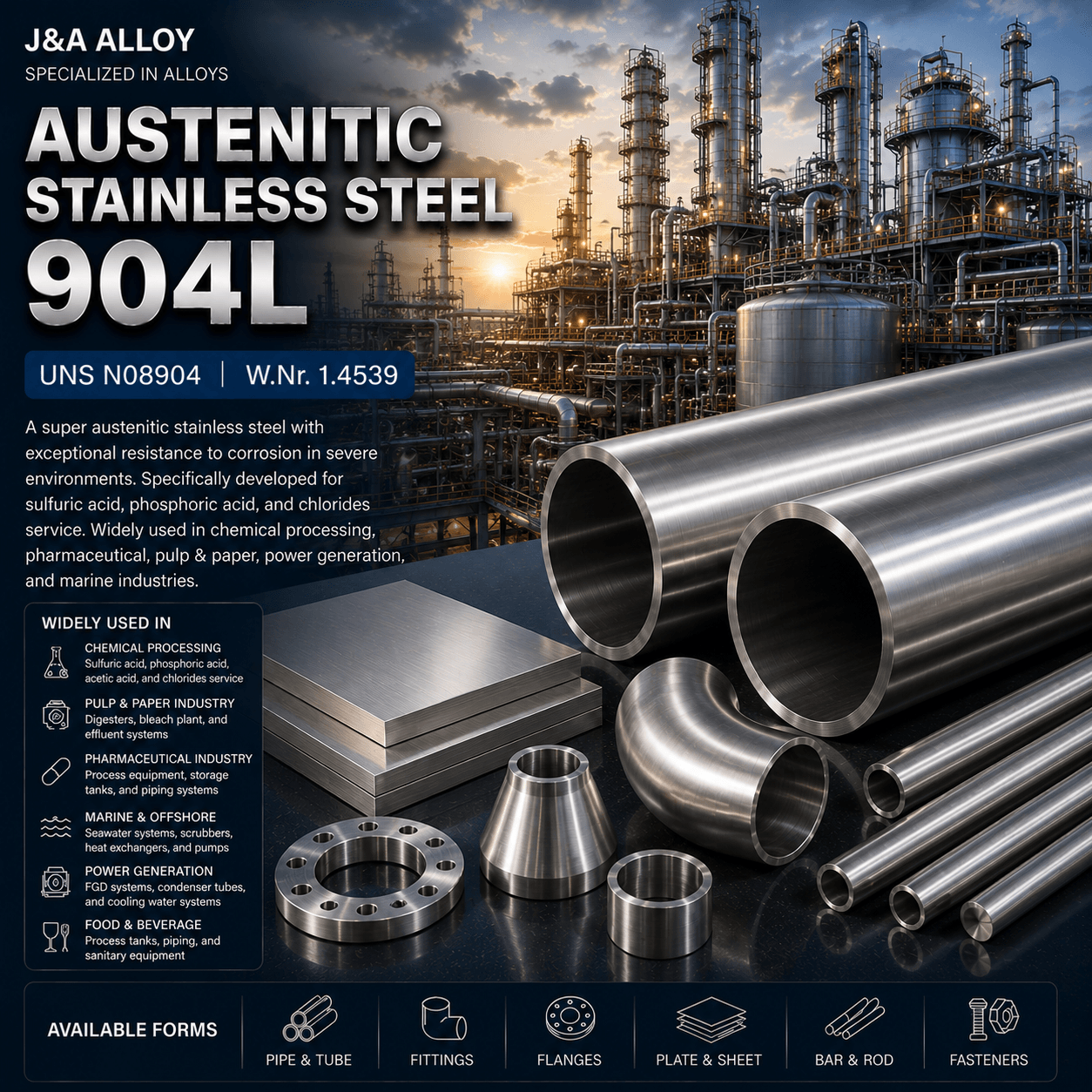
904L (UNS N08904 / W.Nr. 1.4539) is a low-carbon, high-alloy super austenitic stainless steel designed for exceptional corrosion resistance in reducing acids and chloride-containing environments. With high nickel, chromium, molybdenum, and copper contents, it provides excellent resistance to sulfuric acid, phosphoric acid, pitting, crevice corrosion, and chloride stress corrosion cracking, making it widely used in chemical processing, oil & gas, marine engineering, and pollution control systems.
Austenitic Stainless Steel 904L | UNS N08904
904L is a premium super austenitic stainless steel originally developed for handling highly corrosive sulfuric acid environments. Compared with conventional 316L stainless steel, 904L offers significantly improved resistance to reducing acids, localized corrosion, and chloride-induced attack while maintaining excellent weldability, toughness, and fabrication characteristics.
Its unique combination of high nickel, molybdenum, and copper makes it a preferred material for chemical processing equipment, seawater systems, heat exchangers, flue gas desulfurization units, and pharmaceutical industries.
904L At a Glance
| Key Attribute | Value |
|---|---|
| Material | 904L Stainless Steel |
| UNS Number | N08904 |
| EN / W.Nr. | 1.4539 |
| Material Type | Super Austenitic Stainless Steel |
| Density | 8.0 g/cm³ |
| PREN | 35–36 |
| Main Advantage | Excellent Sulfuric Acid & Chloride Corrosion Resistance |
| Typical Service Temperature | -196°C to 400°C |
| Main Industries | Chemical Processing, Marine, Oil & Gas, FGD |
| Comparable Grades | 316L, 254SMO, Alloy 20 |
Features of 904L
- Outstanding resistance to sulfuric acid
- Excellent resistance to phosphoric acid
- Superior resistance to pitting corrosion
- Excellent crevice corrosion resistance
- High resistance to chloride stress corrosion cracking
- Excellent resistance to reducing acids
- Good weldability
- Excellent formability
- Outstanding toughness at low temperatures
- Low carbon content minimizes sensitization
Chemical Composition of 904L
| Element | Content (%) |
|---|---|
| Chromium (Cr) | 19.0–23.0 |
| Nickel (Ni) | 23.0–28.0 |
| Molybdenum (Mo) | 4.0–5.0 |
| Copper (Cu) | 1.0–2.0 |
| Manganese (Mn) | ≤2.0 |
| Silicon (Si) | ≤1.0 |
| Carbon (C) | ≤0.02 |
| Phosphorus (P) | ≤0.045 |
| Sulfur (S) | ≤0.035 |
| Iron (Fe) | Balance |
Physical Properties of 904L
| Property | Value |
|---|---|
| Density | 8.0 g/cm³ |
| Melting Range | 1300–1390°C |
| Electrical Resistivity | 0.95 μΩ·m |
| Thermal Conductivity | 12 W/m·K |
| Specific Heat Capacity | 500 J/kg·K |
| Modulus of Elasticity | 195 GPa |
Mechanical Properties of 904L
Solution Annealed
| Property | Typical Value |
|---|---|
| Tensile Strength | ≥490 MPa |
| Yield Strength (0.2%) | ≥220 MPa |
| Elongation | ≥35% |
| Hardness | ≤200 HB |
Corrosion Resistance
904L provides outstanding resistance to sulfuric acid, phosphoric acid, and many organic acids. Its high nickel and molybdenum contents significantly improve resistance to pitting, crevice corrosion, and chloride stress corrosion cracking compared with 316L.
It performs exceptionally well in:
- Sulfuric acid processing
- Phosphoric acid production
- Marine environments
- Seawater cooling systems
- Chemical reactors
- Flue gas desulfurization units
High Temperature Performance
904L maintains stable mechanical properties from cryogenic temperatures to approximately 400°C. Prolonged exposure between 600°C and 900°C should be avoided due to possible precipitation of intermetallic phases that can reduce corrosion resistance.
Available Forms
J&A Alloy supplies 904L in:
- Round Bar
- Flat Bar
- Plate
- Sheet
- Coil
- Pipe
- Tube
- Forgings
- Flanges
- Wire
- Billets
- Rings
- Precision Machined Parts
Applications of 904L
Chemical Processing
- Sulfuric acid plants
- Phosphoric acid plants
- Fertilizer equipment
- Pressure vessels
Marine Engineering
- Seawater piping
- Pumps
- Valves
- Heat exchangers
Oil & Gas
- Offshore platforms
- Produced water systems
- Process piping
Environmental Protection
- Flue gas desulfurization
- Scrubbers
- Wastewater treatment
Pharmaceutical & Food
- Process tanks
- Hygienic piping
- Reactor vessels
904L vs Other Stainless Steels
| Grade | PREN | Main Advantage |
|---|---|---|
| 904L | 35–36 | Excellent Acid Resistance |
| 254SMO | 42–44 | Superior Chloride Resistance |
| 316L | 24 | General Corrosion Resistance |
| 2205 Duplex | 35 | Higher Mechanical Strength |
Welding & Fabrication
904L offers excellent weldability using GTAW (TIG), GMAW (MIG), SMAW, and plasma welding processes. Low heat input and suitable filler metals are recommended to preserve corrosion resistance. Post-weld heat treatment is generally unnecessary.
Standards & Equivalent Grades
| Standard | Designation |
|---|---|
| UNS | N08904 |
| EN / W.Nr. | 1.4539 |
| Common Name | 904L |
| ASTM Plate | A240 UNS N08904 |
| ASTM Bar | A276 / A479 UNS N08904 |
| ASTM Pipe | A312 UNS N08904 |
| NACE | MR0175 / ISO 15156 (where applicable) |
Frequently Asked Questions
What is 904L stainless steel?
904L is a super austenitic stainless steel with high nickel, molybdenum, and copper contents, designed for excellent corrosion resistance in aggressive acidic and chloride-containing environments.
What is the UNS number of 904L?
UNS N08904.
What is the EN/Werkstoff number of 904L?
EN 1.4539.
Is 904L better than 316L?
Yes. 904L provides significantly better resistance to sulfuric acid, pitting, crevice corrosion, and chloride stress corrosion cracking.
Can 904L be used in seawater?
Yes. It performs well in many seawater applications, although 254SMO and 654SMO are generally preferred for the most aggressive chloride conditions.
Is 904L magnetic?
No. In the solution-annealed condition, 904L is essentially non-magnetic due to its fully austenitic microstructure.
Can 904L be welded?
Yes. It has excellent weldability using conventional fusion welding processes, with matching filler metals recommended.
What forms are available?
904L is available as bar, rod, plate, sheet, pipe, tube, wire, flanges, forgings and custom-machined components.
What industries use 904L?
Chemical processing, oil & gas, marine engineering, power generation, pharmaceuticals, food processing, and environmental protection.
What is the difference between 904L and 254SMO?
254SMO has a higher molybdenum and nitrogen content, giving it superior resistance to localized corrosion in chloride-rich environments, while 904L excels in sulfuric acid service and offers a cost-effective solution for many chemical processing applications.
Why Choose J&A Alloy
Global Stainless Steel Solutions
J&A Alloy supplies a comprehensive range of super austenitic, duplex, super duplex, precipitation-hardening stainless steels and nickel alloys for demanding industrial applications.
Strict Quality Assurance
- PMI Testing
- Chemical Composition Analysis
- Mechanical Property Testing
- Corrosion Testing
- Ultrasonic Inspection
- EN 10204 3.1 / 3.2 Certification
International Standards
Products are supplied in accordance with ASTM, ASME, EN, ISO, and NACE requirements to meet global industry standards.
Value-Added Services
- Precision Cutting
- CNC Machining
- Forging
- Heat Treatment
- Custom Fabrication
Worldwide Supply
With extensive export experience, J&A Alloy provides reliable delivery, technical support and tailored material solutions for customers in offshore, marine, chemical, energy and industrial markets.