Nickel Alloy GH4738 | UNS N07001
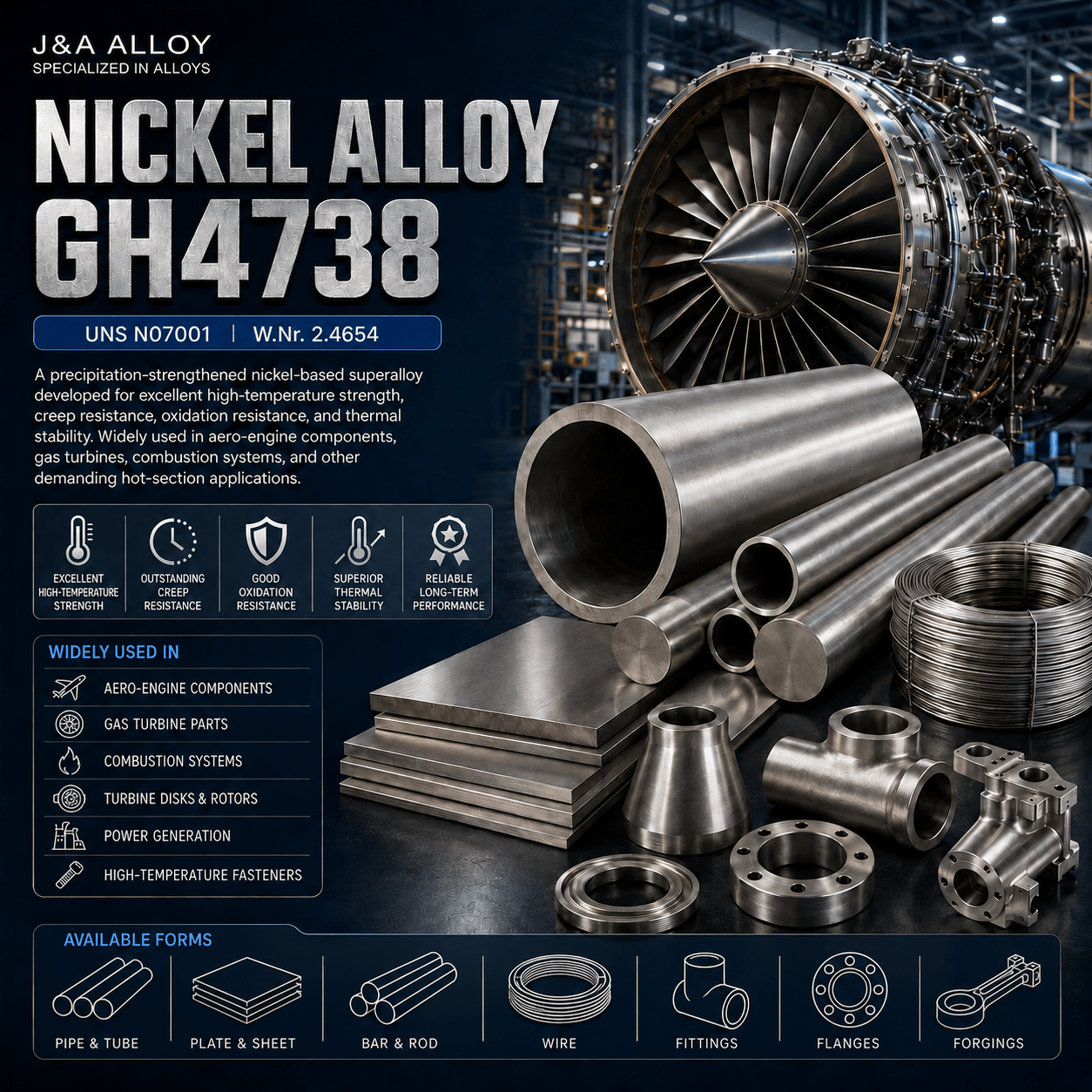
Nickel Alloy GH4738, also known as GH738, Waspaloy, UNS N07001 and EN 2.4654, is a precipitation-hardenable nickel-based superalloy designed for high strength, excellent creep resistance, good fatigue strength and oxidation resistance at elevated temperatures. J&A Alloy supplies GH4738 in bar, plate, sheet, strip, wire, forgings, rings, discs, billets and custom machined components for aerospace engines, gas turbines, power generation, high-temperature fasteners and demanding industrial applications.
Nickel Alloy GH4738 | UNS N07001 | Waspaloy丨EN 2.4654
Nickel Alloy GH4738 is a nickel-chromium-cobalt-molybdenum-titanium-aluminum precipitation-hardening superalloy. It is commonly used as the Chinese designation for an alloy equivalent or closely comparable to GH738 / Waspaloy / UNS N07001 / EN 2.4654. The alloy is designed to provide high mechanical strength, excellent creep rupture resistance, good fatigue performance and oxidation resistance in high-temperature service.
The strengthening mechanism of GH4738 is mainly based on gamma prime, or γ′, precipitation hardening. Aluminum and titanium form strengthening γ′ precipitates within the nickel matrix, while chromium contributes oxidation and corrosion resistance. Cobalt, molybdenum and other alloying elements improve solid-solution strengthening, high-temperature stability and creep resistance.
Compared with many standard nickel-chromium alloys, GH4738 provides higher strength at elevated temperatures. Compared with Alloy 718, GH4738 is commonly selected where higher long-term strength and oxidation resistance are needed at higher operating temperatures. Compared with non-age-hardenable alloys such as Alloy 625, GH4738 offers much higher age-hardened strength but requires more controlled heat treatment and fabrication procedures.
Nickel Alloy GH4738 is widely used for turbine discs, shafts, rings, high-temperature fasteners, compressor components, casings, seals, combustion-related components and other parts exposed to high stress and elevated temperature. It is especially valuable in aerospace, gas turbine, power generation and high-performance mechanical systems where creep resistance and fatigue strength are critical.
GH4738 At a Glance
| Key Attribute | Value |
|---|---|
| Material | Nickel Alloy GH4738 / GH738 / Waspaloy |
| UNS Number | N07001 |
| EN / W.Nr. | 2.4654 |
| Material Type | Age-Hardenable Nickel-Based Superalloy |
| Density | Approx. 8.19 g/cm³ |
| PREN | Not typically used for nickel-based superalloys |
| Main Advantage | High-Temperature Strength, Creep Resistance, Fatigue Resistance and Oxidation Resistance |
| Typical Service Temperature | Commonly used up to approx. 760°C for high-stress service; oxidation resistance may extend to higher temperatures depending on exposure |
| Main Industries | Aerospace, Gas Turbines, Power Generation, High-Temperature Fasteners, Industrial Turbomachinery |
| Comparable Grades | Alloy 718, Alloy 625, Nimonic 90, Inconel X-750, A-286, Haynes 188 |
Features of GH4738
- Age-hardenable nickel-based superalloy for high-temperature structural applications.
- Excellent creep rupture strength under high stress and elevated temperature.
- High tensile strength and fatigue resistance after proper heat treatment.
- Good oxidation resistance in gas turbine and aerospace engine environments.
- γ′ precipitation strengthening provides stable high-temperature mechanical performance.
- Better high-temperature strength capability than many non-age-hardenable nickel alloys.
- Suitable for forged rings, discs, shafts, fasteners and turbine engine components.
- Good resistance to many combustion gas and hot gas environments.
- Available in bar, sheet, plate, wire, forgings, billets and custom machined parts.
- Applicable for aerospace, power generation, gas turbines and high-performance engineering systems.
Chemical Composition of GH4738
| Element | Content (%) |
|---|---|
| Nickel (Ni) | Balance |
| Chromium (Cr) | 18.00–21.00 |
| Cobalt (Co) | 12.00–15.00 |
| Molybdenum (Mo) | 3.50–5.00 |
| Titanium (Ti) | 2.75–3.25 |
| Aluminum (Al) | 1.20–1.60 |
| Iron (Fe) | ≤ 2.00 |
| Carbon (C) | 0.02–0.10 |
| Boron (B) | ≤ 0.010 |
| Zirconium (Zr) | ≤ 0.10 |
| Manganese (Mn) | ≤ 0.50 |
| Silicon (Si) | ≤ 0.75 |
| Phosphorus (P) | ≤ 0.015 |
| Sulfur (S) | ≤ 0.015 |
Physical Properties of GH4738
| Property | Typical Value |
|---|---|
| Density | Approx. 8.19 g/cm³ / 0.296 lb/in³ |
| Melting Range | Approx. 1320–1360°C / 2408–2480°F |
| Electrical Resistivity | Approx. 1.20–1.30 μΩ·m |
| Thermal Conductivity | Approx. 11–13 W/m·K at room temperature |
| Specific Heat Capacity | Approx. 430–460 J/kg·K |
| Modulus of Elasticity | Approx. 205–215 GPa / 29.7–31.2 × 10⁶ psi |
Mechanical Properties of GH4738
Mechanical properties of Nickel Alloy GH4738 depend on product form, section size, heat treatment, forging ratio and testing temperature. The following values are typical for solution treated and age hardened material. Final requirements should be confirmed by the applicable standard, drawing or customer specification.
| Condition | Tensile Strength | Yield Strength | Elongation | Hardness |
|---|---|---|---|---|
| Solution Treated + Aged, Room Temperature | Approx. 1200–1400 MPa / 174–203 ksi | Approx. 800–1000 MPa / 116–145 ksi | Approx. 10–20% | Approx. 350–485 HV |
| Solution Treated + Aged, Elevated Temperature | High strength retention depending on temperature and exposure time | Good yield strength retention under load | Application-dependent | Condition-dependent |
| Forged Ring / Disc Typical Condition | Specified by drawing or aerospace standard | Specified by drawing or aerospace standard | Specified by drawing or aerospace standard | Controlled by heat treatment and final inspection |
Corrosion Resistance
Nickel Alloy GH4738 provides good oxidation and corrosion resistance in high-temperature gas turbine, combustion gas and industrial hot gas environments. Its chromium content supports the formation of protective oxide scales, helping the alloy resist oxidation during elevated-temperature exposure.
For pitting and crevice corrosion, GH4738 is not normally selected as a primary seawater or chloride corrosion alloy. Although the nickel-chromium base provides useful general corrosion resistance, alloys such as Alloy 625, Alloy 825, Alloy C-276, Alloy C-22 or super duplex stainless steels are usually better choices for severe chloride, seawater or aggressive chemical service.
Stress corrosion cracking resistance depends on temperature, stress level, environment and heat treatment condition. Nickel-based alloys generally provide better resistance to chloride stress corrosion cracking than many stainless steels, but high-strength age-hardened alloys such as GH4738 should still be reviewed carefully for high-stress corrosive applications.
In acid environments, GH4738 provides useful resistance in some oxidizing and mildly corrosive media, but it is not intended as a universal acid-resistant alloy. For strong reducing acids such as hydrochloric acid, hot sulfuric acid or mixed acid-chloride environments, dedicated corrosion-resistant nickel alloys should be evaluated.
High Temperature Performance
High-temperature performance is the primary reason for selecting Nickel Alloy GH4738. The alloy is designed for applications requiring strength, creep resistance and fatigue resistance at elevated temperatures. It is widely used in gas turbine and aerospace engine environments where long-term stability under high stress is essential.
GH4738 can retain useful mechanical strength at temperatures where many stainless steels lose strength rapidly. For high-stress components such as turbine discs, rings and fasteners, practical service temperatures are commonly limited by stress, exposure time, creep rupture requirements and design code. Many high-stress applications use the alloy up to approximately 700–760°C, depending on design requirements.
The alloy also provides good oxidation resistance in hot gas environments. However, exposure above the recommended range may lead to microstructural changes, over-aging, oxidation damage or loss of mechanical properties. For very high-temperature oxidation-dominated service, other nickel alloys or cobalt alloys may be more appropriate depending on the application.
GH4738 should be selected based on a full evaluation of temperature, stress, creep life, fatigue cycle, oxidation environment and manufacturing route. For critical aerospace or turbine components, heat treatment and quality inspection must be tightly controlled.
Available Forms
- Round bar
- Flat bar
- Rod
- Wire
- Sheet
- Plate
- Strip
- Forgings
- Forged rings
- Discs
- Billets
- Blocks
- Fastener blanks
- Shaft blanks
- Precision machined parts
- Custom heat-treated components
Applications of GH4738
Aerospace Engines
- Turbine discs
- Turbine shafts
- Compressor components
- Engine fasteners
- High-temperature structural parts
Gas Turbines
- Turbine rings
- Hot-section components
- Bolts and studs
- Retaining rings
- High-temperature rotating components
Power Generation
- Industrial turbine components
- High-temperature fasteners
- Power plant mechanical parts
- Heat-resistant shafts
- Critical bolting systems
High-Temperature Fasteners
- Bolts
- Nuts
- Studs
- Washers
- Threaded high-temperature components
Industrial Turbomachinery
- Compressor parts
- Rotating rings
- Sealing components
- High-strength shafts
- Precision machined hot-section components
Defense & High-Performance Engineering
- High-temperature load-bearing parts
- Missile and propulsion components
- Thermal mechanical assemblies
- Special forged components
- Custom machined superalloy parts
GH4738 vs Alloy 718 vs Alloy 625 vs Inconel X-750
| Grade | Main Advantage | Strength | High Temperature Performance | Typical Application |
|---|---|---|---|---|
| GH4738 / Waspaloy / UNS N07001 | Excellent creep strength, fatigue resistance and oxidation resistance at elevated temperatures | Very High after aging | Excellent for high-stress turbine applications | Turbine discs, rings, shafts, high-temperature fasteners and aerospace engine parts |
| Alloy 718 / UNS N07718 | High strength, excellent weldability and broad availability | High | Excellent up to about 650°C | Aerospace parts, oil and gas components, springs, fasteners and cryogenic equipment |
| Alloy 625 / UNS N06625 | Excellent corrosion resistance and good weldability without age hardening | Medium to High | Good oxidation resistance but lower age-hardened strength | Chemical processing, seawater, offshore, exhaust systems and weld overlays |
| Inconel X-750 / UNS N07750 | Age-hardenable nickel alloy with good high-temperature spring properties | High | Good for springs and fasteners | Springs, bolts, turbine components and nuclear applications |
GH4738 vs A-286
| Item | Nickel Alloy GH4738 | A-286 Stainless Alloy |
|---|---|---|
| Material Type | Nickel-based precipitation-hardening superalloy | Iron-nickel-chromium age-hardenable alloy |
| Strength Level | Higher at elevated temperatures | Good, but generally lower than nickel-based superalloys |
| Creep Resistance | Excellent | Good |
| Oxidation Resistance | Very good in turbine and hot gas environments | Good at moderate high temperatures |
| Cost | Higher | More economical |
| Typical Use | Turbine discs, rings, high-temperature fasteners and critical rotating components | Aerospace fasteners, springs, bolts and moderate-temperature high-strength parts |
Welding & Fabrication
Nickel Alloy GH4738 is a precipitation-hardenable nickel-based superalloy, so welding and fabrication require careful control. The alloy is stronger and less forgiving than many solid-solution nickel alloys, especially in age-hardened condition. Welding procedure qualification is recommended for critical components.
GTAW is commonly used for precision welding, repair welding and high-quality joints where heat input control is important. GMAW can be used for suitable sections under controlled production conditions. SMAW may be used for selected repair or thicker-section applications, but it is less common for critical aerospace components.
Post-weld heat treatment may be required depending on the component, joint design, service temperature and required mechanical properties. Because GH4738 relies on precipitation hardening, welding in the wrong condition or applying uncontrolled heat input can reduce local strength, create cracking risk or change microstructure.
Hot working should be performed within a controlled temperature range to avoid cracking and to maintain grain structure. Forgings, rings and discs require carefully designed forging and heat treatment routes. Machining is best performed with rigid tooling, sharp cutting tools, appropriate speeds and generous coolant because the alloy has high strength and work-hardening tendency.
Standards & Equivalent Grades
| Category | Designation / Standard |
|---|---|
| Chinese Grade | GH4738 / GH738 |
| Common Name | Waspaloy |
| UNS | N07001 |
| EN / W.Nr. | 2.4654 |
| EN / DIN Designation | NiCr20Co13Mo4Ti3Al |
| AMS | AMS 5544, AMS 5704, AMS 5706, AMS 5708, AMS 5709, AMS 5828 depending on product form and condition |
| ASTM | Project-specific ASTM or customer specifications may apply depending on product form |
| ASME | Project-specific ASME requirements may apply for pressure or high-temperature equipment |
| ISO | Equivalent ISO or customer material specifications may apply |
| NACE | Not a default NACE sour-service grade; suitability requires project-specific review |
| Material Family | Age-Hardenable Nickel-Based Superalloy |
Frequently Asked Questions
What is Nickel Alloy GH4738?
Nickel Alloy GH4738 is an age-hardenable nickel-based superalloy also known as GH738, Waspaloy and UNS N07001. It is designed for high strength, creep resistance, fatigue resistance and oxidation resistance at elevated temperatures.
Is GH4738 the same as Waspaloy?
GH4738 is commonly treated as the Chinese designation corresponding to GH738 / Waspaloy-type nickel-based superalloy. Project specifications should always be checked because exact requirements may vary by standard, heat treatment and product form.
What is the UNS number of GH4738?
The commonly referenced UNS number for the Waspaloy-type equivalent of GH4738 is UNS N07001.
What is the EN number of GH4738?
The commonly referenced EN / Werkstoff number for the Waspaloy-type equivalent is 2.4654.
What is GH4738 used for?
GH4738 is used for turbine discs, rings, shafts, high-temperature fasteners, compressor components, aerospace engine parts, gas turbine components and other high-temperature load-bearing parts.
What is the main advantage of GH4738?
The main advantage of GH4738 is its excellent combination of high-temperature strength, creep rupture resistance, fatigue strength and oxidation resistance.
What is the strengthening mechanism of GH4738?
GH4738 is strengthened mainly by γ′ precipitation hardening. Aluminum and titanium form strengthening precipitates in the nickel matrix, while cobalt, molybdenum and chromium improve high-temperature strength and oxidation resistance.
What temperature can GH4738 withstand?
GH4738 is commonly used in high-stress service up to approximately 700–760°C depending on design requirements, stress level, exposure time and heat treatment. Oxidation resistance may extend to higher temperatures under selected conditions.
Is GH4738 corrosion resistant?
GH4738 provides good oxidation and general corrosion resistance in high-temperature gas and atmospheric environments. It is not normally selected as the first choice for severe seawater, chloride or strong acid corrosion service.
Can GH4738 be welded?
GH4738 can be welded using controlled procedures such as GTAW, GMAW and selected SMAW processes. Because it is an age-hardenable superalloy, welding procedure qualification and post-weld heat treatment may be required for critical parts.
Is GH4738 suitable for turbine discs?
Yes. GH4738 / Waspaloy-type alloys are widely used for turbine discs, rings and other high-temperature rotating components where creep strength and fatigue resistance are required.
What is the difference between GH4738 and Alloy 718?
Alloy 718 offers excellent weldability and high strength up to about 650°C. GH4738 is often selected for higher-temperature turbine components where creep resistance and oxidation resistance are more critical.
What is the difference between GH4738 and Alloy 625?
GH4738 is an age-hardenable high-strength superalloy for elevated-temperature load-bearing parts. Alloy 625 is a solid-solution nickel alloy mainly selected for corrosion resistance, weldability and oxidation resistance rather than maximum age-hardened strength.
What forms of GH4738 are available?
GH4738 is available in round bar, rod, wire, sheet, plate, strip, forgings, forged rings, discs, billets, fastener blanks, shaft blanks and custom machined components.
Why Choose J&A Alloy
Global Material Solutions
J&A Alloy supplies nickel alloys, high-temperature alloys, stainless steels, precipitation-hardening stainless steels, duplex stainless steels, titanium alloys and corrosion-resistant alloys for demanding industrial applications. For Nickel Alloy GH4738, we support bar, plate, sheet, wire, forgings, rings, discs, billets and custom processed components according to project requirements.
Strict Quality Assurance
J&A Alloy provides strict quality control for chemical composition, mechanical properties, dimensional tolerance, heat treatment condition and surface quality. Available inspection and documentation services include PMI, chemical analysis, mechanical testing, hardness testing, ultrasonic testing, grain size inspection, dimensional inspection and EN 10204 3.1 / 3.2 certification when required.
International Standards
Materials can be supplied according to GB, AMS, ASTM, ASME, EN, ISO and customer-specific specifications. For Nickel Alloy GH4738 / Waspaloy-type materials, we support specification review, equivalent grade comparison and heat treatment condition confirmation based on product form and end-use requirements.
Value-added Services
J&A Alloy offers cutting, forging coordination, CNC machining, heat treatment coordination, turning, milling, grinding, polishing, custom fabrication and export packaging. We help customers reduce processing time, control material waste and receive ready-to-use or semi-finished nickel alloy components for manufacturing.
Worldwide Supply
J&A Alloy serves customers in aerospace, gas turbines, power generation, industrial turbomachinery, chemical processing, marine engineering and high-performance mechanical equipment markets. With experience in international logistics and export documentation, we support global buyers with reliable material supply and responsive technical communication.