Stainless Steel 17-7PH | UNS S17700
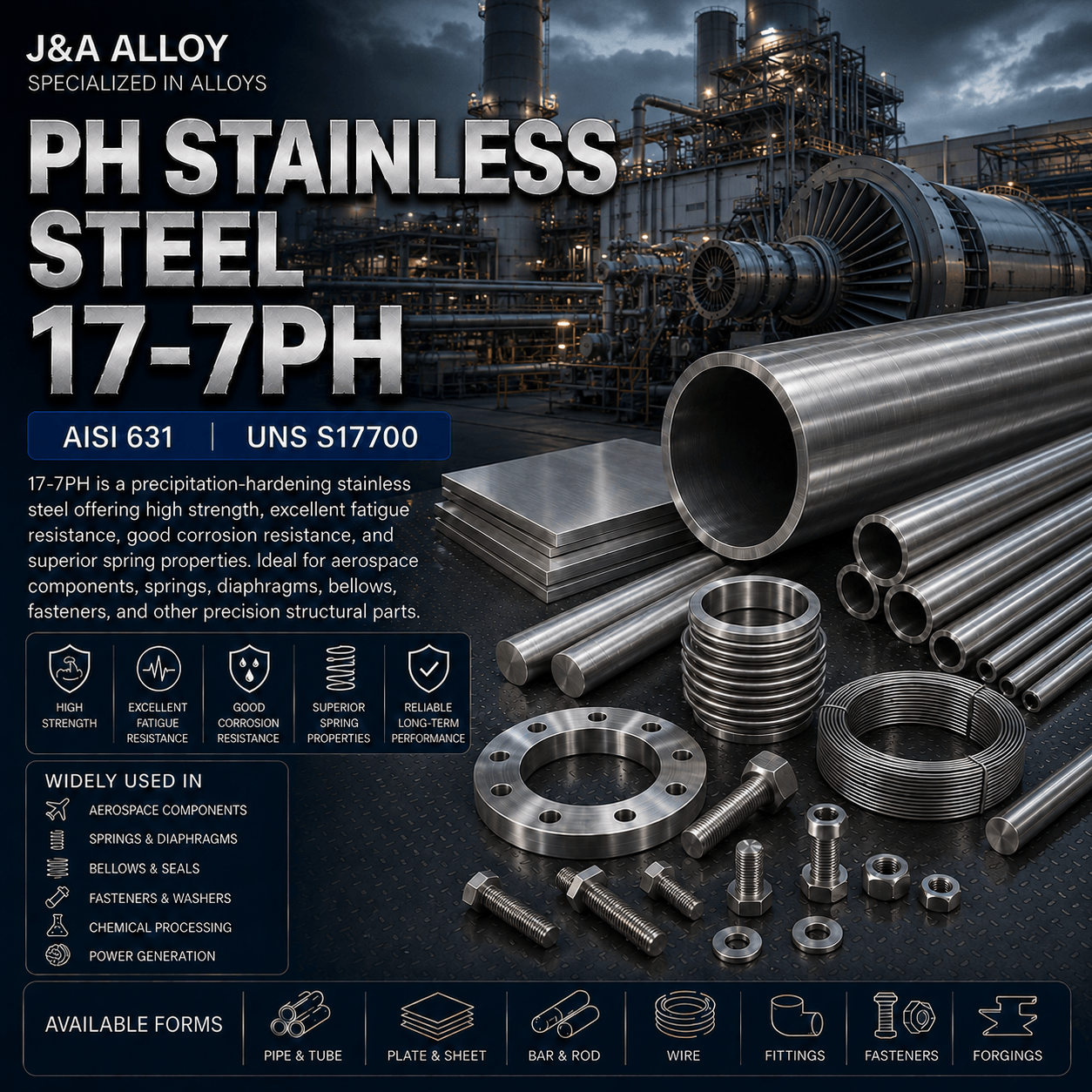
PH stainless steel 17-7PH, also known as UNS S17700, AISI Type 631, or EN 1.4568, is a semi-austenitic precipitation-hardening stainless steel offering high strength, excellent fatigue resistance, good formability, and moderate corrosion resistance. J&A Alloy supplies 17-7PH stainless steel in sheet, strip, plate, bar, wire, forgings, and custom processed forms for aerospace, springs, diaphragms, bellows, washers, clips, and precision engineering components.
PH Stainless Steel 17-7PH | UNS S17700 | Alloy 631 | EN 1.4568
PH stainless steel 17-7PH is a chromium-nickel-aluminum precipitation-hardening stainless steel designed for applications that require high strength, high hardness, excellent fatigue properties, and good formability before final heat treatment. It is commonly identified as 17-7PH, 17-7 PH, AISI Type 631, UNS S17700, and W.Nr. 1.4568 / X7CrNiAl17-7.
The alloy is semi-austenitic in the annealed condition, which gives it better forming capability than many fully martensitic precipitation-hardening stainless steels. After forming, it can be transformed and precipitation hardened through controlled heat treatment to achieve high mechanical strength and spring performance.
17-7PH stainless steel is widely used in aerospace components, spring washers, retaining rings, diaphragms, bellows, clips, fasteners, heat-resistant formed parts, and precision strip components. Compared with 301 and 304 stainless steels, 17-7PH provides much higher strength after heat treatment. Compared with 17-4PH, it is more commonly used in thin sheet, strip, and spring applications where formability and fatigue resistance are critical.
17-7PH At a Glance
| Key Attribute | Value |
|---|---|
| Material | PH Stainless Steel 17-7PH |
| UNS Number | S17700 |
| AISI Type | Type 631 |
| EN / W.Nr. | 1.4568 / X7CrNiAl17-7 |
| Material Type | Semi-Austenitic Precipitation-Hardening Stainless Steel |
| Density | Approx. 7.80 g/cm³ |
| PREN | Approx. 17–18 |
| Main Advantage | High Strength, Excellent Fatigue Resistance & Good Formability |
| Typical Service Temperature | Commonly used up to approx. 315°C / 600°F; higher-temperature service requires engineering evaluation |
| Main Industries | Aerospace, Springs, Precision Engineering, Instrumentation, Power Generation, Industrial Manufacturing |
| Comparable Grades | 301, 304, 17-4PH, 15-7Mo, 15-5PH |
Features of 17-7PH
- High strength and hardness after precipitation hardening.
- Excellent fatigue resistance for spring and cyclic-load applications.
- Good formability in the annealed condition before final hardening.
- Suitable for thin-gauge sheet, strip, foil, and precision formed components.
- Good corrosion resistance in atmospheric and mild industrial environments.
- Low distortion during heat treatment compared with many high-strength alloys.
- Available in multiple heat-treated conditions such as TH1050, RH950, and CH900.
- Good spring properties for washers, clips, retaining rings, and elastic components.
- Useful strength retention at moderately elevated temperatures.
- Widely used in aerospace, power generation, instrumentation, and precision engineering.
Chemical Composition of 17-7PH
| Element | Content (%) |
|---|---|
| Carbon (C) | ≤ 0.09 |
| Manganese (Mn) | ≤ 1.00 |
| Phosphorus (P) | ≤ 0.040 |
| Sulfur (S) | ≤ 0.030 |
| Silicon (Si) | ≤ 1.00 |
| Chromium (Cr) | 16.00–18.00 |
| Nickel (Ni) | 6.50–7.75 |
| Aluminum (Al) | 0.75–1.50 |
| Iron (Fe) | Balance |
Physical Properties of 17-7PH
| Property | Typical Value |
|---|---|
| Density | Approx. 7.80 g/cm³ / 0.282 lb/in³ |
| Melting Range | Approx. 1400–1450°C / 2550–2640°F |
| Electrical Resistivity | Approx. 0.80 μΩ·m |
| Thermal Conductivity | Approx. 15.5–16.5 W/m·K at room temperature |
| Specific Heat Capacity | Approx. 460 J/kg·K |
| Modulus of Elasticity | Approx. 196–200 GPa / 28.4–29.0 × 10⁶ psi |
17-7PH Strip, Sheet and Spring Wire Selection
17-7PH is frequently purchased as strip, sheet and wire for spring-like behavior, formed precision parts and fatigue-related components. RFQs should specify thickness or diameter, temper, final heat treatment condition, flatness, surface finish and fatigue or spring performance requirements.
| Product Form | Typical Use | RFQ Details |
|---|---|---|
| Strip / Sheet | Diaphragms, washers, clips, bellows and precision formed parts | Confirm thickness, width, coil/sheet form, flatness, temper and surface. |
| Spring Wire | Springs, clips and elastic components | Confirm diameter, coil/spool, tensile range, final condition and surface finish. |
| Plate / Bar | Structural or machined PH stainless components | Confirm size, condition, standard, tolerance and inspection requirement. |
Mechanical Properties of 17-7PH
Mechanical properties of PH stainless steel 17-7PH depend on product form, thickness, cold work level and heat treatment condition. Condition A provides good formability, while TH1050, RH950 and CH900 provide high strength and hardness for spring and aerospace applications.
| Condition | Tensile Strength | Yield Strength | Elongation | Hardness |
|---|---|---|---|---|
| Condition A / Annealed | Approx. 900–1035 MPa / 130–150 ksi | Approx. 380 MPa / 55 ksi | Approx. 20–30% | Approx. HRB 88–95 |
| TH1050 Condition | Approx. 1380–1450 MPa / 200–210 ksi | Approx. 1240–1310 MPa / 180–190 ksi | Approx. 3–6% | Approx. HRC 43–47 |
| RH950 Condition | Approx. 1450–1550 MPa / 210–225 ksi | Approx. 1310–1450 MPa / 190–210 ksi | Approx. 3–6% | Approx. HRC 44–48 |
| CH900 Condition | Approx. 1650–1900 MPa / 240–275 ksi | Approx. 1500–1750 MPa / 218–254 ksi | Limited ductility | Approx. HRC 46–50 |
Corrosion Resistance
PH stainless steel 17-7PH provides good corrosion resistance in many atmospheric, fresh water and mild industrial environments. In hardened conditions such as TH1050 and RH950, its corrosion resistance is generally better than standard hardenable chromium stainless steels such as 410 and 420, but it is usually not as corrosion resistant as fully austenitic Type 304 in all environments.
The alloy can resist light oxidation, humidity and mildly corrosive media when properly heat treated, cleaned and passivated. However, because 17-7PH does not contain molybdenum, its pitting and crevice corrosion resistance in chloride-rich environments is limited compared with 316L, 904L, 254SMO, duplex stainless steel or nickel alloys.
In marine and chloride-bearing environments, stagnant solutions, deposits, tight crevices and high tensile stress can increase the risk of pitting, crevice corrosion and stress corrosion cracking. For spring parts or precision components exposed to salt spray, seawater splash, cleaning chemicals or industrial chloride contamination, surface finish, passivation and stress level should be carefully controlled.
17-7PH is not recommended for strong acid service such as hydrochloric acid, hot sulfuric acid or aggressive reducing acid environments. For severe acid resistance, J&A Alloy can help evaluate alternative materials such as 904L, Alloy 20, 254SMO, Hastelloy C-276 or Hastelloy C-22.
High Temperature Performance
PH stainless steel 17-7PH retains useful strength and spring properties at moderately elevated temperatures. It is often selected for aerospace components, washers, springs, heat shields, clips and precision elastic parts that require better strength retention than conventional austenitic stainless steels.
For many engineering applications, 17-7PH is commonly used up to approximately 315°C / 600°F. Higher-temperature service may be possible in selected applications, but long-term exposure can reduce spring performance, cause over-aging or affect toughness and dimensional stability.
17-7PH should not be used as a direct substitute for dedicated high-temperature nickel alloys where long-term creep strength, oxidation resistance or thermal fatigue resistance is required. For continuous high-temperature service above its practical range, materials such as Inconel X-750, Inconel 718, Inconel 625 or A-286 may be more suitable.
17-7PH Heat Treatment and Condition Notes
Common 17-7PH conditions include solution-treated, cold-worked and precipitation-hardened routes such as TH1050, RH950 and CH900. The right condition depends on whether the buyer needs formability before aging, high strength, spring performance or dimensional stability after forming.
Available Forms
- Sheet
- Strip
- Precision strip
- Foil
- Plate
- Round bar
- Flat bar
- Rod
- Wire
- Spring wire
- Forgings
- Rings
- Billets
- Cut-to-size blanks
- Stamped components
- Machined parts
Applications of 17-7PH
Aerospace
- Aircraft structural clips
- Heat shields
- Spring washers
- Retaining rings
- Lightweight high-strength formed parts
Springs & Elastic Components
- Flat springs
- Disc springs
- Belleville washers
- Spring clips
- High-fatigue strip springs
Precision Instrumentation
- Diaphragms
- Bellows
- Pressure sensor elements
- Control components
- Precision stamped parts
Industrial Engineering
- Washers
- Retaining components
- Locking parts
- High-strength brackets
- Wear-resistant precision parts
Power Generation
- Thermal shielding parts
- High-strength spring elements
- Instrument components
- Auxiliary turbine-related parts
- Fastening components
Chemical & Process Equipment
- Moderate corrosion-resistant spring parts
- Instrument diaphragms
- Thin-gauge formed components
- Clips and retaining rings
- Light-duty process equipment parts
PH Stainless Steel 17-7PH vs 301 vs 304 vs 17-4PH
| Grade | Main Advantage | Strength | Corrosion Resistance | Typical Application |
|---|---|---|---|---|
| 17-7PH / UNS S17700 | High strength, excellent fatigue resistance and good formability before hardening | Very High | Good in mild environments | Aerospace springs, washers, diaphragms, bellows and precision strip parts |
| 301 Stainless Steel | Excellent cold-work hardening and economical cost | Medium to High after cold work | Good | General springs, clamps, clips and structural strip parts |
| 304 Stainless Steel | Excellent general corrosion resistance and weldability | Moderate | Good | General fabrication, equipment, tanks and non-high-strength parts |
| 17-4PH / UNS S17400 | High strength and wide availability in bars, forgings and machined parts | High | Good | Shafts, valve parts, pump parts, fasteners and machined components |
17-7PH vs 15-7Mo
| Item | 17-7PH Stainless Steel | 15-7Mo Stainless Steel / Type 632 |
|---|---|---|
| UNS Number | S17700 | S15700 |
| Alloy Design | Chromium-nickel-aluminum PH stainless steel | Chromium-nickel-molybdenum-aluminum PH stainless steel |
| Strength | High | High to very high |
| Elevated Temperature Strength | Good | Generally better due to molybdenum addition |
| Formability | Good in annealed condition | Good in annealed condition |
| Typical Use | Springs, washers, clips, diaphragms, bellows and aerospace parts | Aerospace springs, heat shields, diaphragms, bellows and high-strength precision parts |
Welding & Fabrication
PH stainless steel 17-7PH can be welded using common welding processes such as GTAW, GMAW and SMAW, provided that proper procedures are used. For thin-gauge sheet and strip components, GTAW and resistance welding are often preferred because they allow better control of heat input and distortion.
GTAW is suitable for precision welding, aerospace parts, diaphragms, bellows and thin sections. GMAW can be used for production welding when procedure qualification, shielding gas and heat input are properly controlled. SMAW may be used for selected repair or thicker-section applications, although it is less common for precision strip and spring parts.
Post-weld heat treatment is usually required when the final part must achieve specified strength, hardness or spring performance. Welding after final hardening may soften the heat-affected zone or create non-uniform properties. For critical components, the recommended manufacturing route is normally forming in Condition A, welding if required, then applying the specified transformation and precipitation-hardening treatment.
17-7PH has good formability in the annealed condition and can be cold formed, stamped, drawn and rolled into precision parts. During machining, sharp tools, rigid setups and controlled cutting parameters are recommended. Springback, heat treatment distortion and final dimensional tolerance should be considered during tool and process design.
17-7PH vs 17-4PH Selection
Choose 17-7PH for strip, spring wire, diaphragms, bellows, clips and precision formed parts. Choose 17-4PH for more common bar, shaft, valve, fastener and machined high-strength stainless components. Related pages: Super Stainless Steel Products, Aerospace Alloys, 15-7Mo and PH13-8Mo.
Standards & Equivalent Grades
| Category | Designation / Standard |
|---|---|
| UNS | S17700 |
| AISI | Type 631 |
| Common Names | 17-7PH, 17-7 PH, Alloy 631, PH 17-7 |
| EN / W.Nr. | 1.4568 / X7CrNiAl17-7 |
| ASTM | ASTM A693 Grade 631, ASTM A564 Grade 631, ASTM A313 Type 631, ASTM A705 Grade 631 |
| AMS | AMS 5528, AMS 5529, AMS 5644, AMS 5678 |
| ASME | Equivalent ASME material requirements may apply by project specification |
| ISO | Equivalent ISO references may apply depending on product form and customer specification |
| JIS | SUS631 |
| NACE | Not a standard default NACE sour-service grade; project-specific review required |
| Material Family | Semi-Austenitic Precipitation-Hardening Stainless Steel |
Frequently Asked Questions
What is PH stainless steel 17-7PH?
PH stainless steel 17-7PH is a semi-austenitic precipitation-hardening stainless steel that provides high strength, high hardness, excellent fatigue resistance, good formability and moderate corrosion resistance.
What is the UNS designation for 17-7PH stainless steel?
The UNS designation for 17-7PH stainless steel is UNS S17700.
Is 17-7PH the same as AISI Type 631?
Yes. 17-7PH stainless steel is commonly designated as AISI Type 631. It is also known as UNS S17700, EN 1.4568 and X7CrNiAl17-7.
What is 17-7PH stainless steel used for?
17-7PH stainless steel is used for aerospace components, springs, washers, retaining rings, clips, diaphragms, bellows, fasteners, heat shields and precision strip parts.
What is the main advantage of 17-7PH stainless steel?
The main advantage of 17-7PH stainless steel is its combination of high strength after heat treatment, excellent fatigue resistance and good formability in the annealed condition.
Can 17-7PH stainless steel be welded?
Yes. 17-7PH stainless steel can be welded using GTAW, GMAW, SMAW and resistance welding methods. For critical parts, post-weld heat treatment is usually required to achieve final properties.
Does 17-7PH need post-weld heat treatment?
Post-weld heat treatment is recommended when the component requires high strength, uniform hardness and stable mechanical properties after welding.
Is 17-7PH stainless steel magnetic?
17-7PH may be slightly magnetic in the annealed condition and becomes more magnetic after transformation and precipitation hardening because of martensitic structure formation.
What temperature can 17-7PH stainless steel withstand?
17-7PH is commonly used up to approximately 315°C / 600°F in many spring and aerospace applications. Higher-temperature service requires evaluation of strength retention, relaxation and over-aging.
Is 17-7PH stainless steel corrosion resistant?
17-7PH provides good corrosion resistance in atmospheric, fresh water and mild industrial environments. It is not recommended for severe chloride, seawater or strong acid service without engineering review.
What is the difference between 17-7PH and 17-4PH?
17-7PH is a semi-austenitic precipitation-hardening stainless steel commonly used for sheet, strip, springs and formed parts. 17-4PH is a martensitic precipitation-hardening stainless steel more commonly used for bars, forgings, shafts, valve parts and machined components.
What is the difference between 17-7PH and 301 stainless steel?
301 stainless steel gains strength mainly through cold working, while 17-7PH gains very high strength through transformation and precipitation hardening. 17-7PH is often selected when higher spring strength and heat-treated stability are required.
What forms of 17-7PH stainless steel are available?
17-7PH stainless steel is available in sheet, strip, foil, plate, round bar, flat bar, wire, rod, forgings, rings, billets, stamped parts and custom machined components.
What standards apply to 17-7PH stainless steel?
Common standards include AMS 5528, AMS 5529, AMS 5644, AMS 5678, ASTM A693 Grade 631, ASTM A564 Grade 631, ASTM A313 Type 631 and ASTM A705 Grade 631.
Why Choose J&A Alloy
Global Material Solutions
J&A Alloy supplies stainless steels, precipitation-hardening stainless steels, duplex stainless steels, super austenitic stainless steels, nickel alloys, titanium alloys and high-performance corrosion-resistant alloys for demanding industrial applications. For PH stainless steel 17-7PH, we support sheet, strip, plate, bar, wire, forgings and custom processed components according to project requirements.
Strict Quality Assurance
J&A Alloy provides strict quality control for chemical composition, mechanical properties, dimensional tolerance and surface condition. Available inspection and documentation services include PMI, chemical analysis, mechanical testing, hardness testing, ultrasonic testing, dimensional inspection and EN 10204 3.1 / 3.2 certification when required.
International Standards
Materials can be supplied according to ASTM, ASME, EN, ISO, AMS and customer-specific specifications. For PH stainless steel 17-7PH, we support common standards such as AMS 5528, AMS 5529, AMS 5644, ASTM A693 Grade 631 and ASTM A564 Grade 631 depending on product form and technical requirements.
Value-added Services
J&A Alloy offers cutting, slitting, CNC machining, heat treatment coordination, grinding, polishing, custom fabrication, and export packaging. We help customers reduce processing time, control material waste, and receive ready-to-use or semi-finished materials for manufacturing.
Worldwide Supply
J&A Alloy serves customers in aerospace, chemical processing, oil and gas, marine engineering, power generation, precision manufacturing, and industrial equipment markets. With experience in international logistics and export documentation, we support global buyers with reliable material supply and responsive technical communication.