Duplex Stainless Steel F55 | UNS S32760
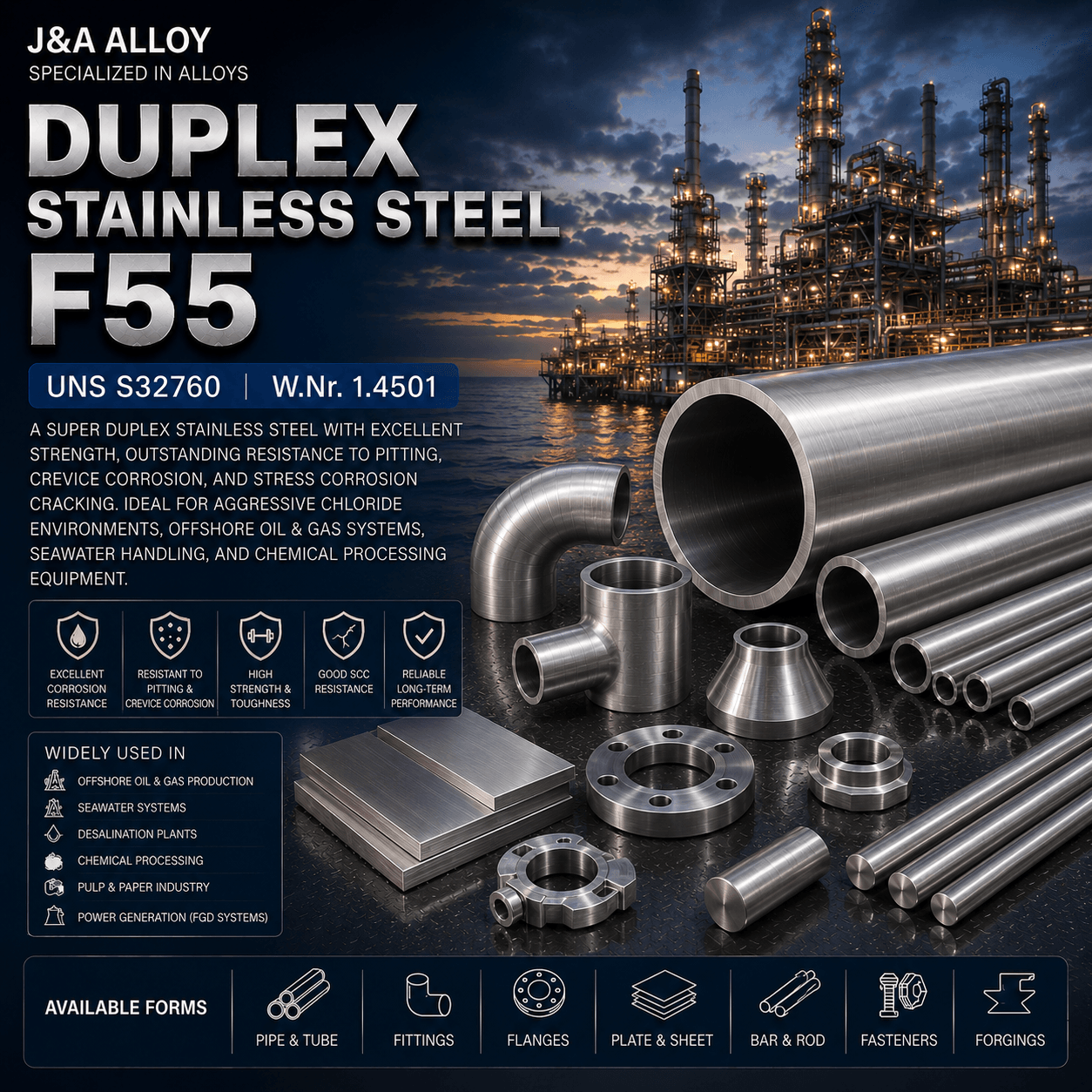
Duplex stainless steel F55, also known as Super Duplex F55, UNS S32760, and EN 1.4501, is a high-performance super duplex stainless steel with excellent resistance to chloride pitting, crevice corrosion, and stress corrosion cracking. With high chromium, molybdenum, nitrogen, copper, and tungsten additions, F55 provides high strength and superior corrosion resistance for offshore oil and gas, marine engineering, chemical processing, desalination, pumps, valves, flanges, and pressure equipment.
Duplex Stainless Steel F55 | UNS S32760 | EN 1.4501
Duplex stainless steel F55 is a super duplex stainless steel designed for severe chloride-containing environments where high strength and excellent corrosion resistance are required. It is commonly identified as ASTM A182 F55, UNS S32760, EN 1.4501, and X2CrNiMoCuWN25-7-4.
The alloy has a balanced ferrite-austenite microstructure, typically close to 50% ferrite and 50% austenite after proper solution annealing. This duplex structure gives F55 a combination of high yield strength, good toughness, excellent resistance to chloride stress corrosion cracking, and strong resistance to pitting and crevice corrosion.
Compared with standard duplex 2205, F55 has higher chromium, molybdenum, and nitrogen content, giving it a PREN value above 40. Compared with super duplex F53 / UNS S32750, F55 includes copper and tungsten additions, which can improve resistance in selected acid and chloride environments. It is widely used in offshore oil and gas systems, seawater equipment, desalination plants, chemical processing, marine engineering, pump parts, valve components, flanges, and high-pressure fittings.
F55 At a Glance
| Key Attribute | Value |
|---|---|
| Material | Duplex Stainless Steel F55 / Super Duplex F55 |
| UNS Number | S32760 |
| EN / W.Nr. | 1.4501 / X2CrNiMoCuWN25-7-4 |
| Material Type | Super Duplex Stainless Steel |
| Density | Approx. 7.8 g/cm³ |
| PREN | Typically ≥ 40 |
| Main Advantage | Excellent Chloride Pitting, Crevice Corrosion and SCC Resistance |
| Typical Service Temperature | Approx. -50°C to 300°C depending on code, environment and application design |
| Main Industries | Oil & Gas, Offshore, Marine, Chemical Processing, Desalination, Power Generation |
| Comparable Grades | 2205, F53 / UNS S32750, 2507, 904L, 254SMO, 6Mo Stainless Steel |
Features of F55
- Super duplex stainless steel with a PREN value typically above 40.
- Excellent resistance to chloride pitting and crevice corrosion.
- High resistance to chloride stress corrosion cracking compared with austenitic stainless steels.
- Higher yield strength than 316L, 904L and many standard austenitic grades.
- Good corrosion resistance in seawater, brine, sour environments and aggressive process media.
- Copper and tungsten additions support performance in selected acid and chloride-containing environments.
- Suitable for high-pressure fittings, flanges, valves, pumps and offshore equipment.
- Good weldability when proper super duplex welding procedures are followed.
- Excellent strength-to-weight performance for marine and offshore structures.
- Available in forgings, bars, pipes, fittings, flanges, plates and custom machined components.
Chemical Composition of F55
| Element | Content (%) |
|---|---|
| Carbon (C) | ≤ 0.030 |
| Manganese (Mn) | ≤ 1.00 |
| Phosphorus (P) | ≤ 0.030 |
| Sulfur (S) | ≤ 0.010 |
| Silicon (Si) | ≤ 1.00 |
| Chromium (Cr) | 24.00–26.00 |
| Nickel (Ni) | 6.00–8.00 |
| Molybdenum (Mo) | 3.00–4.00 |
| Copper (Cu) | 0.50–1.00 |
| Tungsten (W) | 0.50–1.00 |
| Nitrogen (N) | 0.20–0.30 |
| Iron (Fe) | Balance |
Physical Properties of F55
| Property | Typical Value |
|---|---|
| Density | Approx. 7.8 g/cm³ / 0.282 lb/in³ |
| Melting Range | Approx. 1350–1390°C / 2460–2535°F |
| Electrical Resistivity | Approx. 0.80 μΩ·m |
| Thermal Conductivity | Approx. 14–16 W/m·K at room temperature |
| Specific Heat Capacity | Approx. 500 J/kg·K |
| Modulus of Elasticity | Approx. 200 GPa / 29.0 × 10⁶ psi |
Mechanical Properties of F55
The mechanical properties of duplex stainless steel F55 are based on solution annealed condition unless otherwise specified. Actual values depend on product form, thickness, forging ratio, heat treatment and applicable standard.
| Condition | Tensile Strength | Yield Strength | Elongation | Hardness |
|---|---|---|---|---|
| Solution Annealed | ≥ 795 MPa / ≥ 115 ksi | ≥ 550 MPa / ≥ 80 ksi | ≥ 15% | ≤ 310 HB typical maximum |
| Forged / ASTM A182 F55 | ≥ 795 MPa / ≥ 115 ksi | ≥ 550 MPa / ≥ 80 ksi | ≥ 15% | ≤ 310 HB depending on specification |
| Plate / Bar Typical Range | 800–1000 MPa / 116–145 ksi | 550–750 MPa / 80–109 ksi | 15–25% | Approx. 250–310 HB |
Corrosion Resistance
Duplex stainless steel F55 is designed for severe chloride environments. Its high chromium, molybdenum and nitrogen content provides excellent resistance to pitting corrosion, while tungsten and copper additions support performance in selected aggressive environments. With a PREN value typically above 40, F55 is suitable for seawater systems, brine handling, offshore equipment, desalination plants and chloride-containing process streams.
F55 also offers strong resistance to crevice corrosion compared with standard austenitic stainless steels such as 316L and 904L. This makes it valuable for flanges, valves, fittings, fasteners, pump components and heat exchanger parts exposed to stagnant seawater, deposits or gasketed joints. Proper design should still minimize crevices, dead zones and deposits to maintain long-term corrosion performance.
Resistance to chloride stress corrosion cracking is one of the major advantages of super duplex F55. Standard austenitic stainless steels can suffer SCC in hot chloride environments, while F55 offers much better resistance due to its duplex ferrite-austenite microstructure. However, very high temperature, extreme chloride concentration, high tensile stress or poor welding practice can still increase risk.
In acid service, F55 performs well in many oxidizing and moderately reducing environments, especially where chlorides are present. Copper helps improve resistance in some acid media, but F55 should not be considered a universal acid-resistant alloy. For strong hydrochloric acid, hot concentrated sulfuric acid or highly reducing acid systems, nickel alloys such as Alloy 625, Alloy 825, Hastelloy C-276 or C-22 may be more suitable.
High Temperature Performance
Duplex stainless steel F55 provides high strength and good corrosion resistance at ambient and moderately elevated temperatures. In many engineering applications, it is used from sub-zero temperatures up to approximately 300°C, depending on design code, media, stress level and exposure time.
Long-term exposure above approximately 250–300°C should be carefully evaluated because duplex and super duplex stainless steels may suffer embrittlement or microstructural changes if exposed for extended periods. These changes can reduce toughness and corrosion resistance, especially in critical pressure equipment or offshore components.
F55 is not intended as a high-temperature creep-resistant alloy. It should not replace nickel alloys or heat-resistant stainless steels in continuous high-temperature service where creep strength, oxidation resistance or thermal fatigue resistance is the primary requirement. For severe high-temperature applications, materials such as 310S, Alloy 800H, Alloy 625, Alloy 600 or Alloy 617 may be more appropriate.
Available Forms
- Plate
- Sheet
- Pipe
- Tube
- Round bar
- Flat bar
- Rod
- Wire
- Forgings
- Flanges
- Fittings
- Forged rings
- Billets
- Blocks
- Pump components
- Valve components
- Machined parts
- Custom fabricated components
Applications of F55
Oil & Gas
- Subsea equipment
- Manifolds and flowlines
- Wellhead components
- Pressure-containing parts
- Sour-service and chloride-containing equipment
Offshore & Marine Engineering
- Seawater piping systems
- Marine valves
- Propulsion-related components
- Heat exchanger parts
- Fasteners, flanges and fittings
Chemical Processing
- Reactors and pressure equipment
- Chloride-containing process systems
- Acid handling components
- Pump and valve parts
- Process piping and fittings
Desalination
- High-pressure seawater systems
- Reverse osmosis equipment
- Brine handling components
- Pump shafts and impellers
- Flanges and connectors
Power Generation
- Cooling water systems
- Flue gas desulfurization equipment
- Heat exchanger components
- Pump parts
- Corrosion-resistant fasteners
Pulp & Paper
- Bleaching equipment
- Chloride-containing process lines
- Rolls and shafts
- Pumps and valves
- Corrosion-resistant fittings
F55 vs F53 vs 2205 vs 904L
| Grade | Main Advantage | Strength | Corrosion Resistance | Typical Application |
|---|---|---|---|---|
| F55 / UNS S32760 | Super duplex grade with Cu and W additions for severe chloride and selected acid environments | Very High | Excellent, PREN typically ≥ 40 | Offshore, subsea, seawater, desalination, pumps, valves and high-pressure fittings |
| F53 / UNS S32750 | Widely used super duplex grade with excellent chloride resistance | Very High | Excellent, PREN typically ≥ 40 | Oil and gas, marine, desalination, chemical processing and pressure equipment |
| 2205 / UNS S32205 | Cost-effective duplex stainless steel with good strength and chloride resistance | High | Good to Very Good, PREN around 34–36 | Process equipment, tanks, piping, structural parts and moderate chloride service |
| 904L / UNS N08904 | High-nickel austenitic stainless steel with good acid resistance and weldability | Moderate | Very Good in many acid and chloride environments | Chemical processing, sulfuric acid service, marine equipment and FGD systems |
F55 vs 316L Stainless Steel
| Item | Duplex Stainless Steel F55 | 316L Stainless Steel |
|---|---|---|
| Material Type | Super duplex stainless steel | Austenitic stainless steel |
| UNS Number | S32760 | S31603 |
| Strength | Much higher yield strength | Moderate strength |
| PREN | Typically ≥ 40 | Typically around 24–26 |
| Chloride Resistance | Excellent | Limited in severe chloride environments |
| SCC Resistance | Excellent compared with austenitic stainless steels | Susceptible in hot chloride environments |
| Typical Use | Seawater, offshore, high-pressure equipment and severe corrosion service | General fabrication, tanks, piping and mild corrosion service |
Welding & Fabrication
Duplex stainless steel F55 can be welded using GTAW, GMAW, SMAW, FCAW and SAW processes when qualified super duplex welding procedures are used. The key objective during welding is to maintain a balanced ferrite-austenite microstructure and avoid harmful intermetallic phases that can reduce toughness and corrosion resistance.
GTAW is commonly used for root passes, precision welding and high-quality pipe or fitting welds. GMAW and FCAW are suitable for production welding when heat input, interpass temperature and shielding gas are properly controlled. SMAW is widely used for field welding and repair work, while SAW may be used for thicker sections under controlled conditions.
Post-weld heat treatment is generally not required for properly welded super duplex components. However, incorrect heat input, excessive interpass temperature or slow cooling can lead to sigma phase formation, reduced impact toughness and lower corrosion resistance. For critical components, ferrite testing, impact testing, corrosion testing and procedure qualification may be required.
Fabrication of F55 requires more attention than standard austenitic stainless steels. Cutting, forming and machining should consider its higher strength. Good tooling rigidity, suitable cutting parameters and adequate coolant are recommended. After welding or hot working, surfaces should be cleaned, pickled and passivated to restore optimum corrosion resistance.
Standards & Equivalent Grades
| Category | Designation / Standard |
|---|---|
| UNS | S32760 |
| ASTM Forging Grade | ASTM A182 F55 |
| ASTM | ASTM A182 F55, ASTM A276 UNS S32760, ASTM A479 UNS S32760, ASTM A789, ASTM A790, ASTM A815 |
| ASME | ASME SA182 F55, ASME SA479, ASME SA789, ASME SA790, ASME SA815 |
| EN / W.Nr. | 1.4501 / X2CrNiMoCuWN25-7-4 |
| ISO | ISO 15156 / NACE MR0175 may apply subject to project conditions and material limits |
| NACE | NACE MR0175 / ISO 15156 and NACE MR0103 may apply for sour service with project-specific verification |
| Common Names | Super Duplex F55, UNS S32760, 1.4501, Zeron 100 type super duplex stainless steel |
| Material Family | Super Duplex Stainless Steel |
Frequently Asked Questions
What is duplex stainless steel F55?
Duplex stainless steel F55 is a super duplex stainless steel also known as UNS S32760 and EN 1.4501. It offers high strength, excellent chloride corrosion resistance and strong resistance to stress corrosion cracking.
Is F55 a duplex or super duplex stainless steel?
F55 is a super duplex stainless steel. It has higher chromium, molybdenum and nitrogen content than standard duplex grades such as 2205.
What is the UNS designation for F55 stainless steel?
The UNS designation for duplex stainless steel F55 is UNS S32760.
What is ASTM A182 F55?
ASTM A182 F55 is the forged product grade for UNS S32760 super duplex stainless steel, commonly used for flanges, forged fittings, valve parts and pressure components.
What is the EN number for F55 stainless steel?
The EN / Werkstoff number for F55 stainless steel is 1.4501, with the material designation X2CrNiMoCuWN25-7-4.
What is F55 stainless steel used for?
F55 stainless steel is used for offshore oil and gas equipment, subsea components, seawater piping, valves, pumps, flanges, fittings, desalination systems, chemical processing equipment and high-pressure components.
What is the main advantage of F55 stainless steel?
The main advantage of F55 stainless steel is its combination of very high strength, PREN above 40, excellent chloride pitting resistance, crevice corrosion resistance and stress corrosion cracking resistance.
What is the difference between F55 and F53?
F55 / UNS S32760 and F53 / UNS S32750 are both super duplex stainless steels. F55 contains copper and tungsten additions, while F53 is the more widely used 2507-type super duplex grade. Both offer high strength and excellent chloride resistance.
What is the difference between F55 and 2205?
F55 has higher chromium, molybdenum and nitrogen content than 2205, giving it higher PREN, better chloride resistance and higher performance in severe seawater and offshore environments.
Is F55 stainless steel suitable for seawater?
Yes. F55 is widely used in seawater systems, offshore equipment, desalination plants and marine engineering because of its excellent resistance to chloride pitting, crevice corrosion and stress corrosion cracking.
Can F55 stainless steel be welded?
Yes. F55 can be welded using GTAW, GMAW, SMAW, FCAW and SAW processes. Proper super duplex welding procedures are required to maintain phase balance, toughness and corrosion resistance.
Does F55 need post-weld heat treatment?
Post-weld heat treatment is generally not required for properly welded F55 components. However, welding heat input and interpass temperature must be controlled to avoid harmful intermetallic phases.
What temperature can F55 stainless steel withstand?
F55 is commonly used from sub-zero temperatures up to approximately 300°C depending on design code, stress and exposure time. Long-term exposure above about 250–300°C should be evaluated carefully.
What forms of F55 stainless steel are available?
F55 stainless steel is available in plate, sheet, pipe, tube, bar, rod, wire, forgings, flanges, fittings, rings, billets, valve components, pump components and custom machined parts.
Why Choose J&A Alloy
Global Material Solutions
J&A Alloy supplies stainless steels, duplex stainless steels, super duplex stainless steels, super austenitic stainless steels, nickel alloys, titanium alloys and high-performance corrosion-resistant alloys for demanding industrial applications. For duplex stainless steel F55, we support plates, bars, pipes, fittings, flanges, forgings, valve parts, pump parts and custom processed components according to project requirements.
Strict Quality Assurance
J&A Alloy provides strict quality control for chemical composition, mechanical properties, dimensional tolerance, ferrite balance and surface condition. Available inspection and documentation services include PMI, chemical analysis, mechanical testing, hardness testing, impact testing, ultrasonic testing, ferrite testing, corrosion testing and EN 10204 3.1 / 3.2 certification when required.
International Standards
Materials can be supplied according to ASTM, ASME, EN, ISO, NACE and customer-specific specifications. For duplex stainless steel F55, we support common standards such as ASTM A182 F55, ASME SA182 F55, ASTM A276 UNS S32760, ASTM A479 UNS S32760, ASTM A789, ASTM A790 and ASTM A815 depending on product form and project requirements.
Value-added Services
J&A Alloy offers cutting, CNC machining, heat treatment coordination, forging, drilling, turning, milling, surface finishing, custom fabrication and export packaging. We help customers reduce processing time, control material waste and receive ready-to-use or semi-finished super duplex components for manufacturing.
Worldwide Supply
J&A Alloy serves customers in oil and gas, offshore engineering, marine systems, chemical processing, desalination, power generation, pulp and paper and industrial equipment markets. With experience in international logistics and export documentation, we support global buyers with reliable material supply and responsive technical communication.