Nickel 200丨UNS N02200
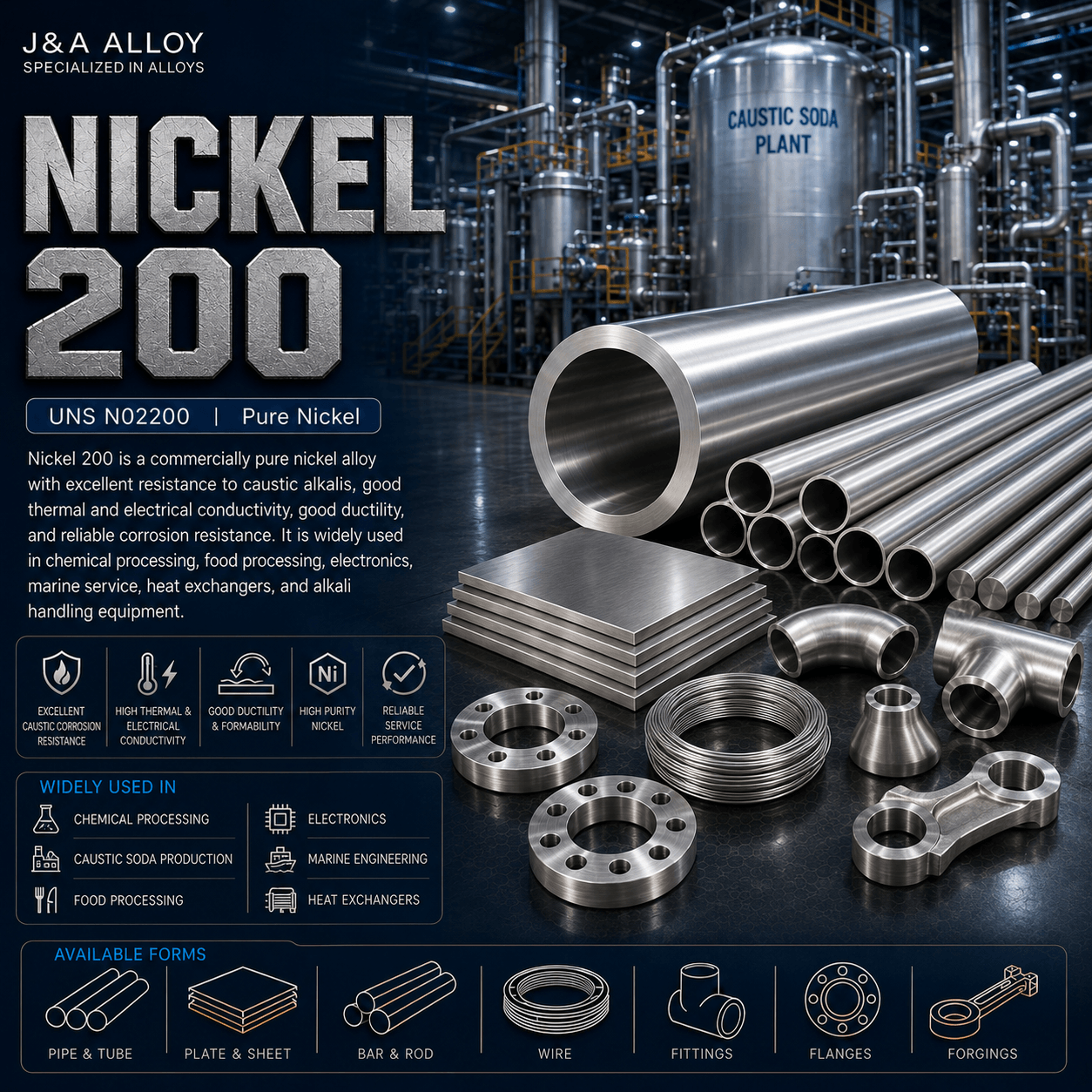
Nickel 200, also known as UNS N02200 or Nickel Alloy 200, is a commercially pure wrought nickel alloy with excellent resistance to caustic alkalis, good corrosion resistance in neutral and reducing environments, high thermal conductivity, high electrical conductivity and good mechanical properties. J&A Alloy supplies Nickel 200 in sheet, plate, strip, pipe, tube, bar, rod, wire, forgings, flanges, fittings and custom machined parts for chemical processing, caustic soda production, electronics, batteries, food processing, marine, aerospace and industrial equipment applications.
Nickel 200丨UNS N02200丨W.Nr 2.4060, 2.4066 Pure Nickel Alloy
Nickel 200 is a commercially pure wrought nickel alloy with a minimum nickel content of approximately 99.0%. It is commonly identified as Nickel Alloy 200, UNS N02200 and W.Nr. 2.4066 / 2.4060 depending on specification and product form. The alloy is known for its excellent resistance to caustic alkalis, good resistance to neutral and reducing media, high thermal conductivity, high electrical conductivity and good mechanical strength.
Nickel 200 is especially valuable in environments involving caustic soda, sodium hydroxide, potassium hydroxide, dry fluorine, anhydrous ammonia, food-grade media and selected reducing chemical conditions. Its high purity and stable nickel matrix make it suitable for chemical processing equipment, alkali handling systems, electrical components, battery parts, heat exchangers and industrial fabrication.
Compared with Nickel 201, Nickel 200 has a higher carbon content limit and is generally preferred for service below approximately 315°C. For applications above approximately 315°C, Nickel 201 is usually selected because its lower carbon content provides better resistance to graphitization and embrittlement at elevated temperatures.
Compared with stainless steels such as 304 and 316L, Nickel 200 provides much better resistance to caustic alkalis and offers higher thermal and electrical conductivity. Compared with nickel-copper alloy Monel 400, Nickel 200 provides higher nickel purity and better caustic alkali resistance, while Monel 400 provides stronger seawater and hydrofluoric acid resistance in many conditions.
Nickel 200 At a Glance
| Key Attribute | Value |
|---|---|
| Material | Nickel 200 / Nickel Alloy 200 |
| UNS Number | N02200 |
| EN / W.Nr. | 2.4066 / 2.4060 |
| Material Type | Commercially Pure Wrought Nickel |
| Density | Approx. 8.89 g/cm³ |
| PREN | Not typically used for commercially pure nickel |
| Main Advantage | Excellent Caustic Alkali Resistance, High Thermal Conductivity and High Electrical Conductivity |
| Typical Service Temperature | Generally recommended below approx. 315°C; Nickel 201 is preferred for higher-temperature service |
| Main Industries | Chemical Processing, Caustic Soda, Electronics, Batteries, Food Processing, Marine, Aerospace, Industrial Equipment |
| Comparable Grades | Nickel 201, Monel 400, Alloy 600, 304, 316L, Copper Alloys |
Features of Nickel 200
- Commercially pure wrought nickel with high nickel content and stable performance.
- Excellent resistance to caustic soda, sodium hydroxide and potassium hydroxide.
- Good corrosion resistance in neutral, alkaline and selected reducing environments.
- High thermal conductivity compared with many nickel alloys and stainless steels.
- High electrical conductivity for electronic, battery and conductive components.
- Good mechanical strength and ductility over a wide temperature range.
- Good weldability, formability and fabrication performance.
- Ferromagnetic at room temperature due to its high nickel content.
- Suitable for chemical equipment, heat exchangers, electrodes, battery parts and food processing components.
- Available in sheet, plate, strip, pipe, tube, bar, rod, wire, forgings and custom machined parts.
Chemical Composition of Nickel 200
| Element | Content (%) |
|---|---|
| Nickel (Ni) | ≥ 99.00 |
| Copper (Cu) | ≤ 0.25 |
| Iron (Fe) | ≤ 0.40 |
| Manganese (Mn) | ≤ 0.35 |
| Carbon (C) | ≤ 0.15 |
| Silicon (Si) | ≤ 0.35 |
| Sulfur (S) | ≤ 0.010 |
Physical Properties of Nickel 200
| Property | Typical Value |
|---|---|
| Density | Approx. 8.89 g/cm³ / 0.321 lb/in³ |
| Melting Range | Approx. 1435–1446°C / 2615–2635°F |
| Electrical Resistivity | Approx. 0.096 μΩ·m at 20°C |
| Thermal Conductivity | Approx. 70 W/m·K at 20°C |
| Specific Heat Capacity | Approx. 456 J/kg·K |
| Modulus of Elasticity | Approx. 200–207 GPa / 29.0–30.0 × 10⁶ psi |
Mechanical Properties
Mechanical properties of Nickel 200 depend on product form, cold work level, annealing condition, section size and specification. The following values are typical reference values for annealed material. Final acceptance values should be confirmed according to ASTM, ASME, EN or customer-specific requirements.
| Condition | Tensile Strength | Yield Strength | Elongation | Hardness |
|---|---|---|---|---|
| Annealed Sheet / Plate | Approx. 380–550 MPa / 55–80 ksi | Approx. 100–170 MPa / 15–25 ksi | Approx. 40–50% | Approx. 70–90 HRB |
| Annealed Bar / Rod | Approx. 380–520 MPa / 55–75 ksi | Approx. 100–170 MPa / 15–25 ksi | Approx. 35–50% | Approx. 70–95 HRB |
| Cold Worked Condition | Higher than annealed condition | Higher than annealed condition | Reduced ductility | Increased hardness depending on cold reduction |
Nickel 200 Caustic Soda and Alkali Service Notes
Nickel 200 is commonly selected for caustic soda, sodium hydroxide, alkali and reducing chemical environments below about 315°C. For higher-temperature pure nickel service, compare Nickel 201 because its lower carbon content helps reduce graphitization risk.
| Service | Common Material Choice | RFQ Detail |
|---|---|---|
| Caustic soda / alkali below about 315°C | Nickel 200 | Provide concentration, temperature, impurities, product form and pressure. |
| Higher-temperature pure nickel service | Nickel 201 | Confirm temperature, carbon limit, fabrication and final standard. |
| Conductive or chemical equipment parts | Nickel 200 plate, sheet, bar or pipe | Confirm size, tolerance, surface, MTC and inspection requirement. |
Corrosion Resistance
Nickel 200 provides excellent corrosion resistance in caustic alkalis, especially sodium hydroxide and potassium hydroxide, across a wide concentration range. It is one of the preferred materials for caustic soda production, alkali evaporators, caustic handling tanks, alkali pipelines and related chemical processing equipment where stainless steels may suffer corrosion or stress corrosion cracking.
The alloy performs well in neutral and reducing environments, including selected organic acids, dry gases and alkaline solutions. Nickel 200 is also resistant to many food-grade and pharmaceutical processing media where high purity, corrosion resistance and cleanability are required.
For pitting and crevice corrosion, Nickel 200 is generally better suited to alkaline and reducing environments than aggressive oxidizing chloride environments. It is not normally the first choice for stagnant seawater, hot chlorides or strong oxidizing acid-chloride media. In severe chloride or seawater service, alloys such as Monel 400, Alloy 625, Alloy 825, Hastelloy C-276, Hastelloy C-22 or super duplex stainless steels may be more suitable.
Nickel 200 has good resistance to stress corrosion cracking in many alkaline environments, which is a major advantage over some stainless steels in caustic service. However, material selection should still consider concentration, temperature, impurities, dissolved oxygen, velocity, deposits and welding condition.
In acid environments, Nickel 200 is useful in selected reducing acids and neutral salts but has limited resistance to oxidizing acids. It is not recommended for nitric acid or strongly oxidizing media. For mixed acid, oxidizing chloride or severe chemical processing environments, dedicated corrosion-resistant nickel alloys should be evaluated.
High Temperature Performance
Nickel 200 can be used at elevated temperatures where high thermal conductivity, nickel purity and oxidation behavior are required. However, because it contains a higher carbon content than Nickel 201, Nickel 200 is generally recommended for service below approximately 315°C.
At temperatures above approximately 315°C, Nickel 200 may be susceptible to graphitization or embrittlement after prolonged exposure, especially in certain atmospheres or stressed conditions. For this reason, Nickel 201, the low-carbon version of commercially pure nickel, is usually preferred for higher-temperature service.
Nickel 200 is not a high-strength superalloy. It should not be selected for high-temperature load-bearing components where creep strength or turbine-grade mechanical performance is required. For high-temperature structural applications, materials such as Alloy 600, Alloy 601, Alloy 625, Alloy 718, GH3128 or other nickel-based superalloys may be more appropriate.
For caustic, electrical and thermal applications at moderate temperatures, Nickel 200 offers an excellent combination of corrosion resistance, conductivity and fabrication performance.
Nickel 200 Plate, Sheet and Pipe RFQ Notes
For Nickel 200 plate and sheet, confirm ASTM B162 / ASME SB-162, thickness, width, length, cutting and surface requirements. For bar, confirm ASTM B160, diameter, length and tolerance. For pipe or tube, confirm ASTM B161 / B163, OD, wall thickness, length, seamless/welded requirement and inspection scope.
Available Forms
- Plate
- Sheet
- Strip
- Foil
- Pipe
- Tube
- Round bar
- Flat bar
- Square bar
- Rod
- Wire
- Forgings
- Forged rings
- Flanges
- Fittings
- Discs
- Billets
- Blocks
- Electrodes
- Bus bars
- Machined parts
- Custom fabricated components
Applications of Nickel 200
Chemical Processing
- Caustic soda production equipment
- Sodium hydroxide evaporators
- Alkali storage tanks
- Caustic transfer piping
- Chemical process vessels
Caustic Alkali Industry
- Concentrated alkali handling systems
- Alkali evaporator tubes
- Caustic soda heaters
- Pumps and valves for alkaline media
- Alkali-resistant fittings and flanges
Electronics & Electrical
- Electrical leads
- Battery current collectors
- Bus bars
- Electronic connectors
- Conductive nickel components
Battery & Energy
- Battery tabs
- Nickel strips
- Electrode components
- Fuel cell parts
- Energy storage connection components
Food & Pharmaceutical Processing
- Food processing equipment
- Pharmaceutical process components
- Clean handling systems
- High-purity process parts
- Corrosion-resistant containers
Marine & Industrial Equipment
- Selected marine components
- Heat exchangers in suitable environments
- Pump and valve parts
- Industrial fasteners
- Custom machined nickel components
Aerospace & Thermal Engineering
- Thermal management components
- Specialty nickel sheet parts
- Conductive components
- Heat transfer parts
- Precision fabricated nickel structures
Nickel 200 Vs Other Grades
Nickel 200 vs Nickel 201 vs Monel 400 vs Alloy 600
| Grade | Main Advantage | Strength | Corrosion Resistance | Typical Application |
|---|---|---|---|---|
| Nickel 200 / UNS N02200 | Commercially pure nickel with excellent caustic alkali resistance and high conductivity | Moderate | Excellent in caustic alkalis and reducing environments | Caustic soda equipment, electrical parts, batteries, heat exchangers and chemical processing components |
| Nickel 201 / UNS N02201 | Low-carbon pure nickel for better elevated-temperature stability | Moderate | Similar to Nickel 200 | High-temperature caustic service, hot chemical equipment and thermal applications above 315°C |
| Monel 400 / UNS N04400 | Nickel-copper alloy with strong seawater and hydrofluoric acid resistance | Higher than Nickel 200 | Excellent in seawater and selected reducing acids | Marine equipment, pumps, valves, heat exchangers and hydrofluoric acid service |
| Alloy 600 / UNS N06600 | Nickel-chromium alloy with good oxidation and high-temperature corrosion resistance | Moderate to High | Good in high-temperature oxidizing environments | Furnace parts, heat-treating equipment, chemical processing and high-temperature components |
Nickel 200 vs 304 Stainless Steel vs 316L Stainless Steel
| Item | Nickel 200 | 304 Stainless Steel | 316L Stainless Steel |
|---|---|---|---|
| Material Type | Commercially pure nickel | Austenitic stainless steel | Molybdenum-bearing austenitic stainless steel |
| UNS Number | N02200 | S30400 / S30403 | S31603 |
| Caustic Alkali Resistance | Excellent | Limited in severe caustic service | Limited in severe caustic service |
| Chloride Resistance | Moderate; environment-dependent | Limited | Better than 304 but limited in severe chlorides |
| Electrical Conductivity | High | Low | Low |
| Thermal Conductivity | High | Lower | Lower |
| Typical Use | Caustic soda, electrical parts, batteries and pure nickel components | General fabrication, food equipment and mild corrosion service | Marine-related fabrication, chemical equipment and sanitary applications |
Nickel 200 Selection Guide
Nickel 200 and Nickel 201 are closely related commercially pure nickel grades. The main selection factor is service temperature and carbon control.
| Question | Recommended Choice | Reason |
|---|---|---|
| Lower-temperature caustic alkali service | Nickel 200 | Nickel 200 is commonly used below about 315°C when standard carbon content is acceptable. |
| Long-term elevated-temperature service | Nickel 201 | Lower carbon content helps reduce graphitization and embrittlement risk. |
| High electrical or thermal conductivity | Nickel 200 / Nickel 201 | Both grades offer high conductivity compared with many stainless steels. |
| Marine or seawater service | Review Monel 400 or project-specific alloy choice | Commercially pure nickel is not always the first choice for chloride-rich seawater environments. |
- Nickel 200 is best for: Caustic soda evaporators, alkali tanks, anodes, cathodes, current collectors, food processing parts and chemical handling equipment.
- Selection note: Choose Nickel 200 for caustic alkali equipment, conductive parts and fabricated components normally operating below about 315°C.
- Alternative grade: Choose Nickel 201 when the part will see prolonged service above about 315°C or when a low-carbon specification is required.
- Engineering caution: Avoid using Nickel 200 for long-term elevated-temperature service above about 315°C when graphitization risk is a concern.
Welding & Fabrication
Nickel 200 has good weldability and can be welded using common nickel alloy welding processes such as GTAW, GMAW and SMAW. GTAW is often preferred for precision welds, thin sections, tubing, heat exchanger parts and chemical equipment. GMAW may be used for production welding when shielding gas, filler metal and heat input are properly controlled. SMAW can be used for thicker sections and repair welding when suitable nickel electrodes are selected.
Post-weld heat treatment is generally not required for many Nickel 200 applications, but stress relief or annealing may be considered depending on fabrication history, component design and service environment. For components used in caustic service, proper cleaning, removal of contaminants and avoidance of sulfur-bearing residues are important.
Nickel 200 has good formability and can be cold worked, deep drawn, spun, bent and formed into many shapes. Cold working increases strength and hardness but reduces ductility. Annealing can restore ductility after heavy forming.
Machining Nickel 200 requires attention because pure nickel can be gummy and may work harden. Sharp tools, positive rake angles, rigid setups, adequate cutting fluid and controlled feeds are recommended. Welding and fabrication should avoid contamination from copper, sulfur, lead, zinc and low-melting-point metals that can cause hot cracking or embrittlement.
Standards & Equivalent Grades
| Category | Designation / Standard |
|---|---|
| UNS | N02200 |
| Common Names | Nickel 200, Nickel Alloy 200, Commercially Pure Nickel |
| EN / W.Nr. | 2.4066 / 2.4060 |
| EN Material Designation | Ni 99.2 / LC-Ni 99.6 references may apply depending on specification |
| ASTM | ASTM B160, ASTM B162, ASTM B163, ASTM B161, ASTM B725, ASTM B730, ASTM B366, ASTM B564 |
| ASME | ASME SB160, ASME SB162, ASME SB163, ASME SB161, ASME SB725, ASME SB730, ASME SB366, ASME SB564 |
| AWS Filler Metals | ERNi-1 and ENi-1 may be used depending on welding procedure and service requirement |
| ISO | Equivalent ISO references may apply depending on product form and customer specification |
| NACE | Project-specific review required for sour or special corrosion service |
| Material Family | Commercially Pure Nickel |
Nickel 200 Standards by Product Form
For procurement and quotation, the applicable standard should be confirmed by product form, size range, manufacturing route and inspection requirement. Common Nickel 200 (UNS N02200) supply standards include:
| Product Form | Common Standards / Notes |
|---|---|
| Bar / Rod | ASTM B160 / ASME SB160 |
| Plate / Sheet / Strip | ASTM B162 / ASME SB162 |
| Seamless Pipe / Tube | ASTM B161, ASTM B163 / ASME SB161, SB163 |
| Welded Pipe / Tube | ASTM B725, ASTM B730 / ASME SB725, SB730 |
| Forgings / Flanges / Fittings | ASTM B564, ASTM B366 / ASME SB564, SB366 |
| Welding Consumables | ERNi-1, ENi-1, project-specific WPS/PQR review |
J&A Alloy can quote Nickel 200 bar, rod, plate, sheet, strip, pipe, tube, wire, forgings, flanges and fittings according to ASTM, ASME or customer project specifications.
Frequently Asked Questions
What is Nickel 200?
Nickel 200 is a commercially pure wrought nickel alloy with high nickel content, excellent caustic alkali resistance, good corrosion resistance, high thermal conductivity and high electrical conductivity.
What is the UNS number of Nickel 200?
The UNS number of Nickel 200 is UNS N02200.
Is Nickel 200 commercially pure nickel?
Yes. Nickel 200 is commercially pure nickel with a minimum nickel content of approximately 99.0%.
What is Nickel 200 used for?
Nickel 200 is used for caustic soda equipment, alkali evaporators, chemical processing components, electrical conductors, battery parts, food processing equipment, heat exchangers, pump parts, valves, flanges and custom fabricated components.
What is the main advantage of Nickel 200?
The main advantage of Nickel 200 is its excellent resistance to caustic alkalis, combined with high thermal conductivity, high electrical conductivity and good fabrication performance.
Is Nickel 200 resistant to caustic soda?
Yes. Nickel 200 is highly resistant to caustic soda and is widely used for sodium hydroxide and potassium hydroxide handling equipment.
Is Nickel 200 suitable for seawater?
Nickel 200 may be used in selected marine or neutral environments, but it is not normally the first choice for severe seawater or stagnant chloride service. Monel 400, Alloy 625 or super duplex stainless steels are often better options for demanding seawater applications.
Can Nickel 200 be welded?
Yes. Nickel 200 can be welded using GTAW, GMAW, SMAW and other suitable nickel welding processes. Proper filler selection, cleaning and procedure control are important for reliable weld quality.
Does Nickel 200 require post-weld heat treatment?
Post-weld heat treatment is generally not required for many Nickel 200 applications. Stress relief or annealing may be considered for heavily formed or critical components depending on service conditions.
What temperature can Nickel 200 withstand?
Nickel 200 is generally recommended for service below approximately 315°C. For higher-temperature service, Nickel 201 is usually preferred because of its lower carbon content.
What is the difference between Nickel 200 and Nickel 201?
Nickel 200 has a higher carbon content limit and is commonly used below approximately 315°C. Nickel 201 is the low-carbon version and is preferred for higher-temperature service where carbon-related embrittlement must be avoided.
What is the difference between Nickel 200 and Monel 400?
Nickel 200 is commercially pure nickel with excellent caustic alkali resistance and high conductivity. Monel 400 is a nickel-copper alloy with higher strength and better resistance to seawater and hydrofluoric acid in many conditions.
Is Nickel 200 magnetic?
Yes. Nickel 200 is ferromagnetic at room temperature because it is commercially pure nickel.
What standards apply to Nickel 200?
Common standards include UNS N02200, ASTM B160, ASTM B162, ASTM B163, ASTM B161, ASTM B725, ASTM B730, ASTM B366, ASTM B564 and corresponding ASME SB specifications.
What forms of Nickel 200 are available?
Nickel 200 is available in plate, sheet, strip, foil, pipe, tube, round bar, flat bar, rod, wire, forgings, flanges, fittings, discs, billets, blocks, electrodes, bus bars and custom machined parts.
Request a Quote for Nickel 200
To receive an accurate Nickel 200 (UNS N02200) quotation, please send the following details with your inquiry:
- Required product form: bar, plate, sheet, pipe, tube, wire, forging, flange or fitting.
- Applicable standard: ASTM, ASME, EN, DIN, AMS or project-specific specification.
- Size, thickness, outside diameter, wall thickness, length and quantity.
- Material condition, heat treatment, surface finish and tolerance requirements.
- Inspection documents: EN 10204 3.1 MTC, PMI, ultrasonic testing, third-party inspection or other requirements.
- Destination country, delivery terms and required lead time.
Contact J&A Alloy for Nickel 200 material selection support, mill test certificate review and export quotation.
Why Choose J&A Alloy
Global Material Solutions
J&A Alloy supplies commercially pure nickel, nickel alloys, high-temperature alloys, stainless steels, precipitation-hardening stainless steels, duplex stainless steels, titanium alloys and corrosion-resistant alloys for demanding industrial applications. For Nickel 200, we support sheet, plate, strip, pipe, tube, bar, wire, forgings, flanges, fittings, billets and custom processed components according to project requirements.
Strict Quality Assurance
J&A Alloy provides strict quality control for chemical composition, mechanical properties, dimensional tolerance, surface quality and product traceability. Available inspection and documentation services include PMI, chemical analysis, mechanical testing, hardness testing, ultrasonic testing, dimensional inspection, surface inspection and EN 10204 3.1 / 3.2 certification when required.
International Standards
Materials can be supplied according to ASTM, ASME, EN, ISO, AWS and customer-specific specifications. For Nickel 200, we support common standards such as ASTM B160, ASTM B162, ASTM B163, ASTM B161, ASTM B725, ASTM B730, ASTM B366, ASTM B564 and corresponding ASME specifications depending on product form and technical requirements.
Value-added Services
J&A Alloy offers cutting, slitting, CNC machining, forming support, welding support, heat treatment coordination, turning, milling, grinding, polishing, custom fabrication and export packaging. We help customers reduce processing time, control material waste and receive ready-to-use or semi-finished nickel components for manufacturing.
Worldwide Supply
J&A Alloy serves customers in chemical processing, caustic soda production, electronics, batteries, food processing, marine engineering, aerospace, thermal engineering and industrial equipment markets. With experience in international logistics and export documentation, we support global buyers with reliable material supply and responsive technical communication.
Nickel 200 Internal Selection Links
Related pages: Nickel 200 Plate Supplier, Caustic Soda and Alkali Alloys, Corrosion Resistant Alloy Products, Nickel 201, Monel 400 and Incoloy 825.