
Nickel Alloy Forgings for Critical Industrial Components
Source open-die, ring-rolled, closed-die and drawing-based forgings by alloy, geometry, condition, grain-flow requirement, testing and final application.
Common and Custom Forging Types
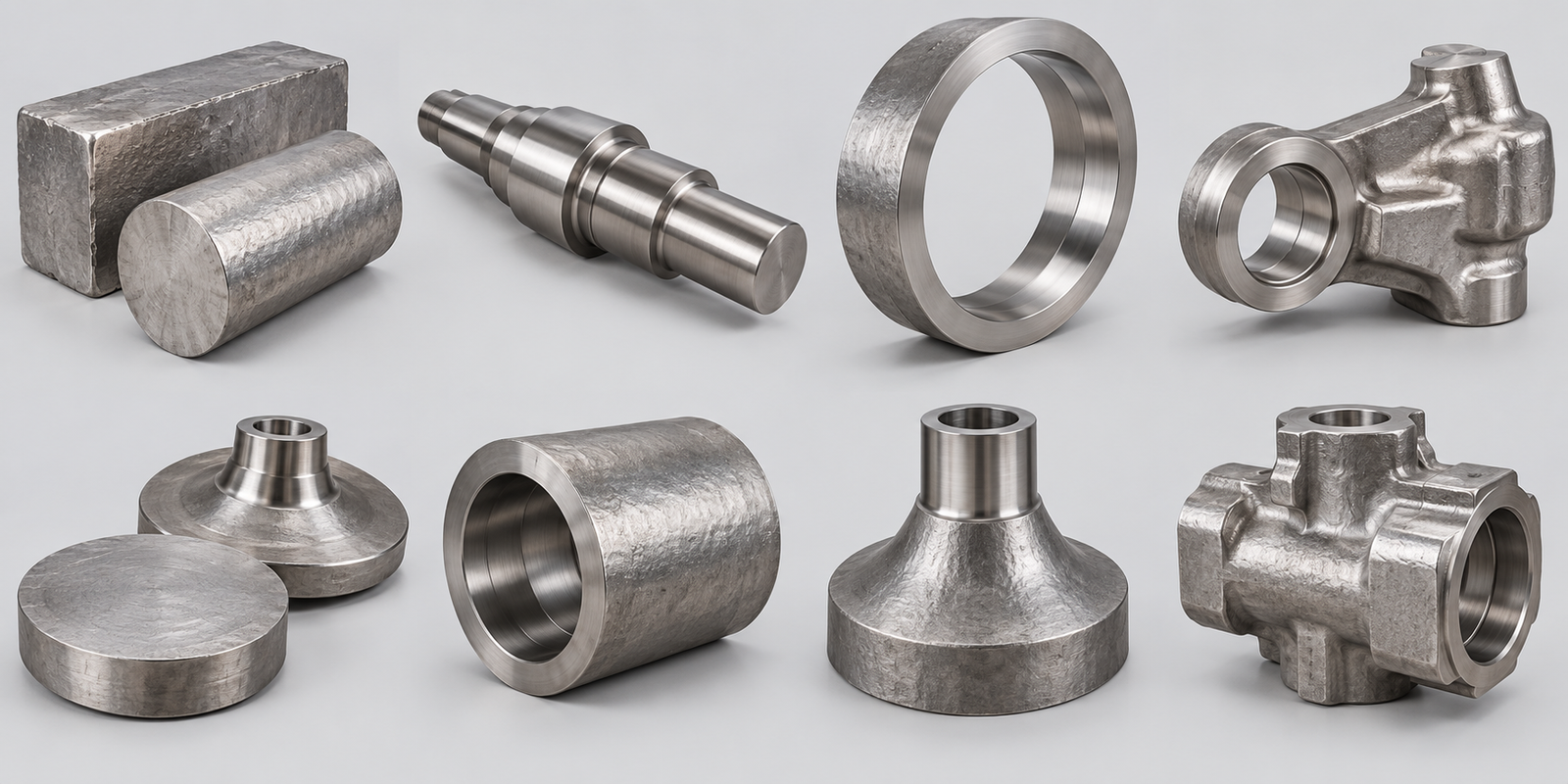
Open-Die Blocks, Billets & Bars
Large or low-volume rectangular blocks, round billets and forged bars with controlled reduction and machining allowance.
Forged Shafts & Stepped Shafts
Straight, shouldered and stepped shafts for pumps, turbines, aerospace hardware and rotating equipment.
Seamless Rolled Rings
Rectangular or profiled rings for flanges, seals, bearings, pressure equipment and rotating assemblies.
Closed-Die / Impression-Die Forgings
Repeatable near-net components made in shaped tooling for suitable quantities and qualified manufacturing programs.
Discs, Pancakes & Turbine Blanks
Solid discs, upset pancakes and contoured disc blanks for impellers, turbine parts and pressure-retaining components.
Hollow Forgings & Sleeves
Pierced or mandrel-forged cylinders, sleeves and thick-wall hollows that reduce machining and material waste.
Hubs, Nozzles & Necks
Integral-neck hubs, vessel nozzles and transition shapes supplied as rough, proof-machined or finished forgings.
Custom Drawing Forgings
Valve bodies, impeller blanks and asymmetric near-net parts developed from a controlled drawing, machining model and inspection plan.
Choose the Forging Manufacturing Route
| Route | Best Fit | Typical Forms | Critical RFQ Inputs |
|---|---|---|---|
| Open-die forging | Large size, low-to-medium quantity, simple or stepped geometry | Blocks, bars, shafts, discs and hollows | Stock size, reduction ratio, grain flow and machining allowance |
| Ring rolling | Axisymmetric seamless rings with efficient material use | Flange rings, bearing rings, seal rings and profiled rings | OD, ID, height, section profile and test location |
| Closed-die forging | Repeatable near-net shape at suitable production quantity | Aerospace, valve, pump and mechanical components | Tooling ownership, minimum quantity and first-article approval |
| Upsetting / disc forging | Increased cross-section and radial grain flow | Discs, pancakes, hubs and bolt-head preforms | Upset ratio, center soundness and macrostructure |
| Mandrel / hollow forging | Thick-wall cylindrical geometry | Sleeves, shells, cylinders and nozzle bodies | ID/OD allowance, wall variation, ovality and UT coverage |
Custom Forging Development From Drawing to Inspection
1. Design and Stock Envelope
Review finished geometry, datums, fillets, machining allowance, draft, flash or parting line, weight and available starting stock.
2. Process and Grain Flow
Select open-die, ring rolling, upsetting, mandrel forging or closed-die route; define minimum reduction and grain-flow orientation where functionally required.
3. Heat Treatment
Control solution anneal, stabilization and age-hardening condition with furnace records, transfer time and cooling route appropriate to the alloy.
4. Qualification and Testing
Agree prolongations, sacrificial test coupons, orientation, mechanical tests, macrostructure, grain size, UT/PT and first-article requirements before manufacture.
5. Proof or Finish Machining
Define as-forged, rough-machined, proof-machined or finished delivery plus surface texture, dimensional report and protected critical surfaces.
6. Traceability and Release
Maintain heat/lot identity through cutting, forging, heat treatment and machining, then compile MTC, NDE, dimensions and release documentation.
Nickel Alloy and Super Stainless Forging Materials
| Material | Why It Is Selected | Typical Specification Route |
|---|---|---|
| Inconel 718 | High strength, fatigue and elevated-temperature duty | ASTM B637; aerospace AMS/project specifications where required |
| Inconel X-750 | Springs, fasteners and hot rotating components | ASTM B637; applicable AMS/project condition |
| Inconel 625 | Corrosion resistance and strength across broad temperatures | ASTM B564 for covered forging grades/conditions |
| Hastelloy C-276 / C-22 | Aggressive chemical and chloride environments | ASTM B564 or B462 for covered product scope |
| Incoloy 825 | Sulfuric/phosphoric acid and process equipment | Verify exact grade coverage and product specification |
| Monel 400 / Nickel 200 | Marine, caustic and commercially pure nickel applications | ASTM B564 / ISO 9725 where grade and project scope permit |
| PH stainless / Super Duplex 2507 | High strength or chloride-resistant stainless applications | ASTM A182/A473 or EN 10222/10250 route as applicable |
Specification applicability depends on the exact UNS grade, product type, size and heat-treatment condition. Confirm current-edition grade tables before ordering.
American Forging Standards: ASTM, ASME and AMS
| Standard | Principal Scope | Procurement Guidance |
|---|---|---|
| ASTM B564-25 | Nickel alloy forgings | Verify exact UNS grade, heat-treatment condition, mechanical properties, sampling and UT requirements in the current edition. |
| ASTM B637-26 | Precipitation-hardening and cold-worked nickel-alloy bars, forgings and forging stock | Common starting point for Inconel 718 and X-750; specify alloy, condition, heat treatment and required tensile/stress-rupture tests. |
| ASTM B462-26 | Listed forged/rolled pipe flanges, forged fittings, valves and parts for corrosive high-temperature service | Product-scope standard, not a universal specification for every forged blank or nickel alloy. |
| ASTM B472-26 | Nickel-alloy billets and bars for reforging | Use when purchasing reforging stock rather than a finished qualified forging. |
| ASTM A182/A182M and A473 | Stainless/alloy-steel pressure components and stainless forgings | Relevant to covered stainless and duplex grades; do not apply them automatically to nickel alloys. |
| ASME BPVC Sections II and VIII | Code material adoption and pressure-vessel design/fabrication | A material listing does not by itself establish finished-part design, allowable load, weld qualification or code stamping. |
| AMS / customer aerospace specifications | Grade-, condition- and process-specific aerospace material requirements | State exact document revision, heat treatment, grain-flow, test location, approval and source-control requirements. |
European Forging Standards and PED Requirements
| Standard / Framework | Principal Scope | Scope Boundary |
|---|---|---|
| EN 10222-1 | General requirements for steel forgings for pressure purposes | Used with the applicable material-specific part; confirm PED/design-code route. |
| EN 10222-5:2017 | Martensitic, austenitic and austenitic-ferritic stainless forgings for pressure purposes | Covers open-die forgings, ring-rolled products and forged bars within its stated stainless scope, not all nickel alloys. |
| EN 10250-4:2021 | Stainless open-die forgings for general engineering | Technical delivery conditions for stainless open-die forgings, forged bars and ring-rolled products. |
| EN 10088-3 | Stainless semi-finished products, bars, rods, sections and bright products | Useful material reference for covered stainless products but not a substitute for a finished-forging specification. |
| EN 10204 | Inspection documents | Specify 3.1 or 3.2 and who validates results; it does not define forging dimensions or acceptance properties. |
| PED 2014/68/EU and EN 13445 | European pressure-equipment framework and unfired vessel design | Define material route, PMA/harmonized standard, category, notified-body involvement and component design responsibility. |
EN 10222 and EN 10250 are steel/stainless systems. For nickel alloys, use a covered ASTM/ISO route or an approved Particular Material Appraisal where the governing European pressure-equipment procedure requires it.
International Forging and Inspection Standards
| Standard | Scope | How to Use It |
|---|---|---|
| ISO 9725:2017 | Nickel and nickel-alloy forgings for general purposes | Current standard confirmed in 2022; add project-specific design, NDE or pressure/aerospace requirements as needed. |
| ISO 9712 | Qualification and certification of NDT personnel | State technique, personnel level and employer/third-party responsibilities in the inspection plan. |
| ISO 16810 | General principles of ultrasonic testing | UT procedure, calibration block, scan coverage and acceptance criteria still require product-specific agreement. |
| ISO 21920 series | Surface texture indication, terms and parameters | Use on finished drawings when machined surface texture is a controlled requirement. |
| JIS G 3214 and project national standards | Stainless steel forgings for pressure vessels and other national routes | Use only when the alloy, product and design jurisdiction are explicitly covered; confirm equivalence rather than assuming it. |
Quality, NDE and Mechanical Test Planning
Material and Process Records
- Heat/lot traceability and EN 10204 3.1 or 3.2 documents
- Original melt chemistry, product analysis and PMI
- Forging route, reduction, heat-treatment charts and hardness maps
- Tensile, impact, stress-rupture, grain-size or macro tests as specified
Part and Surface Inspection
- UT scan plan, calibration, coverage and acceptance class
- PT or MT only where compatible with alloy and specification
- As-forged/proof-machined dimensions and machining allowance
- Surface condition, laps/folds, decarburization/scale and marking
Choose Forgings by Application
| Application | Common Starting Materials | Critical Review Items |
|---|---|---|
| Aerospace | 718, X-750, A286 and specified superalloys | Grain flow, heat treatment, stress rupture, first article and approved source |
| Oil & Gas / Sour Service | 625, 718, C-276, duplex/super duplex | NACE/project requirements, through-thickness UT, hardness and pressure boundary |
| Chemical Processing | C-276, C-22, 625, 825, Nickel 200 | Corrosion medium, heat treatment, PMI and weldability |
| Power Generation | 718, X-750, 625 and heat-resistant alloys | Creep/fatigue duty, grain structure, high-temperature tests and machining datum |
| Marine & Offshore | 625, Monel 400, duplex/super duplex | Seawater exposure, galvanic design, impact/UT and third-party inspection |
Related Materials and Product Forms
Nickel Alloy Forgings FAQ
What types of nickel alloy forgings can be supplied?
Common forms include open-die blocks, billets, forged bars, stepped shafts, discs, hubs, hollow cylinders and seamless rolled rings. Closed-die and drawing-based near-net forgings can be reviewed when annual quantity, tooling, geometry and qualification requirements are defined.
Which ASTM standard applies to nickel alloy forgings?
The correct standard depends on alloy and end use. ASTM B564 covers listed nickel-alloy forgings, ASTM B637 covers precipitation-hardening and cold-worked nickel-alloy bars, forgings and forging stock, and ASTM B462 covers listed forged or rolled flanges, forged fittings and valve parts for corrosive high-temperature service. Grade coverage must be checked in the current edition.
What is the international standard for nickel and nickel alloy forgings?
ISO 9725:2017 specifies requirements for nickel and nickel-alloy forgings for general purposes and remains current following its 2022 confirmation. Project, pressure-equipment, aerospace or customer requirements may impose additional material, testing and qualification rules.
What is the difference between open-die and closed-die forging?
Open-die forging shapes stock between non-enclosing tools and is practical for large, low-volume or simple parts with machining allowance. Closed-die forging uses shaped dies to produce repeatable near-net geometry, normally requiring tooling, minimum quantities and process qualification.
What is a seamless rolled ring?
A seamless rolled ring is pierced and radially or axially rolled from a forged preform so grain flow follows the ring shape. RFQs should state OD, ID, height, rectangular or profiled section, machining allowance, heat treatment and test locations.
Do EN 10222 and EN 10250 cover nickel alloys?
These EN series principally cover steel forgings. EN 10222-5 addresses martensitic, austenitic and austenitic-ferritic stainless forgings for pressure purposes, while EN 10250-4 covers stainless open-die forgings for general engineering. They must not be assumed to cover every nickel alloy; ISO 9725, ASTM specifications or a project-approved material route may be required.
Which tests are commonly specified for critical forgings?
Typical controls include heat traceability, chemistry and mechanical tests, heat-treatment charts, hardness, grain size, ultrasonic testing, liquid penetrant testing, PMI, dimensions and surface inspection. Test location, acceptance criteria and sampling must be stated because they affect qualification and usable forging size.
What information is needed for a custom forging RFQ?
Provide alloy and UNS or EN designation, governing material standard and edition, finished drawing, as-forged or proof-machined dimensions, machining allowance, quantity, heat treatment, grain-flow or reduction requirements, test locations, NDE acceptance criteria, inspection documents and destination.
Request a Nickel Alloy Forging Quote
Send enough information to distinguish the finished component from its forging envelope and qualification plan.
- Alloy, UNS/EN designation, material standard and edition
- Finished drawing plus as-forged or proof-machined envelope
- Quantity, unit weight, machining allowance and delivery condition
- Heat treatment, reduction/grain-flow requirements and test locations
- UT/PT, mechanical tests, inspection documents and third-party witness points