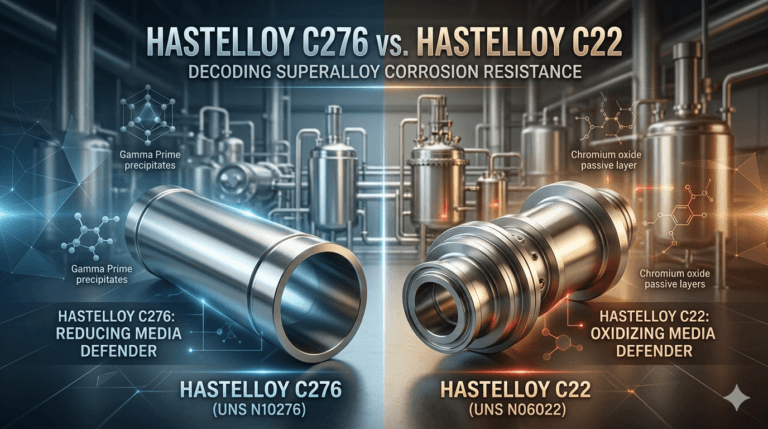
Hastelloy C-2000 and C-276 are low-carbon nickel-chromium-molybdenum alloys for severe chemical service. C-2000 (UNS N06200) adds about 1.6% copper and uses substantially more chromium to extend resistance across reducing sulfuric acid and oxidizing contaminants. C-276 (UNS N10276) uses tungsten, has a longer service history and is usually easier to source in multiple product forms.
Direct answer: Choose C-2000 when mixed oxidizing-reducing acids, sulfuric acid, oxidizing contamination or severe crevice conditions justify its higher chromium-copper design. Choose C-276 when broad reducing-acid resistance, proven field history, standard availability and easier replacement control the decision. C-2000 is not automatically superior in every test; C-276 retains advantages in availability and some pitting comparisons.
Hastelloy C-2000 vs C-276 at a Glance
| Selection factor | Hastelloy C-2000 | Hastelloy C-276 |
|---|---|---|
| UNS number | N06200 | N10276 |
| Nominal nickel | Balance, about 59% | Balance, about 57% |
| Nominal chromium | 23% | 14.5-16.5% |
| Nominal molybdenum | 16% | 15-17% |
| Copper | About 1.6% intentional addition | 0.5% maximum |
| Tungsten | Not a principal addition | 3-4.5% |
| Primary design emphasis | Broad oxidizing/reducing balance, sulfuric acid and crevice resistance | Broad severe-corrosion service, especially reducing and mixed media |
| Typical ASTM G48 pitting result reported by Haynes | CPT about 145°C in 6% ferric chloride | CPT above 150°C in the same comparison |
| Typical ASTM G48 crevice result reported by Haynes | CCT about 80°C | CCT about 55°C |
| Matching bare filler | ERNiCrMo-17 | ERNiCrMo-4 |
| Market availability | More specialized; verify mill campaign and fittings | Widely recognized and more commonly stocked |
| Cost tendency | May carry a premium and longer lead time | Often the commercial baseline for C-family severe service |
The reported CPT and CCT values come from controlled laboratory tests published by Haynes International. They compare localized-corrosion resistance under a specific test method; they do not define safe service temperatures for process equipment.
What Makes C-2000 Different from C-276?
C-2000 Uses Chromium and Copper to Broaden the Envelope
The official Haynes C-2000 alloy page lists a nominal composition of 23% chromium, 16% molybdenum and 1.6% copper. Copper improves sulfuric-acid resistance, while the higher chromium level helps in oxidizing chemicals and streams contaminated with ferric ions or dissolved oxygen.
This balance addresses a common chemical-plant problem: the process may alternate between reducing and oxidizing conditions. Feedstock changes, cleaning cycles, air ingress and metal-ion contamination can make a narrowly optimized alloy unreliable even when the normal stream chemistry appears simple.
C-276 Uses Molybdenum and Tungsten for Proven Broad Resistance
The Haynes C-276 brochure lists 15-17% molybdenum, 14.5-16.5% chromium and 3-4.5% tungsten. Molybdenum and tungsten support resistance to reducing acids and localized attack. Very low carbon minimizes carbide precipitation that could otherwise impair corrosion resistance in weld heat-affected zones.
C-276 has become a default severe-corrosion material because it performs across many chemical-processing, pollution-control, waste-treatment and pulp-and-paper environments. That installed base also improves engineer familiarity, filler-metal availability, repair planning and regional stock.
Mixed Acids: Where C-2000 Can Earn the Upgrade
A mixed-acid stream should be treated as its own environment. The most aggressive species is not always the one with the highest concentration. Trace oxidizers can change passivation, while chlorides can drive pitting or crevice attack even when the general corrosion rate is acceptable.
C-2000 is a strong candidate for:
- sulfuric acid with oxidizing contamination;
- hydrochloric and sulfuric acid mixtures;
- process streams with ferric or cupric ions;
- batch reactors that alternate between reducing and oxidizing chemicals;
- heat-transfer surfaces where local concentration changes; and
- chloride-bearing media where crevice resistance is critical.
Haynes reports that C-2000 provides strong performance in hydrochloric acid up to 10% and sulfuric acid up to 80% in comparative 0.1 mm/y iso-corrosion plots. Those statements apply to the manufacturer’s reagent-grade laboratory datasets, not every industrial mixture.
C-276 remains a strong candidate for:
- reducing acids with limited oxidizing contamination;
- hydrochloric acid equipment with established C-276 history;
- multipurpose chemical equipment where broad service experience matters;
- FGD, waste treatment and process streams already standardized on N10276; and
- projects where C-276 plate, pipe, fittings and filler metal are readily available.
Pitting and Crevice Corrosion Are Different Decisions
Pitting initiates on an exposed surface; crevice corrosion develops in shielded locations where chemistry becomes concentrated and oxygen is depleted. Gaskets, deposits, lap joints, tube-to-tubesheet interfaces and stagnant nozzles can create crevices that are more severe than the bulk solution.
Haynes’ comparative ferric-chloride data illustrate why one number cannot rank the alloys:
- C-276 showed a critical pitting temperature above 150°C, slightly higher than the approximately 145°C reported for C-2000.
- C-2000 showed a critical crevice temperature of about 80°C, substantially higher than the approximately 55°C reported for C-276.
Therefore, “C-2000 is better than C-276” is too broad. C-2000’s major localized-corrosion advantage is crevice resistance in the reported test, while C-276 remains extremely resistant to pitting. The actual geometry and solution determine which test is more relevant.
Sulfuric, Hydrochloric and Oxidizing Acids
Sulfuric Acid
C-2000’s intentional copper addition makes it especially attractive for sulfuric-acid environments. It can offer a wider usable range than C-276 in selected concentration-temperature conditions, particularly when the stream also contains oxidizers. Still, acid dilution during startup or shutdown can move the equipment into a more corrosive regime.
Hydrochloric Acid
Both alloys resist hydrochloric acid far better than conventional stainless steels. C-276’s high molybdenum and tungsten content supports its long-standing reputation in reducing HCl service. C-2000 can be competitive or superior in selected dilute HCl ranges, especially where oxidizing contamination is present.
Nitric Acid and Oxidizing Contamination
Higher chromium gives C-2000 an advantage when oxidizing conditions become important. Neither alloy should be assumed ideal for every nitric-acid concentration or for hot concentrated oxidizing acid. Depending on the environment, a higher-chromium C-family alloy or another material may be more appropriate.
Wet Chlorine, Ferric Chloride and Mixed Halides
These environments combine oxidizing potential with chloride attack. C-2000’s chromium-molybdenum balance and strong reported crevice performance make it a valuable candidate. Use service-specific test data because halide concentration, pH, temperature and crevice geometry can change the result sharply.
Mechanical Properties and Design Temperature
Both alloys are normally supplied in a solution-annealed condition for optimum corrosion resistance and ductility. Typical room-temperature strengths are similar enough that corrosion and code allowables often dominate selection. They are not precipitation-hardening structural alloys, and neither should be chosen for creep service based only on room-temperature tensile strength.
The design engineer must use allowable stresses from the governing pressure-vessel or piping code and the correct product specification. If elevated-temperature service is combined with corrosion, evaluate thermal stability, oxidation, embrittlement and weld condition in addition to aqueous corrosion.
Welding: Matching Filler Is Not Interchangeable
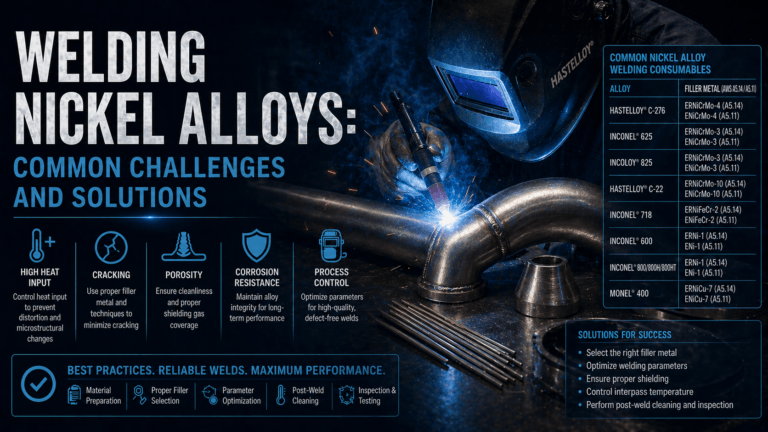
C-2000 and C-276 are readily weldable by GTAW, GMAW and SMAW with qualified procedures, but they use different matching consumables:
- C-2000 bare wire: AWS A5.14 ERNiCrMo-17.
- C-2000 covered electrode: AWS A5.11 ENiCrMo-17.
- C-276 bare wire: AWS A5.14 ERNiCrMo-4.
- C-276 covered electrode: AWS A5.11 ENiCrMo-4.
The Haynes filler-metal tables confirm the matching classifications. Filler selection should account for dilution, dissimilar base metals, weld position, heat input, process contaminants and required corrosion resistance.
Welding controls should include:
- Degreasing and removal of sulfur-, lead- and zinc-bearing contamination.
- Dedicated clean tools and stainless brushes.
- Qualified shielding and purge-gas practice.
- Controlled heat input and interpass temperature.
- Full slag and oxide removal between passes.
- Design that avoids inaccessible crevices and stagnant pockets.
- Inspection of root profile and heat tint.
- Corrosion testing of representative welds when service is critical.
Forming, Machining and Heat Treatment
Both alloys work harden rapidly compared with conventional austenitic stainless steels. Use rigid machines, sharp tooling, positive feed and controlled coolant delivery. Heavy cold forming may require intermediate annealing.
Haynes recommends solution annealing C-276 at about 1121°C (2050°F), followed by water quenching or sufficiently rapid cooling for thin sections. Its brochure recommends re-annealing after cold forming that produces 7% or more outer-fiber elongation when optimum corrosion performance is required. Use the alloy-specific procedure, section size and approved furnace qualification rather than applying the C-276 schedule automatically to C-2000.
Product Forms and Specifications
Both alloys may be ordered under common Ni-Cr-Mo product specifications, provided the UNS number is explicitly included and the current edition covers it.
| Product form | Common specification routes |
|---|---|
| Plate, sheet and strip | ASTM B575 |
| Rod and bar | ASTM B574 |
| Seamless pipe and tube | ASTM B622 |
| Welded pipe | ASTM B619/B619M or project-specific code route |
| Welded tube | ASTM B626 |
| Forgings, flanges, fittings and valves | ASTM B564 |
| Bare welding wire | AWS A5.14 |
| Covered electrodes | AWS A5.11 |
Verify the current edition, dimensions, solution-annealed condition, mechanical requirements, supplementary tests and ASME adoption. “Hastelloy plate” is not a complete purchase description.
Availability and Cost: C-276’s Commercial Advantage
C-276 is more widely specified and stocked. A project can often source plate, sheet, pipe, fittings, flanges, bar and matching filler metal from multiple regions. This installed supply base reduces replacement risk and may shorten delivery.
C-2000 is commercially available in sheet, plate, bar, wire, tubular products and forging stock, as summarized in the Haynes C-2000 alloy-at-a-glance sheet. However, the exact size or fitting may require a mill order. Low-volume projects can face minimum order quantities, campaign timing and a higher premium.
Compare lifecycle cost using:
- raw-material price and alloy surcharge;
- minimum order quantity;
- plate utilization and machining yield;
- pipe, fitting and flange availability;
- matching consumable availability;
- procedure qualification and test coupons;
- corrosion allowance and expected life;
- downtime consequence and spare strategy; and
- future repair or replacement lead time.
C-2000 can be the lower-risk lifecycle choice when its corrosion advantage prevents an outage. C-276 can be the better business choice when its performance is sufficient and the supply chain is materially stronger.
RFQ Checklist for C-2000 or C-276
Include these items in the inquiry:
- UNS N06200 or UNS N10276.
- Current ASTM/ASME/AWS specification and edition.
- Product form, size, tolerance, quantity and surface finish.
- Solution-annealed condition and cooling requirement.
- Complete stream chemistry and contaminant ranges.
- Normal, cleaning, startup, shutdown and upset temperatures.
- Pressure, velocity, solids, aeration and stagnant zones.
- Crevice locations and gasket or deposit conditions.
- Corrosion allowance and design life.
- Welding process and matching filler classification.
- Procedure qualification and welder qualification requirements.
- NDE method, extent and acceptance criteria.
- PMI, heat traceability and EN 10204 certificate type.
- Corrosion-test method, specimen condition and acceptance rate.
- Third-party inspection and document hold points.
- Spare-material and future replacement requirements.
For broader C-276 context, read Inconel 625 vs Hastelloy C-276 and Hastelloy C-276 Corrosion Resistance. For an oxidizing-environment comparison, see Hastelloy C-22 vs C-276.
Frequently Asked Questions
Is Hastelloy C-2000 better than C-276?
Not in every environment. C-2000 offers higher chromium, intentional copper and stronger reported crevice resistance, making it attractive for mixed acids and oxidizing contamination. C-276 has slightly stronger reported pitting performance in the cited ferric-chloride comparison, a longer service record and generally better availability.
Why does C-2000 contain copper?
Copper improves resistance to reducing sulfuric-acid conditions. Combined with high chromium and molybdenum, it allows C-2000 to cover a broad range of reducing and oxidizing process chemistries.
Which alloy is better for hydrochloric acid?
Both are strong candidates. C-276 has a long record in reducing HCl service because of its high molybdenum and tungsten content. C-2000 can perform very well in dilute HCl and mixed or oxidizer-contaminated streams. Concentration, temperature, oxygen and metal ions control the final choice.
Can C-276 filler metal be used on C-2000?
Only with engineering approval. ERNiCrMo-4 does not reproduce C-2000’s high-chromium and copper-bearing chemistry. The weld may have a different corrosion envelope from the base metal. Matching ERNiCrMo-17 is the normal starting point for C-2000.
Which alloy is easier to buy?
C-276 is usually easier to source because it is more widely specified and stocked. C-2000 is available in major wrought forms, but size, quantity, fittings and filler metal should be confirmed before the design is frozen.
Should laboratory corrosion rates be used directly for design?
No. They are valuable screening data, but industrial streams include impurities, heat-transfer effects, crevices, solids, velocity and transients not reproduced in every laboratory test. Use relevant service history, a corrosion specialist or testing with the actual process liquor for critical equipment.
Procurement Recommendation
Specify C-2000 when its high-chromium, copper-bearing design solves a documented mixed-acid, oxidizing-contamination or crevice-corrosion problem. Specify C-276 when its proven broad resistance and supply-chain advantage meet the real process envelope. In both cases, lock the decision to a UNS number, current product specification, matching filler and traceable inspection plan.