Inconel 718 does not have one universal heat-treatment condition. Its solution temperature, aging schedule, cooling route, section size and prior processing determine grain structure, precipitation response, strength, ductility, fatigue behavior and stress-rupture performance. A purchase order that states only “solution treated and aged” may still leave a critical engineering decision undefined.
The correct condition must come from the product specification, drawing and service requirements – not from a generic furnace chart.
Important: The temperatures below summarize widely used Alloy 718 routes. They are not substitutes for the current controlling AMS, ASTM, ASME, API, NACE or customer specification. Use the specified revision, tolerances, hold-time rules, cooling rate, test method and acceptance criteria.
The Short Answer
For high strength, fatigue and stress-rupture performance, Alloy 718 commonly uses a 1700-1850°F solution treatment followed by two-step aging at 1325°F and 1150°F. A 1900-1950°F solution treatment with 1400°F and 1200°F aging can favor transverse ductility and impact performance in heavy sections. Never choose between them by temperature alone; select the governing material condition first.
Common Inconel 718 Heat-Treatment Routes
| Selection point | Lower-temperature solution route | Higher-temperature solution route |
|---|---|---|
| Typical solution range | 1700-1850°F (927-1010°C), then air cool | 1900-1950°F (1038-1066°C), then air cool |
| Typical first aging step | 1325°F (718°C) for 8 hours | 1400°F (760°C) for 10 hours |
| Controlled cooling during aging | Furnace cool toward 1150°F (621°C) | Furnace cool toward 1200°F (649°C) |
| Total aging time | 18 hours | 20 hours |
| Typical property emphasis | High tensile/yield and fatigue strength; strong rupture-property combination | Transverse ductility in heavy sections, impact and low-temperature notch tensile properties |
| Common procurement association | Conditions represented in specifications such as AMS 5662/5663, subject to revision and product form | Conditions represented in specifications such as AMS 5664, subject to revision and product form |
| Important limitation | Exact temperature and tests depend on the specification | Higher solution temperature can change grain size and stress-rupture behavior |
Special Metals notes that a furnace-cooling rate around 100°F (56°C) per hour is sometimes specified between the two aging plateaus, while emphasizing that the specified total aging time must be observed. The current purchase specification controls the actual tolerance and timing.
Why Alloy 718 Responds to Aging
Alloy 718 is a nickel-iron-chromium alloy containing niobium, molybdenum, titanium and aluminum. Its high strength comes primarily from fine strengthening precipitates formed during controlled aging. The Nb-bearing gamma-double-prime phase is particularly important, with gamma-prime also contributing.
This strengthening response is deliberately slower than in some aluminum-titanium-hardened nickel alloys. The slower response helps welding and fabrication because a brief passage through the aging range does not instantly produce full hardness. It does not mean time and temperature are unimportant: aging outside the approved window can produce underaged, overaged or otherwise nonconforming properties.
Other phases also influence behavior. Delta phase can affect grain boundaries, grain growth and forgeability; excessive or poorly controlled precipitation can reduce the balance of strength and ductility. Heat treatment must therefore be understood as microstructure control, not simply “making the part hard.”
Solution Annealing Is Not the Same as Aging
What Solution Treatment Does
Solution treatment prepares the alloy’s microstructure for subsequent aging. Depending on temperature, time and prior processing, it can dissolve precipitates, redistribute strengthening elements, change residual stress and influence grain size.
The phrase “solution annealed” is incomplete without:
- solution temperature and permitted tolerance;
- time at temperature or time-after-load thermocouple recovery;
- cooling method and transfer time;
- starting product form and section thickness;
- prior cold or hot work; and
- applicable material specification and revision.
What Two-Step Aging Does
The first aging plateau develops strengthening precipitates. Controlled furnace cooling and the second lower-temperature hold continue the precipitation sequence and establish the intended property balance. The process is normally completed by air cooling.
Starting the second hold too early, using the wrong total time or treating a heavily loaded furnace as if it were an empty qualification load can change results. Furnace uniformity, load thermocouples, recorder accuracy and calibration are part of product assurance.
1775°F-Type vs 1950°F-Type Conditions
The shorthand “1775 condition” and “1950 condition” is useful in conversation but risky on a purchase order. It can refer to different product specifications, revisions and delivery stages.
Lower-Temperature Solution Treatment
Special Metals describes the 1700-1850°F route with its corresponding aging treatment as the preferred route where rupture life, notch-rupture life and rupture ductility must be balanced. It also produces high room-temperature tensile and yield strength and, with its relatively fine grain, high fatigue strength.
This route is widely associated with aerospace bar, forging, ring, sheet and tubing conditions, but each product form has its own specification. Do not apply a bar schedule automatically to sheet, tube, fastener stock or a welded assembly.
Higher-Temperature Solution Treatment
The 1900-1950°F route can improve transverse ductility in heavy sections, impact strength and low-temperature notch tensile strength. The same Special Metals bulletin warns that this treatment can show a tendency toward notch brittleness in stress-rupture testing.
That tradeoff explains why “higher temperature” does not mean “better heat treatment.” The correct route depends on which properties control the design and which tests the governing specification requires.
Material Specifications Define the Purchasable Condition
For bars, forgings and rings, common references include:
| Specification route | Typical delivery concept | Buyer question |
|---|---|---|
| AMS 5662 | Alloy 718 supplied solution heat treated and precipitation hardenable | Who performs aging, and to which approved schedule? |
| AMS 5663 | Alloy 718 supplied solution and precipitation heat treated using a lower solution-temperature route | Are mechanical, hardness and stress-rupture tests required for this size and lot? |
| AMS 5664 | Alloy 718 supplied after a higher-temperature solution treatment and precipitation hardenable | Is final aging performed by the material producer or part manufacturer? |
| ASTM B637 | Precipitation-hardenable nickel alloy bar, forging and forging stock under the specified grade and condition | Which heat-treatment table, supplementary tests and product dimensions apply? |
The table is a selection aid, not a substitute for the standards. SAE pages show that these specifications are revised over time, so the purchase order should identify the required suffix or revision date. Terms, size limits and test requirements can change.
Sheet, strip, plate, pipe, tube, welding products and finished fasteners may use different specifications. Confirm that the standard covers both UNS N07718 and the ordered product form.
Direct Aging, Solution-and-Age and Re-Heat Treatment
Some forged Alloy 718 products are directly aged after controlled thermomechanical processing. Direct aging can exploit the existing microstructure and cold or hot work to obtain high strength. It is not interchangeable with a solution-and-age route unless the drawing and material specification permit it.
Re-heat treating nonconforming material is also not automatically acceptable. Repeated solution treatment can alter grain size; repeated aging can change precipitation; stripping scale or correcting distortion can reduce dimensions. Any re-treatment should be approved through the applicable nonconformance process and documented on the inspection certificate.
Heat Treatment and Machining Sequence
Alloy 718 is normally easier to machine before precipitation hardening. A practical route often includes rough machining in the solution-treated condition, aging, then finish machining critical features.
However, four risks must be balanced:
- Distortion: Rough machining releases residual stress, while heat treatment adds thermal movement.
- Stock allowance: Too little allowance may not clean up after aging; too much increases aged-material machining time.
- Scale and surface reaction: Open-air heating can create scale that must be removed without violating minimum dimensions.
- Feature sequence: Threads, thin walls, sealing faces and intersecting holes may require different stages.
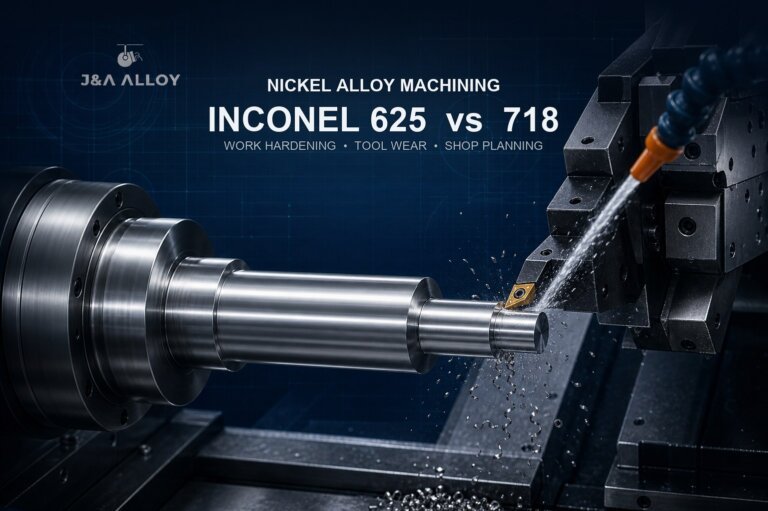
The machining supplier, heat treater and buyer should agree on datum retention, intermediate inspection, allowance and final NDE before the first part is cut. For detailed shop planning, read How to Machine Inconel 625 vs 718.
Furnace and Process-Control Requirements
Temperature Uniformity
A furnace setpoint is not proof that the part experienced the required cycle. Define the applicable pyrometry standard, furnace class, instrumentation type, temperature-uniformity survey and system-accuracy requirements. Aerospace work commonly invokes AMS 2750 through the processing specification or supplier approval system.
Furnace Atmosphere and Cleanliness
Special Metals advises that Alloy 718 be clean and free of oil, paint, grease and shop soil before heating, and that heating fuels be very low in sulfur. Contamination can create surface attack that later machining may not fully remove.
Specify whether heat treatment will occur in air, vacuum, inert gas, protective atmosphere or salt, and define acceptable discoloration, scale removal and alpha-case-like surface concerns where relevant. The suitable route depends on the product and customer specification.
Load Thermocouples and Hold Time
For thick sections, the furnace atmosphere can reach temperature before the part core does. The process specification should define when soak time begins, whether load thermocouples are required and how sensors are attached or located.
Cooling Control
Air cooling after solution treatment and controlled furnace cooling between aging plateaus are common, but section size, load density and airflow affect actual cooling. Record cooling transitions and interruptions. A power failure during the 18- or 20-hour aging cycle needs an approved disposition, not an undocumented restart.
Verification After Heat Treatment
Hardness is useful, but it cannot prove the complete microstructure or every mechanical property. A robust acceptance plan may include:
- furnace chart and heat-treatment traveler review;
- calibration and pyrometry records;
- hardness testing at defined locations;
- room-temperature tensile testing;
- elevated-temperature tensile or stress-rupture testing;
- grain-size or microstructure examination;
- dimensional inspection after thermal processing;
- surface NDE after scale removal; and
- traceability from test specimens to the production lot.
Test frequency, specimen orientation and location matter. A longitudinal coupon from a small bar does not automatically represent the transverse properties of a large forging.
Oil and Gas Sour-Service Conditions Need Separate Review
Alloy 718 used in H2S-containing oil and gas production may be supplied to a special condition with controlled hardness and a heat treatment different from common aerospace schedules. Special Metals describes an oil-field route involving solution treatment around 1850-1900°F and aging at 1450°F for a limited time, but the project-specified edition of NACE MR0175/ISO 15156 and the product standard must control.
“NACE compliant 718” is not a complete purchase description. State the product form, cold work, heat treatment, hardness limit, environmental envelope, inspection and documentation. Compliance for cracking resistance does not establish general-corrosion suitability.
Common Heat-Treatment Errors
The purchase order says only “aged”
This omits the solution condition, aging temperatures, total time, cooling rate and applicable property requirements.
The wrong product-form specification is used
Bar, sheet, tube, forging and finished fastener specifications are not interchangeable even when all identify UNS N07718.
A handbook schedule is treated as the acceptance standard
Technical bulletins provide valuable engineering context, but the manufacturer states that typical data are not specification values. The purchase order must invoke the controlling standard.
Machining allowance ignores heat-treatment movement
Thin walls or asymmetric stock removal can distort. Plan rough and finish allowances with the heat treater and machine shop.
Hardness is accepted as the only proof
Similar hardness can coexist with different grain size, phase balance or stress-rupture response. Require the tests that protect the actual design requirement.
The certificate does not show the complete cycle
The inspection certificate may state a condition without attaching the time-temperature record. Define which records must be submitted and retained.
Heat-Treatment RFQ Checklist
- Alloy designation and UNS N07718.
- Product form, dimensions, weight and quantity.
- Material specification, suffix, revision and required condition.
- Starting condition and complete prior thermal history.
- Required solution temperature, tolerance, soak definition and time.
- Cooling method and maximum transfer time.
- First and second aging temperatures and tolerances.
- Furnace-cooling rate and total aging time.
- Pyrometry and furnace-class requirements.
- Atmosphere, cleanliness and contamination controls.
- Load-thermocouple requirements for thick sections.
- Machining allowance and distortion-control plan.
- Hardness, tensile, stress-rupture and metallographic tests.
- Specimen location, orientation and lot definition.
- NDE stage, method, extent and acceptance criteria.
- Re-treatment and interruption-disposition rules.
- EN 10204 certificate type and required furnace records.
- Marking, traceability and document-retention period.
For certification choices, see EN 10204 3.1 vs 3.2 Certificates. For starting-stock decisions, see Nickel Alloy Forgings: Manufacturing Route, Heat Treatment and Inspection.
Frequently Asked Questions
What is the standard heat treatment for Inconel 718?
There is no single universal schedule. Two common routes use a 1700-1850°F solution treatment with 1325/1150°F aging, or a 1900-1950°F solution treatment with 1400/1200°F aging. The applicable product specification defines the required condition.
Why does Inconel 718 use two aging temperatures?
The two-step cycle controls precipitation of strengthening phases. The first hold initiates and develops precipitation; controlled cooling and the lower hold continue the response to achieve the specified strength-property balance.
What is the difference between AMS 5662 and AMS 5663?
AMS 5662 describes Alloy 718 bar, forgings and rings supplied solution heat treated and precipitation hardenable. AMS 5663 describes product supplied after solution and precipitation heat treatment. Always check the current revisions for exact requirements.
When is AMS 5664 used?
AMS 5664 covers Alloy 718 bars, forgings, rings and related stock using a higher-temperature, approximately 1950°F solution-treated route. It is selected when that specification and its property balance match the component design.
Can Alloy 718 be machined after aging?
Yes, but aged 718 is stronger and generally shortens tool life. Many parts are rough machined before aging and finish machined afterward, with enough allowance for distortion and scale removal.
Does hardness prove that the aging cycle was correct?
No. Hardness is an efficient screening and acceptance test when required, but it does not alone prove grain size, tensile ductility, fatigue capability or stress-rupture performance.
Final Recommendation
Specify Inconel 718 heat treatment as a complete material condition tied to the correct product-form standard and revision. Choose the lower- or higher-temperature solution route from required properties, not habit. Coordinate machining allowances, furnace control, mechanical testing and document review before production.
J&A Alloy can supply Alloy 718 bar, forgings, rings, plate and machining stock in specified solution-treated or aged conditions. Send the product form, size, standard revision, required condition, test scope and certification type so the quotation reflects the complete metallurgical requirement.
References
- Special Metals, INCONEL Alloy 718 technical bulletin.
- SAE International, AMS5662 – solution-treated Alloy 718 bar, forgings and rings.
- SAE International, AMS5663 – solution and precipitation heat-treated Alloy 718.
- SAE International, AMS5664G – 1950°F solution heat-treated Alloy 718.
- ASTM International, ASTM B637 – precipitation-hardening nickel alloy bars, forgings and forging stock.