Inconel 625 and 725 are closely related nickel-chromium-molybdenum-niobium alloys with strong resistance to chloride-bearing and sour environments. Their procurement difference is fundamental: 625 is normally solid-solution strengthened and valued for fabrication, while 725 is age hardenable and selected when much higher yield strength is needed.
Important: NACE MR0175/ISO 15156 compliance depends on product form, condition, hardness, environment and the current edition. A grade name or typical hardness alone does not establish sour-service suitability.
The Short Answer
Choose Alloy 625 (UNS N06625) when corrosion resistance, weldability, availability and as-fabricated reliability dominate. Choose Alloy 725 (N07725) when a similar corrosion-resistance family is needed with far higher age-hardened strength for hangers, fasteners, mandrels or subsurface equipment. Do not substitute without reviewing heat treatment, hardness and qualification requirements.
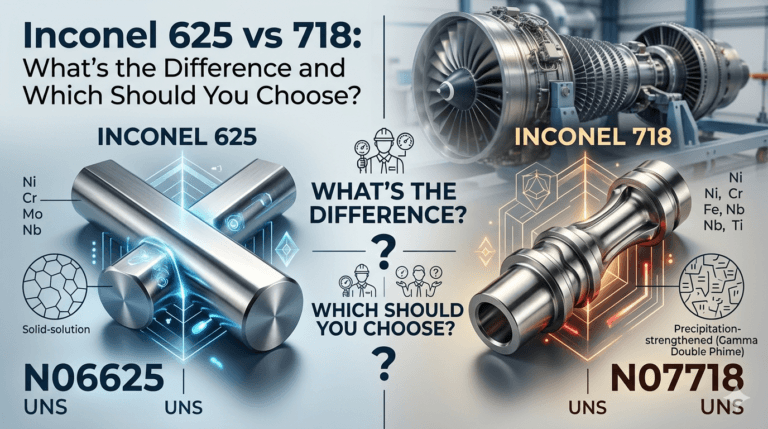
Inconel 625 vs 725 Comparison
| Decision factor | Inconel 625 | Inconel 725 |
|---|---|---|
| UNS | N06625 | N07725 |
| Strengthening | Solid solution from Mo and Nb | Precipitation hardening after solution treatment |
| Typical supply condition | Annealed/solution annealed | Solution annealed and aged as specified |
| Relative strength | Moderate-to-high | Approximately twice annealed 625 according to manufacturer overview |
| Fabrication | Excellent weldability and broad product availability | Heat-treatment control is central; welding route needs application review |
| Typical use | Piping, bellows, weld overlays, marine and chemical equipment | Sour-gas components, high-strength marine fasteners, hangers and subsurface hardware |
| Main risk | Under-strength if selected for a high-load compact part | Incorrect aging or hardness condition can invalidate service qualification |
Why 725 Becomes Stronger
Alloy 625 obtains useful strength from molybdenum and niobium in the nickel matrix and normally requires no precipitation-aging step. This makes its properties comparatively stable through common fabrication routes and supports its reputation for weldability.
Alloy 725 modifies the chemistry so controlled heat treatment forms strengthening precipitates. Special Metals describes age-hardened 725 as having strength approximately twice that of annealed 625 while maintaining comparable corrosion resistance in many environments. Published room-temperature values around 900 MPa yield strength and 1,240 MPa tensile strength illustrate the level achievable in tested forms, but they are typical—not purchase-order guarantees.
Corrosion Resistance Is Similar, Not Identical
Both alloys use high nickel, chromium and molybdenum to resist pitting, crevice corrosion and many reducing/oxidizing environments. That makes both candidates for seawater, brines and oil-and-gas service. However, corrosion performance also depends on:
- actual chemical composition and microstructure;
- solution and aging condition;
- temperature, chloride concentration and pH;
- hydrogen sulfide partial pressure;
- elemental sulfur or other oxidants;
- galvanic coupling and crevice geometry; and
- surface condition and residual stress.
A laboratory statement that 725 is “comparable to 625” is not a blanket substitution rule. Qualification must represent the environment and stressed condition of the component.
Heat Treatment of Alloy 725
A representative manufacturer route includes solution annealing near 1900°F (1040°C), followed by controlled aging. One published sour-gas cycle uses 1350°F (730°C) for 8 hours, furnace cooling at 100°F (56°C) per hour to 1150°F (620°C), holding for 8 hours and air cooling.
The exact specification controls permissible temperatures, tolerances and time. Section size and furnace load affect response. An RFQ should therefore state whether the supplier delivers solution-treated stock, fully aged material or a machined part that will be aged later.
For Alloy 625, a precipitation-aging step is generally not the basis of the grade. Heating during fabrication can still affect grain size, carbide precipitation, oxide condition and corrosion response, so the specified anneal and welding procedure remain important.
Sour-Service Selection
Alloy 725 was developed for high-strength sour-gas applications and is cited in manufacturer literature as approved under NACE MR0175. The current ISO 15156/MR0175 tables, restrictions and qualification routes must nevertheless be checked for the exact product.
Critical variables include maximum hardness, cold work, heat treatment, environmental limits and stress. If the component falls outside a listed condition, additional qualification may be necessary. The MTC should not simply say “NACE compliant”; it should identify the applicable edition, condition, hardness results and any environmental limitations.
Read J&A Alloy’s Nickel Alloys in Oil & Gas for the wider selection context.
Welding and Repair
625 is widely used as wrought product, weld metal and cladding because it tolerates fabrication well. 725 can be joined, but a welded high-strength component requires a qualified plan for weld-metal strength, heat-affected-zone response, postweld aging and corrosion qualification.
Do not assume an Alloy 625 filler will reproduce aged 725 base-metal strength. It may be chosen for corrosion and weldability, but joint efficiency and load path must be calculated. Likewise, local repair heating can create nonuniform aging. Critical 725 parts should define repair limits before production.
For fabrication controls, see How to Weld Inconel 625.
When to Specify Each Alloy
Prefer 625 When
- the assembly contains substantial welding or forming;
- corrosion resistance is more important than maximum yield strength;
- pipe, tube, sheet, plate or weld overlay is required;
- the design benefits from broad availability and simpler heat-treatment logistics; or
- failure is governed by corrosion, fatigue flexibility or weld integrity rather than compact-section strength.
Prefer 725 When
- a compact component must carry high tensile or bearing load;
- an age-hardened bar, forging, ring or fastener condition is qualified;
- sour-service restrictions can be met and documented;
- reduced section size or weight offsets the added processing cost; or
- the application is a hanger, mandrel, connector or high-strength marine fastener.
For a neighboring strength comparison, read Inconel 718 vs Inconel 625.
MTC and RFQ Checklist
- UNS N06625 or N07725 and trade-name equivalence.
- Product form, size, drawing and quantity.
- ASTM, API, AMS or customer specification and revision.
- Melt route and remelt requirements.
- Supplied heat-treatment condition and complete furnace cycle.
- Required tensile, yield, elongation, reduction and hardness.
- Test direction and specimen location in a forging or bar.
- Current ISO 15156/NACE MR0175 edition and environmental limits.
- Corrosion, SCC or hydrogen-embrittlement qualification.
- Welding, repair and postweld heat-treatment rules.
- Ultrasonic, liquid-penetrant or other NDE.
- EN 10204 3.1/3.2 certification and full heat traceability.
Frequently Asked Questions
Is Inconel 725 more corrosion resistant than 625?
Not universally. Manufacturer data describe broadly comparable resistance in many media. Actual performance depends on environment, heat treatment, stress and surface condition.
Is Alloy 725 always twice as strong as Alloy 625?
No. “Approximately twice” is a useful manufacturer summary for age-hardened 725 versus annealed 625. Guaranteed values depend on specification, size, form and condition.
Can 725 replace 718 in sour service?
Sometimes, but not automatically. 725 was developed for strength plus corrosion resistance, while 718 has different chemistry, heat treatment and qualification limits. Engineering review is required.
Can Alloy 725 be welded with 625 filler?
It may be used in qualified procedures, but the weld metal will not automatically match aged 725 strength. Joint design and service qualification control.
What must “NACE compliant” mean on a 725 order?
The order should state the current standard edition, allowed condition, hardness, environment and required test or certification—not only the phrase itself.
Final Recommendation
Use 625 for fabrication-friendly corrosion resistance and 725 when verified age-hardened strength creates real design value. Send J&A Alloy the drawing, load, environment, specification, heat-treatment condition, NACE/ISO 15156 limits, NDE and certificate requirements for an accurate quotation.