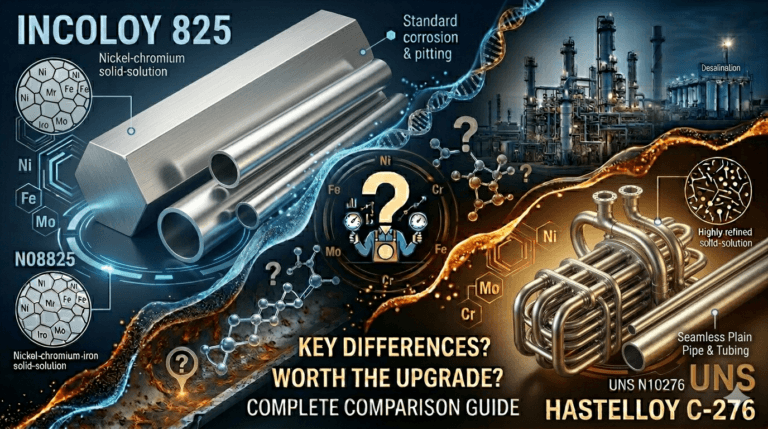
Alloy 20 and Incoloy 825 are iron-nickel-chromium alloys developed for acid service, but they are not interchangeable. Alloy 20 (UNS N08020) is closely associated with sulfuric-acid equipment and uses relatively high copper plus niobium stabilization. Incoloy 825 (UNS N08825) contains more nickel, molybdenum and titanium, giving it a broader resistance profile in chlorides, phosphoric acid and mixed process streams.
Direct answer: Choose Alloy 20 when a proven sulfuric-acid concentration and temperature window, fabrication route and local availability support it. Choose Incoloy 825 when the equipment must also tolerate chlorides, seawater, phosphoric acid or a wider range of oxidizing and reducing conditions. Neither alloy should be selected from the acid name alone; verify concentration, temperature, aeration and contaminants with corrosion data or testing.
Alloy 20 vs Incoloy 825 at a Glance
| Selection factor | Alloy 20 | Incoloy 825 |
|---|---|---|
| UNS number | N08020 | N08825 |
| Alloy family | Fe-Ni-Cr-Mo-Cu, niobium stabilized | Ni-Fe-Cr-Mo-Cu, titanium stabilized |
| Nickel range | Approximately 32-38% depending on specification | 38-46% |
| Chromium range | Approximately 19-21% | 19.5-23.5% |
| Molybdenum range | Approximately 2-3% | 2.5-3.5% |
| Copper range | Approximately 3-4% | 1.5-3.0% |
| Primary selection strength | Established sulfuric-acid service and economical fabricated equipment | Broader acid, chloride and seawater resistance |
| Stabilizing element | Niobium | Titanium |
| Chloride SCC resistance | Better than conventional 300-series stainless steels | Generally stronger selection for chloride-bearing service |
| Typical availability | Common in chemical-processing plate, pipe, fittings and valves, but region dependent | Broad nickel-alloy product range; verify size and lead time |
| Cost tendency | Often lower alloy cost, subject to form and quantity | Usually higher because of greater nickel content |
The table is a screening tool, not a corrosion guarantee. Small changes in sulfuric-acid concentration, temperature, oxygen, ferric ions, chlorides or process carryover can reverse a simple ranking.
Why Sulfuric Acid Does Not Produce One Universal Winner
Sulfuric acid changes from strongly reducing to more oxidizing behavior as concentration and temperature vary. Dilution, startup water, shutdown condensation and evaporation can move equipment through several corrosion regimes even when the normal operating concentration looks stable.
Selection should therefore begin with a complete stream description:
- Minimum, normal and maximum acid concentration.
- Minimum, normal and upset temperature.
- Aeration, dissolved oxygen and agitation.
- Chloride, fluoride, ferric-ion, cupric-ion and nitric-acid contamination.
- Flow velocity, solids, crevices and vapor-liquid interfaces.
- Startup, cleaning, shutdown and stagnant conditions.
The official Special Metals aqueous-corrosion handbook presents separate iso-corrosion information for Alloy 020 and Alloy 825. Those diagrams are more useful than a single statement that either material is “sulfuric-acid resistant,” but they still represent controlled test conditions. A final design should use project-specific experience, a corrosion specialist or coupon testing when failure consequences are significant.
Composition: What Copper, Nickel, Molybdenum and Stabilizers Do
Alloy 20: Higher Copper for Sulfuric-Acid Service
The Special Metals Alloy 020 bulletin identifies UNS N08020 as a corrosion-resistant alloy for chemical environments containing sulfuric acid. Its relatively high copper content supports resistance in reducing sulfuric-acid conditions, while chromium and molybdenum support passivation and localized-corrosion resistance.
Niobium stabilization reduces the tendency for chromium carbide precipitation to impair intergranular corrosion resistance after welding or thermal exposure. That does not eliminate the need for qualified welding procedures, correct filler metal, cleanliness and heat-input control.
Incoloy 825: More Nickel and a Broader Environmental Envelope
The Special Metals Alloy 825 bulletin lists 38-46% nickel, 19.5-23.5% chromium, 2.5-3.5% molybdenum, 1.5-3.0% copper and titanium stabilization. Nickel improves resistance to chloride-ion stress-corrosion cracking. Molybdenum helps with pitting and reducing media, while chromium supports oxidizing resistance.
Titanium stabilization is particularly relevant to fabricated equipment because it helps preserve resistance to intergranular attack. Alloy 825 is therefore often considered where sulfuric acid is only one part of a more complicated environment involving phosphoric acid, chlorides, seawater or oxidizing contamination.
When Alloy 20 Is Usually the Better Starting Point
Alloy 20 is a strong candidate when:
- the main corrosion problem is sulfuric acid within a documented operating window;
- the plant has successful service history with UNS N08020;
- plate, pipe, fittings, valves and weld consumables are locally available;
- the fabrication shop already has qualified Alloy 20 procedures; and
- lifecycle analysis does not justify a higher-nickel alloy.
It is widely used for pickling equipment, acid tanks, process piping, heat exchangers, pumps, valves, pharmaceuticals and chemical production. However, “sulfuric acid” is not sufficient justification. Hot dilute acid, acid contaminated with chlorides or oxidizers, crevices under deposits and acid concentration at heat-transfer surfaces may require a different material.
When Incoloy 825 Is Usually the Better Starting Point
Incoloy 825 is a stronger candidate when:
- sulfuric acid is combined with phosphoric acid or chloride contamination;
- seawater, brine or wet chloride exposure occurs during normal or cleaning service;
- chloride stress-corrosion cracking is a key concern;
- the equipment sees a wider range of process chemistries; or
- the project already standardizes on UNS N08825 product forms and welding consumables.
The alloy is common in acid production, pollution-control systems, chemical-processing equipment, marine systems and oil-and-gas service. For sour service, alloy selection must also comply with the governing NACE MR0175/ISO 15156 requirements and the exact material condition; general corrosion resistance alone does not establish sour-service acceptability.
Sulfuric Acid, Chlorides and Mixed Contamination
Pure Sulfuric Acid
In controlled sulfuric acid, Alloy 20 can be the more economical and well-established solution. Higher copper is one reason it performs effectively in many reducing sulfuric-acid regimes. Incoloy 825 also has strong sulfuric-acid resistance, but its higher nickel and broader composition may not create enough additional value if the service is stable and chloride-free.
Sulfuric Acid with Chlorides
Chlorides introduce pitting, crevice corrosion and stress-corrosion cracking concerns that are not captured by a general corrosion rate. Incoloy 825’s higher nickel and molybdenum content normally make it the more conservative screening choice, especially when crevices, deposits or stagnant zones cannot be eliminated.
Oxidizing Contaminants
Ferric ions, dissolved oxygen, nitric-acid carryover and oxidizing salts can change the corrosion mechanism. Chromium helps both alloys, but the actual concentration-temperature-contaminant combination must be checked. A material that performs well in reagent-grade acid may behave differently in a recycled industrial stream.
Phosphoric Acid and Impure Wet-Process Acid
Wet-process phosphoric acid can contain fluorides, chlorides and solids. Incoloy 825 is often considered because of its combined acid and chloride resistance. Severe fluoride contamination or high temperatures may push the selection toward a higher Ni-Cr-Mo alloy. Coupon testing using the actual plant liquor is valuable when impurity levels fluctuate.
Mechanical Properties and Temperature Limits
Both alloys are ductile and fabricable in the annealed condition, but neither should be treated as a high-temperature creep alloy. The Alloy 825 bulletin warns that exposure above about 1000°F (540°C) can produce microstructural changes that reduce ductility and impact strength; it is not normally selected where creep-rupture properties control.
For pressure equipment, use allowable stresses from the governing design code and product specification rather than typical tensile data from a brochure. Confirm whether the quoted product is solution annealed, cold worked or supplied in another condition, because condition affects strength, hardness, forming and corrosion performance.
Welding and Fabrication
Both alloys can be welded by GTAW, GMAW, SMAW and other qualified processes. The important procurement question is not simply “Is it weldable?” but whether the complete joint has the required corrosion resistance.
Control these variables:
- base-metal specification and heat condition;
- matching or over-alloyed filler-metal classification;
- sulfur, phosphorus, lead, zinc and shop contamination;
- joint geometry, root access and shielding;
- heat input, interpass temperature and cleaning;
- crevice geometry at backing rings, gaskets and lap joints; and
- post-fabrication pickling, passivation and inspection.
Do not substitute Alloy 20 and Alloy 825 filler metals without engineering approval. Dilution, dissimilar-metal contact and the service chemistry determine whether a nominally “more alloyed” weld deposit is actually suitable.
Product Specifications: Verify the Current Edition
UNS identifies chemistry; it does not define dimensions, heat treatment, tolerances or testing. A purchase order should pair the UNS number with a current product-form specification.
Common references include:
| Product form | Alloy 20 / N08020 references | Incoloy 825 / N08825 references |
|---|---|---|
| Plate, sheet and strip | Historically ASTM B463; N08020 also appears in some stainless plate specifications and code routes | ASTM B424 |
| Rod and bar | ASTM B473 | ASTM B425 |
| Seamless pipe and tube | Historically ASTM B729 and related requirements | ASTM B423 |
| Welded pipe | Historically ASTM B464/B464M or project-specific alternatives | ASTM B705 |
| Forgings, flanges and fittings | Historically ASTM B462 and code-specific requirements | ASTM B564 |
Important: several N08020 ASTM specifications were withdrawn or changed during 2025-2026, including ASTM B463 and B464/B464M. A withdrawn standard does not automatically make existing certified material unusable, but it does mean the buyer must check the project code, replacement route, contract edition and regulator requirements before placing a new order. Do not silently replace a specified edition.
Availability, Cost and Total Installed Risk
Alloy 20 often has a lower raw-material cost because it contains less nickel. That advantage can disappear if the required size, wall, forging or fitting is not stocked. Incoloy 825 may provide better global availability in some nickel-alloy supply chains, while Alloy 20 may be easier to source through chemical-process and stainless-alloy distributors.
Compare total installed cost, not price per kilogram:
- minimum order quantity and mill campaign timing;
- plate nesting and machining yield;
- pipe, fitting and flange availability;
- matching filler-metal availability;
- welding procedure qualification;
- corrosion allowance and expected service life;
- shutdown and replacement cost; and
- third-party inspection and documentation.
A slightly more expensive alloy is justified when it reduces credible failure risk. Over-alloying is wasteful when the actual process envelope is narrow and proven.
RFQ Checklist for Alloy 20 or Incoloy 825
Send suppliers and fabricators the following information:
- UNS number: N08020 or N08825.
- Current product specification and edition.
- Product form, dimensions, tolerances and quantity.
- Required solution-annealed or other delivery condition.
- Design code and allowable-stress basis.
- Full chemical stream composition and contaminant limits.
- Normal, startup, shutdown and upset temperatures.
- Pressure, velocity, aeration and solids content.
- Welding process and filler-metal requirements.
- NDE method, extent and acceptance criteria.
- Hydrostatic, pneumatic, PMI or corrosion-test requirements.
- EN 10204 certificate type and complete heat traceability.
- Positive material identification stage and sampling plan.
- Surface finish, pickling, passivation and cleanliness.
- Third-party inspection, hold points and document approval.
For certificate selection, see EN 10204 3.1 vs 3.2 Certificates. For a related nickel-alloy comparison, read Inconel 625 vs Incoloy 825. J&A Alloy’s Incoloy 825 product page lists available product forms and common specifications.
Frequently Asked Questions
Is Alloy 20 better than Incoloy 825 in sulfuric acid?
Not universally. Alloy 20 is an established and often economical choice in many sulfuric-acid concentration-temperature ranges. Incoloy 825 may be better when chlorides, phosphoric acid, seawater or variable contamination broaden the corrosion problem. Use iso-corrosion data and actual service conditions rather than a universal ranking.
Is Alloy 20 a stainless steel or a nickel alloy?
Alloy 20 is commonly described as a superaustenitic stainless alloy or an iron-nickel-chromium corrosion-resistant alloy. Its nickel content is much higher than conventional stainless steels but lower than many nickel-base alloys. For procurement, the unambiguous designation is UNS N08020 plus the applicable product specification.
Can Alloy 20 and Incoloy 825 be welded together?
They can be joined with a qualified dissimilar-metal procedure, but filler selection and dilution must be evaluated for the service environment. A successful mechanical weld is not automatically corrosion resistant. Engineering approval, procedure qualification and representative corrosion testing may be required.
Which alloy is better for chloride stress-corrosion cracking?
Incoloy 825 is generally the stronger screening choice because of its higher nickel content. However, chloride concentration, temperature, stress, crevice geometry and contamination still control risk. Neither alloy should be called immune under all conditions.
Which alloy is cheaper?
Alloy 20 often costs less per kilogram, but availability can dominate the final price. Compare finished component cost, qualification, filler metal, yield loss, inspection, lead time and expected service life instead of using only the mill alloy price.
What must appear on the purchase order?
State UNS number, current product-form specification and edition, dimensions, condition, testing, certificate type, traceability, surface requirements and inspection hold points. Include the actual process environment when asking the supplier for material-selection input.
Procurement Recommendation
Select Alloy 20 for a documented sulfuric-acid window where its service history, fabrication route and supply chain are established. Select Incoloy 825 when the equipment must cover a broader acid and chloride envelope. Before purchase, validate the stream chemistry, confirm the current specification route and convert the material choice into a complete, traceable RFQ.