Quick answer: 17-4PH stainless steel, also known as UNS S17400, AISI 630 and W.Nr. 1.4542, is a martensitic precipitation-hardening stainless steel that combines high strength, moderate corrosion resistance and good machinability in the solution-annealed condition. Common aging conditions include H900, H1025, H1075 and H1150; hardness and tensile strength generally decrease as aging temperature increases, while toughness and ductility improve.
| Material | 17-4PH Stainless Steel |
|---|---|
| UNS | S17400 |
| AISI / Type | 630 / 17-4 precipitation-hardening stainless steel |
| EN / W.Nr. | 1.4542 |
| Alloy type | Martensitic precipitation-hardening stainless steel |
| Key heat treatments | Condition A, H900, H925, H1025, H1075, H1100, H1150, H1150M |
| Common standards | ASTM A564, ASTM A693, ASTM A705, AMS 5604, AMS 5643, AMS 5528, AMS 5678 |
| Available forms | Bar, plate, sheet, strip, wire, forgings and machined components |
Among precipitation-hardening stainless steels, 17-4PH (UNS S17400, AMS 5604, ASTM A564) holds a unique position. It delivers tensile strengths exceeding 1,300 MPa — comparable to some low-alloy quenched-and-tempered steels — while maintaining the corrosion resistance of a 400-series martensitic stainless steel. Unlike most precipitation-hardening alloys, 17-4PH is available in all standard product forms, machines readily in the solution-annealed condition, and requires only a simple single- or two-step aging treatment to reach its final properties. These characteristics have made it one of the most widely specified PH stainless steels in aerospace, chemical processing, oil and gas, and power generation. This article explains the alloy’s metallurgy, compares its heat treatment conditions in detail, and provides practical guidance on selecting the right condition for your application.
Composition and the Metallurgical Basis for Precipitation Hardening
Nominal composition of 17-4PH (UNS S17400):
| Element | Specification | Typical Heat |
|---|---|---|
| Chromium | 15.0–17.5% | 16.0% |
| Nickel | 3.0–5.0% | 4.0% |
| Copper | 3.0–5.0% | 3.5% |
| Columbium + Tantalum (Nb+Ta) | 0.15–0.45% | 0.30% |
| Manganese | ≤1.00% | 0.70% |
| Silicon | ≤1.00% | 0.40% |
| Carbon | ≤0.070% | 0.040% |
| Phosphorus | ≤0.040% | 0.025% |
| Sulfur | ≤0.030% | 0.010% |
| Iron | Balance | ~73% |
Equivalent Grades and Standards of 17-4PH Stainless Steel
Many buyers search this alloy by specification rather than by the 17-4PH name. The table below connects the most common commercial and engineering names used on drawings, material lists and purchase orders.
| Designation | Common reference | Notes |
|---|---|---|
| 17-4PH | Commercial alloy name | Most common purchasing name |
| UNS S17400 | Unified Numbering System | Used in ASTM and international specifications |
| AISI 630 / Type 630 | Stainless steel grade | Often used for bar, shaft and machined part drawings |
| W.Nr. 1.4542 | European material number | Common in EN and European drawings |
| AMS 5604 | Sheet, strip and plate | Aerospace material specification |
| AMS 5643 | Bars, wire, forgings and rings | Aerospace material specification |
| AMS 5528 | Sheet and strip | Often searched as 17-4PH AMS 5528 |
| ASTM A564 | Hot-finished and cold-finished age-hardening stainless steel bars and shapes | Common bar and shaft supply standard |
| ASTM A693 | Precipitation-hardening stainless steel plate, sheet and strip | Common flat product standard |
How the precipitation hardening mechanism works
17-4PH is a martensitic stainless steel — but a special one. Its chromium content (15–17.5%) provides solid corrosion resistance. The nickel addition reduces the martensite transformation temperature (Ms) enough to ensure that the microstructure transforms to martensite upon air cooling from the solution-annealing temperature, without requiring quench hardening. The copper and columbium additions are the key to precipitation hardening.
Step 1 — Solution annealing (typically 1,038°C / 1,900°F, air cool): The material is heated above the austenitizing temperature, dissolving all precipitates into the austenite matrix. Air cooling transforms the microstructure to low-carbon martensite with high dislocation density. In this condition, 17-4PH is relatively soft (approximately 36–40 HRC) and ductile — suitable for machining, forming, and fabrication.
Step 2 — Age hardening (typically 480–620°C): During aging, copper atoms precipitate as fine, coherent Cu-rich particles (diameter 5–20 nm). These nanoscale precipitates impede dislocation motion, dramatically increasing yield strength and hardness. The columbium-tantalum carbides (NbC, TaC) that form at grain boundaries also contribute to strength and provide resistance to grain boundary cracking.
The result: a microstructure with martensite matrix strength + coherent copper precipitate strengthening + grain boundary carbide pinning. This combination delivers high strength without the brittleness of conventional high-carbon martensitic stainless steels.
Heat Treatment Conditions: A Condition-by-Condition Guide
17-4PH is specified using a heat treatment condition designation (H900, H925, H1025, etc.). Each condition specifies a different aging temperature and time, producing a different balance of strength, hardness, and toughness.
17-4PH Hardness by Heat Treatment Condition
For searchers comparing 17-4PH H900, H1025 and H1150, hardness is usually the fastest way to understand the trade-off. Actual values depend on product form, size, governing standard and test method, but the ranges below are useful for early material selection.
| Condition | Aging temperature | Typical hardness | Selection note |
|---|---|---|---|
| Condition A | Solution annealed | Approx. 36-40 HRC | Best for machining and fabrication before final aging |
| H900 | 900F / 482C | 40-47 HRC | Maximum strength and hardness |
| H925 | 925F / 496C | 36-44 HRC | High strength with slightly improved toughness |
| H1025 | 1025F / 552C | 32-40 HRC | Balanced strength, toughness and corrosion resistance |
| H1075 | 1075F / 580C | 28-36 HRC | Better ductility and toughness than H900 |
| H1100 | 1100F / 593C | 24-34 HRC | Used where toughness and stress relaxation resistance matter |
| H1150 | 1150F / 621C | 20-30 HRC | Maximum dimensional stability and toughness among common aging conditions |
The condition system explained
The aging temperature determines the trade-off between strength and toughness:
- Lower aging temperature (H900 at 480°C): Maximum strength and hardness. Fine copper precipitates are small and densely distributed. Toughness is lower.
- Higher aging temperature (H1150 at 620°C): Lower strength but significantly improved toughness and ductility. Copper precipitates coarsen and the martensite matrix softens.
Condition H900 (480°C / 900°F, 1 hour)
The most commonly specified condition when maximum strength is the priority.
- Tensile strength: 1,310–1,500 MPa (190–217 ksi)
- Yield strength (0.2% offset): 1,170–1,310 MPa (170–190 ksi)
- Elongation (% in 50mm): 10–16%
- Hardness: 40–47 HRC
- Notch tensile ratio: ~0.90 (good notch toughness)
- Microstructure: Lath martensite + Cu-rich precipitates + NbC grain boundary carbides
Best for: High-strength fasteners, spline shafts, aerospace structural components where strength is the primary requirement.
Condition H925 (496°C / 925°F, 4 hours)
A slight step back from H900 — slightly lower strength in exchange for improved notch toughness and ductility.
- Tensile strength: 1,240–1,380 MPa (180–200 ksi)
- Yield strength: 1,070–1,240 MPa (155–180 ksi)
- Elongation: 12–18%
- Hardness: 36–44 HRC
Best for: Applications requiring slightly better toughness than H900 while maintaining high strength — pump shafts, valve stems.
Condition H1025 (566°C / 1,050°F, 4 hours)
The most commonly specified “general purpose” condition, offering a balanced combination of strength, toughness, and ductility.
- Tensile strength: 1,100–1,240 MPa (160–180 ksi)
- Yield strength: 930–1,070 MPa (135–155 ksi)
- Elongation: 14–20%
- Hardness: 32–40 HRC
Best for: The widest range of applications: chemical processing equipment, pump shafts, valve bodies, nuclear fuel assembly components.
Condition H1075 (580°C / 1,075°F, 4 hours)
Further softening for improved fabrication and dimensional stability.
- Tensile strength: 1,000–1,140 MPa (145–165 ksi)
- Yield strength: 790–970 MPa (115–140 ksi)
- Elongation: 16–22%
- Hardness: 28–36 HRC
Condition H1100 (593°C / 1,100°F, 4 hours)
For applications requiring maximum toughness and resistance to stress relaxation.
- Tensile strength: 930–1,070 MPa (135–155 ksi)
- Yield strength: 690–880 MPa (100–128 ksi)
- Elongation: 18–24%
Condition H1150 (621°C / 1,150°F, 4 hours)
For maximum dimensional stability and toughness; often specified for nuclear reactor components.
- Tensile strength: 850–1,000 MPa (123–145 ksi)
- Yield strength: 520–760 MPa (75–110 ksi)
- Elongation: 20–28%
Condition H1150M (760°C + 621°C double aging)
A two-step treatment introduced for improved toughness in nuclear applications:
- First step: 760°C (1,400°F) for 2 hours — stabilizes the microstructure, partially reverts some martensite to austenite
- Second step: 621°C (1,150°F) for 4 hours — precipitates copper in the stabilized structure
- Tensile strength: 730–880 MPa (106–128 ksi)
- Yield strength: 385–590 MPa (56–86 ksi)
- Elongation: 18–30%
Best for: Nuclear reactor internal components, applications where dimensional stability during long-term elevated-temperature service is critical.
Condition A (Solution Annealed)
- Tensile strength: 790–1,000 MPa (115–145 ksi)
- Yield strength: 415–620 MPa (60–90 ksi)
- Elongation: 18–30%
- Hardness: 36–40 HRC (as-quenched martensite)
Used for intermediate fabrication stages where machining or forming requires the softest condition. Final aging is performed after fabrication is complete.
Heat treatment comparison summary
| Condition | Aging Temp | Tensile (MPa) | Yield (MPa) | Elongation | Hardness (HRC) | Primary Use |
|---|---|---|---|---|---|---|
| H900 | 480C/900F | 1,310–1,500 | 1,170–1,310 | 10–16% | 40–47 | Maximum strength fasteners |
| H925 | 496C/925F | 1,240–1,380 | 1,070–1,240 | 12–18% | 36–44 | High-strength shafts |
| H1025 | 566C/1,050F | 1,100–1,240 | 930–1,070 | 14–20% | 32–40 | General purpose (most common) |
| H1075 | 580C/1,075F | 1,000–1,140 | 790–970 | 16–22% | 28–36 | Improved toughness |
| H1100 | 593C/1,100F | 930–1,070 | 690–880 | 18–24% | 24–34 | Stress relaxation resistance |
| H1150 | 621C/1,150F | 850–1,000 | 520–760 | 20–28% | 20–30 | Dimensional stability |
| H1150M | 760+621C | 730–880 | 385–590 | 18–30% | — | Nuclear applications |
| A | Annealed | 790–1,000 | 415–620 | 18–30% | 36–40 | Machining/fabrication |
Corrosion Resistance: How It Compares to 316 and Other Stainless Steels
17-4PH is classified as a martensitic precipitation-hardening stainless steel, not an austenitic stainless steel. Its corrosion resistance is determined by its chromium content (15–17.5%) and the specific microstructure after aging.
General corrosion behavior
In atmospheric and fresh water: 17-4PH performs comparably to Type 410 martensitic stainless steel — significantly better than carbon steel, but less resistant than the austenitic 300-series (304/316).
In chloride environments: 17-4PH is more susceptible to pitting and crevice corrosion than 316L stainless steel due to its lower chromium content and the presence of copper precipitates. The threshold chloride concentration for pitting initiation in 17-4PH is approximately 100–200 ppm at room temperature — compared to approximately 1,000 ppm for 316L. This means 17-4PH is not suitable for seawater or high-chloride process streams without protective coatings.
In mild acid environments: 17-4PH handles dilute sulfuric acid and dilute nitric acid reasonably well in the H1025–H1150 conditions. In the high-strength H900 condition, stress corrosion cracking (SCC) can occur in chloride environments above approximately 50°C.
H900 vs H1025: Which condition has better corrosion resistance?
In general, the higher-temperature aging conditions (H1025 and above) provide better corrosion resistance than H900, because:
- The martensite matrix is softer and more chemically homogeneous
- The copper precipitates are larger and more widely spaced (less galvanic effect)
- Less residual stress from the lower aging temperature
For applications where both strength and corrosion resistance are required, H1025 or H1075 are often the better choice than H900.
17-4PH vs 316L: Direct comparison
| Property | 17-4PH (H1025) | 316L Austenitic SS |
|---|---|---|
| Tensile strength | 1,100–1,240 MPa | 485–690 MPa |
| Yield strength | 930–1,070 MPa | 170–310 MPa |
| Hardness | 32–40 HRC | 79–90 HRB (~16 HRC) |
| Corrosion resistance | Moderate (martensitic SS) | Excellent (austenitic SS) |
| Chloride pitting threshold | ~100–200 ppm | ~1,000 ppm |
| Max service temperature | ~350°C | ~870°C (intermittent) |
| Magnetic | Yes (martensitic) | No (austenitic) |
| Weldability | Good (ERNiCrMo-3) | Excellent |
| Machinability (annealed) | Good | Fair |
Bottom line: 17-4PH is chosen when strength is the primary requirement and corrosion resistance is moderate. 316L is chosen when corrosion resistance is the primary requirement and strength requirements are moderate. For applications requiring both high strength and excellent corrosion resistance, consider superaustenitic stainless steels (254 SMO, 904L) or nickel alloys (Inconel 625).
Mechanical Properties at Elevated and Cryogenic Temperatures
Elevated temperature behavior
17-4PH is not designed for sustained high-temperature service. Its aging treatment optimizes room-temperature properties. However, it retains useful strength to approximately 350°C.
Short-term elevated temperature tensile (H1025 condition):
| Temperature | Tensile (% of RT) | Yield (% of RT) |
|---|---|---|
| Room temperature | 100% | 100% |
| 200C (392F) | ~90% | ~85% |
| 300C (572F) | ~80% | ~75% |
| 400C (752F) | ~60% | ~55% |
For sustained service above 350C, consider Inconel 718, Waspaloy, or AISI 630 (which has similar composition to 17-4PH but better elevated-temperature stability).
Cryogenic temperature behavior
17-4PH is not typically specified for cryogenic service. However, in the H1150M condition (double-aged for maximum toughness), it has been used in nuclear reactor internal components where neutron embrittlement resistance is a consideration. Impact toughness in the H1025 condition at -40C remains acceptable (approximately 40–60 J Charpy V-notch).
17-4PH H900 vs H1025 vs H1150 Selection Guide
| Condition | Best Starting Use | RFQ Notes |
|---|---|---|
| H900 | Maximum strength and hardness for shafts, fasteners and precision components. | Confirm hardness, toughness and corrosion exposure because peak strength may reduce toughness. |
| H1025 / H1075 | Balanced strength and toughness for aerospace, valve, pump and structural parts. | Useful when both mechanical strength and toughness matter. |
| H1150 | Improved toughness and stress-corrosion resistance where very high strength is not the only target. | Common for larger sections, pressure-related parts and demanding service conditions. |
Common Applications
Aerospace: Landing gear components, helicopter rotor blade fixtures, aircraft structural fittings, high-strength fasteners, pump and valve parts for hydraulic systems.
Chemical and petrochemical: Pump shafts and impellers, valve stems and seats, agitator shafts, process control instrument components, fasteners in chloride-containing environments (with coating or in H1075/H1150 condition).
Oil and gas: Downhole packer components, subsurface safety valve parts, high-pressure wellhead components, subsea valve trim where strength and moderate corrosion resistance are both required.
Nuclear: Reactor internal components, fuel assembly hardware, control rod drive mechanisms (in H1150M condition for dimensional stability under neutron irradiation).
Medical: Surgical instrument handles, dental equipment components requiring strength and moderate corrosion resistance.
General industrial: High-strength shafts, precision gears, plastic mold tooling, die casting components.
Fabrication, Machining, and Welding
Machining
Machining should always be performed in the solution-annealed (Condition A) state. In the aged condition, 17-4PH has high hardness and strength that dramatically reduces tool life. Standard machining parameters for stainless steel are suitable with appropriate cutting fluid use.
Welding
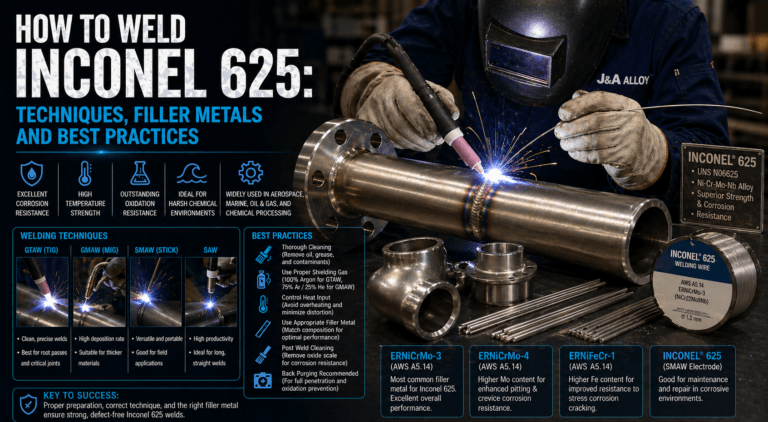
17-4PH is readily weldable in all product forms using matching filler metal (AWS ER630, UNS S17480) or ERNiCrMo-3 for dissimilar joints. The recommended approach:
- Weld in Condition A (solution annealed) to avoid cracking in the hard HAZ
- Use low heat input to minimize HAZ width
- Post-weld heat treat to H900 or H1025 condition
- For critical welds, perform a double aging cycle: H1150M stabilization before final aging
Surface treatments
For enhanced corrosion resistance, 17-4PH is often electropolished or passivated after aging. Electropolishing removes surface chromium-depleted layers and improves pitting resistance. Standard nitric acid passivation (20–25% HNO3, 30–60 min) is acceptable for 17-4PH in the H1025 and higher conditions.
Available Forms and Supply Options
J&A Alloy can supply 17-4PH stainless steel / UNS S17400 in bar, plate, sheet, strip, wire, forgings and custom machined components. If your drawing specifies ASTM A564, ASTM A693, ASTM A705, AMS 5643, AMS 5604, AMS 5528 or AMS 5678, send the required condition, size, quantity and destination for a fast quotation.
Related product: 17-4PH stainless steel bar, plate and wire supplier.
Five Key Facts About 17-4PH
- H900 delivers the highest strength but not the best corrosion resistance. The trade-off between strength and corrosion resistance means H1025 or H1075 are often the better choice for real-world applications requiring both.
- 17-4PH is machinable in Condition A only. Attempting to machine aged material destroys tooling and compromises the part. Always machine before final aging — and plan heat treatment as the last manufacturing step.
- The Nb+Ta addition distinguishes 17-4PH from ordinary martensitic stainless. The columbium-tantalum carbides pin grain boundaries and suppress intergranular cracking during aging and welding — this is what makes 17-4PH weldable without post-weld heat treatment in most conditions.
- 17-4PH is magnetic in all conditions. Unlike austenitic stainless steels, 17-4PH’s martensitic microstructure is ferromagnetic. This is an important consideration for applications where magnetic interference is a concern.
- For seawater or high-chloride service, specify 316L or a nickel alloy. 17-4PH’s chloride pitting threshold (~100–200 ppm) is well below typical seawater chloride levels (~19,000 ppm). Specify corrosion-resistant alloys, not strength alloys.
Need 17-4PH Bar, Plate or Forging?
Send us the grade, product form, size, quantity, standard, heat treatment condition, mechanical properties and inspection requirement. J&A Alloy can quote 17-4PH / UNS S17400 with MTC, PMI, UT and export packing options.
Frequently Asked Questions About 17-4PH Stainless Steel
What is 17-4PH stainless steel?
17-4PH is a martensitic precipitation-hardening stainless steel with chromium, nickel, copper and niobium additions. It is selected when a part needs high strength, good machinability before aging and moderate corrosion resistance.
Is 17-4PH the same as UNS S17400?
Yes. UNS S17400 is the UNS designation for 17-4PH stainless steel. It is also commonly referenced as AISI 630, Type 630 and W.Nr. 1.4542.
What is the hardness of 17-4PH H900?
17-4PH H900 typically reaches about 40-47 HRC, depending on product form, section size and the applicable specification. H900 provides the highest strength among the common aging conditions.
What is the difference between 17-4PH H900 and H1150?
H900 is aged at a lower temperature and gives maximum strength and hardness. H1150 is aged at a higher temperature, so it has lower strength but better toughness, ductility and dimensional stability.
Can 17-4PH stainless steel be welded?
17-4PH can be welded, usually in Condition A, followed by appropriate post-weld aging when final mechanical properties are required. Critical weld procedures should follow the project specification and qualified WPS requirements.
Which ASTM and AMS standards apply to 17-4PH?
Common standards include ASTM A564 for bars and shapes, ASTM A693 for plate, sheet and strip, ASTM A705 for forgings, AMS 5643 for bars and forgings, AMS 5604 for plate and AMS 5528 for sheet and strip.
Related articles: Nickel Alloy vs Stainless Steel: How to Choose for Corrosive Environments, How to Weld Inconel 625: Techniques, Filler Metals and Best Practices, Hastelloy vs Inconel: Key Differences Every Engineer Should Know
Related product-form page prepared for publication: 17-4PH Bar Supplier. Until it is published, compare product families in the Super Stainless Steel Products hub and the 17-4PH product page.