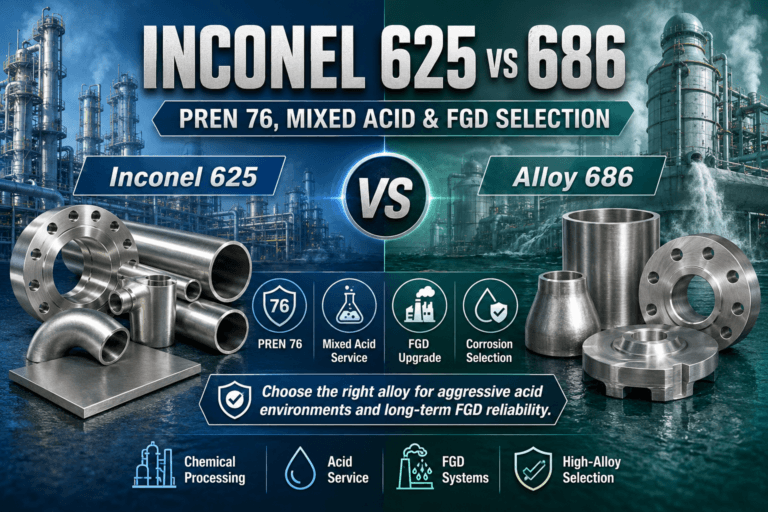
Inconel 600 and 625 are nickel-chromium alloys, but they solve different problems. Alloy 600 is an established high-temperature, oxidation-resistant and fabrication-friendly grade. Alloy 625 adds substantial molybdenum and niobium, raising strength and resistance to chloride pitting and crevice corrosion—at a higher material cost.
Important: Alloy selection requires actual process chemistry, temperature, stress and code requirements. Published typical data are screening information, not guaranteed design allowables.
The Short Answer
Choose Inconel 600 (UNS N06600) for many furnace, heat-treatment, caustic and high-temperature oxidation applications where severe localized wet corrosion is not controlling. Choose Inconel 625 (N06625) for seawater, chlorides, chemical processing, weld overlays and higher-strength fabrication. Paying for 625 is justified only when its Mo-Nb benefits address the failure mode.
Inconel 600 vs 625 Comparison
| Decision factor | Inconel 600 | Inconel 625 |
|---|---|---|
| UNS | N06600 | N06625 |
| Key chemistry | Ni-Cr-Fe | Ni-Cr-Mo-Nb |
| Strengthening | Solid solution | Stronger Mo/Nb solid solution |
| Wet chloride resistance | Useful but limited in severe localized-corrosion duty | Much stronger pitting/crevice resistance |
| High-temperature role | Excellent oxidation and furnace history | Good oxidation plus higher strength; application limits still matter |
| Welding | Readily welded with qualified nickel-alloy procedures | Excellent weldability; widely used as filler/overlay family |
| Relative raw-material cost | Generally lower | Generally higher due to Mo/Nb and market demand |
Composition Creates the Main Difference
Alloy 600 uses high nickel and chromium with iron. Nickel provides austenitic stability and resistance in many reducing/caustic environments; chromium supports oxidation resistance.
Alloy 625 contains at least about 58% nickel, 20–23% chromium, 8–10% molybdenum and 3.15–4.15% combined niobium plus tantalum under the manufacturer’s published limits. Molybdenum strongly improves resistance to localized attack in reducing/chloride environments, while niobium contributes solid-solution strength.
Corrosion Selection
Choose 600 for Its Established Environments
Alloy 600 has long service history in furnace components, chemical equipment, heaters and caustic handling. It resists many organic and inorganic compounds and performs well in high-temperature oxidizing atmospheres. Specific water-chemistry and stress-corrosion concerns must still be reviewed.
Choose 625 for Chlorides and Seawater
Alloy 625 is a common candidate for seawater hardware, bellows, expansion joints, chemical equipment and offshore components because its Mo/Cr combination provides strong localized-corrosion resistance. It is also widely used as weld overlay to protect a lower-cost structural substrate.
Neither alloy is universally immune. Crevice geometry, stagnant zones, temperature and contamination can overwhelm published general-corrosion rates.
Temperature Capability
Alloy 600 is often selected for furnace and heat-treatment hardware because of its oxidation resistance and stable nickel-chromium matrix. Alloy 625 retains useful strength across a broad temperature range and has cryogenic toughness.
At sustained high temperature, however, code allowables, metallurgical stability and sulfur/carburizing atmosphere become decisive. Alloy 625’s excellent wet-corrosion performance does not automatically make it the best furnace alloy. Compare 600 with its oxidation-focused neighbor in Inconel 600 vs 601.
Strength and Fabrication
625 is normally stronger than annealed 600 because of Mo and Nb solid-solution strengthening. This can reduce section size or increase pressure/load capacity, subject to code allowables.
Both alloys can be formed and welded. 625 has an especially strong welding record and is available in matching consumables. The shop should control cleanliness, heat input, interpass temperature and oxide removal. For detailed practice, read How to Weld Inconel 625.
Machining 625 usually requires more rigid setups and deliberate feeds because it is stronger and work hardens. A lower raw-material price for 600 can be offset if premature corrosion occurs; a higher 625 price can be wasted if Mo/Nb provides no service benefit.
Total Installed Cost
Compare more than price per kilogram:
- design thickness and weight;
- forming, welding and machining time;
- filler metal and overlay strategy;
- corrosion allowance;
- inspection and repair;
- expected service life and downtime; and
- availability in the exact form and size.
For some vessels, carbon steel with Alloy 625 cladding is more economical than solid 625. For small severe-service fittings, solid 625 may avoid overlay complexity. For dry furnace fixtures, 600 may deliver the best lifecycle value.
For another 625 selection axis, see Inconel 625 vs 718.
RFQ Checklist
- UNS N06600 or N06625 and product standard.
- Form, dimensions, tolerances and quantity.
- Process fluid, impurities, pH, chlorides and temperature.
- Oxidizing, reducing, carburizing or sulfur-bearing atmosphere.
- Pressure, loads, cycles and design life.
- Construction code and edition.
- Annealed/solution-treated condition.
- Welding filler, cladding or solid-alloy construction.
- Corrosion, mechanical and NDE requirements.
- PMI, traceability and EN 10204 certification.
Frequently Asked Questions
Is Inconel 625 stronger than 600?
Generally yes in common annealed conditions, due to Mo and Nb solid-solution strengthening. Use specification values for the ordered form and size.
Is Inconel 625 more corrosion resistant than 600?
In chloride pitting, crevice corrosion and many aggressive wet environments, usually yes. Alloy 600 may be entirely adequate in other media and high-temperature atmospheres.
Which is better for seawater?
625 is normally the stronger candidate because of its molybdenum-rich localized-corrosion resistance.
Which is better for furnace parts?
600 often offers established oxidation performance and lower cost. Actual atmosphere, temperature, load and thermal cycling determine the answer.
Can 625 replace 600 without redesign?
Not automatically. Review code allowables, thermal expansion, fabrication, product availability and cost, even if corrosion performance improves.
Final Recommendation
Select 600 when its temperature and corrosion capability already addresses the duty; select 625 when chloride resistance or higher strength earns its premium. Send J&A Alloy the full environment, design conditions, form, specification, welding plan, NDE and certificate requirements.