
Nickel Alloy Pipe Fittings for Corrosive and High-Temperature Service
Select elbows, tees, crosses, bends, vessel heads, caps and reducers by geometry, alloy, wall thickness, dimensional system, construction class and inspection scope.
Common Nickel Alloy Fitting Types
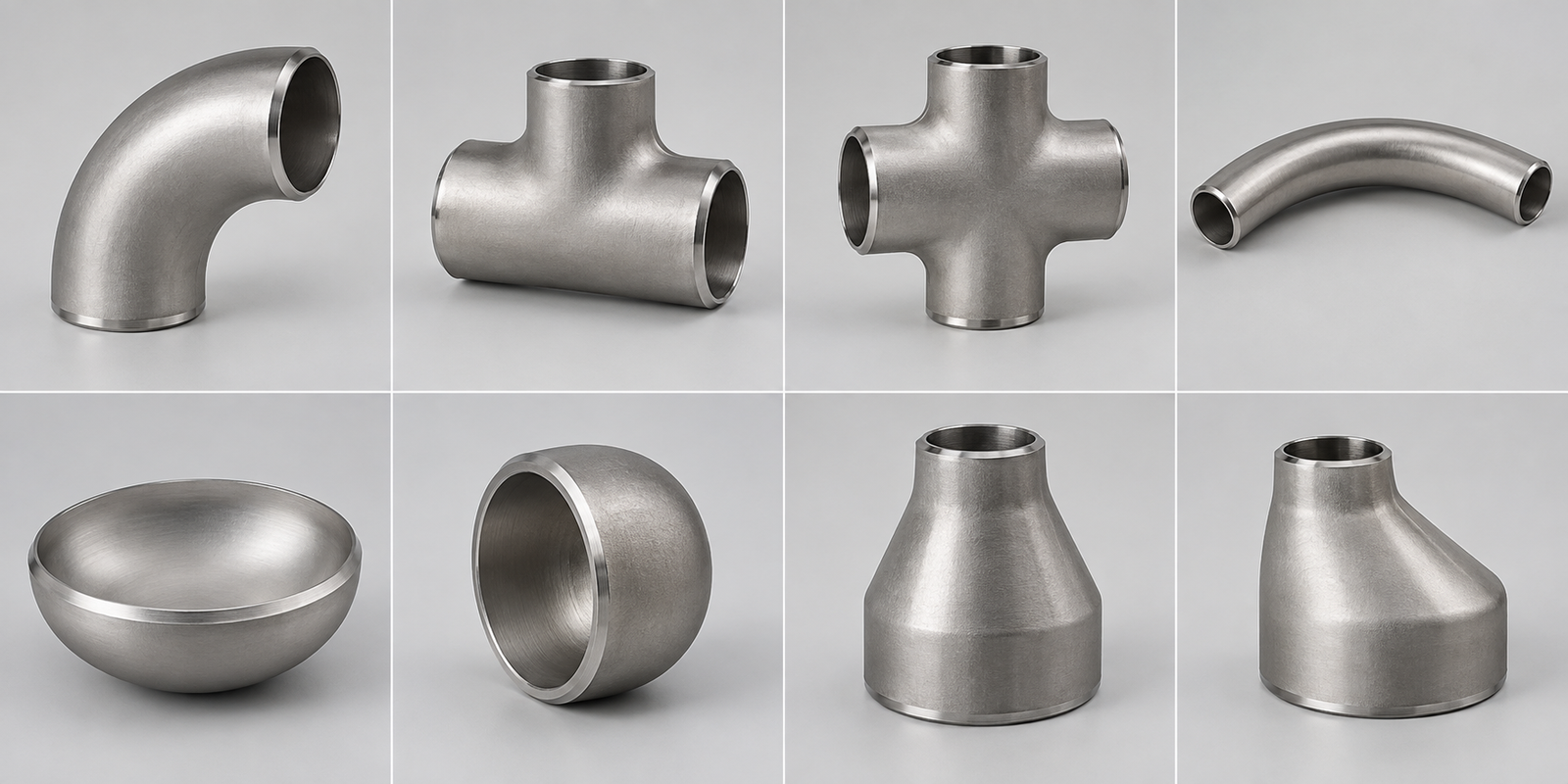
Elbows
45°, 90° and 180° return elbows; long-radius, short-radius and reducing patterns. State LR/SR, angle, NPS/DN, schedule and seamless or welded construction.
Tees
Equal or straight tees maintain branch size; reducing tees connect a smaller branch. Barred tees are pipeline specials and require a controlled drawing.
Crosses
Equal and reducing crosses provide four-way connections. They are less common than tees and require careful pressure, flexibility and branch-stress review.
Pipe Bends
2D, 3D, 5D and larger-radius bends may be induction bent or cold formed, with or without tangents. Specify CLR, angle, wall thinning, ovality and qualification.
Vessel Heads
2:1 ellipsoidal, hemispherical, torispherical/flanged-and-dished and conical heads follow vessel-code calculations and drawings, not ordinary pipe-fitting rules.
Pipe Caps
Butt-weld caps close pipe ends. Specify dimensional standard, NPS/DN, schedule or wall, end preparation, alloy and inspection class.
Concentric Reducers
Maintain a common centerline and are frequently used in vertical piping and general process connections.
Eccentric Reducers
Offset centerlines support flat-on-top or flat-on-bottom installation for pump suction, vapor control and drainage.
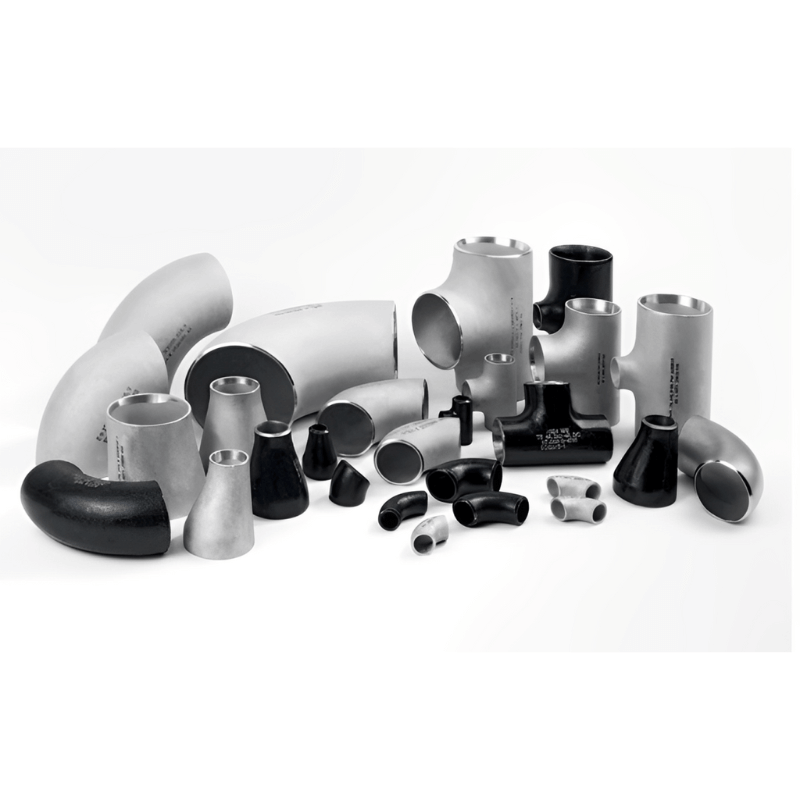
Nickel Alloy and Super Stainless Fitting Materials
| Material | Common Selection Reason | Typical Material Specification |
|---|---|---|
| Inconel 625 | Chloride, seawater and high-strength corrosion service | ASTM B366 / ASME SB-366 |
| Incoloy 825 | Sulfuric and phosphoric acid systems | ASTM B366 / ASME SB-366 |
| Hastelloy C-276 / C-22 | Aggressive acid, chloride and FGD duties | ASTM B366 / ASME SB-366 |
| Monel 400 | Marine and selected hydrofluoric-acid service | ASTM B366 / ASME SB-366 |
| Nickel 200 / 201 | Caustic alkali and commercially pure nickel piping | ASTM B366 / ASME SB-366 |
| Duplex 2205 / 2507 | Chloride-rich, seawater and offshore systems | ASTM A815/A815M; EN 10253-4 where applicable |
Material suitability depends on medium, concentration, temperature, pressure, welding procedure and piping design code. Brand names do not replace UNS/EN designations and current material specifications.
American Fitting Standards: ASME, ASTM and MSS
| Standard | What It Controls and How to Specify It |
|---|---|
| ASME B16.9-2024 | Factory-made wrought butt-welding fitting dimensions, tolerances, testing and marking; it does not by itself specify the nickel alloy. |
| ASME B16.11-2021 | Forged socket-weld fittings Classes 3000/6000/9000 and threaded fittings Classes 2000/3000/6000. |
| ASME B16.25 | Butt-welding end preparation for joining to pipe, valves and fittings. |
| ASTM B366/B366M-25 / ASME SB-366 | Primary wrought nickel and nickel-alloy fitting material/manufacturing reference; purchase orders should state grade and class S, W, WX or WU as applicable. |
| ASTM A403/A403M and A815/A815M | Wrought austenitic stainless and ferritic/austenitic duplex fitting specifications respectively. |
| MSS SP-43 / SP-75 / SP-95 / SP-97 | Supplementary fitting systems used only when the project specification calls for the applicable scope and material route. |
European Fitting Standards and PED Requirements
| Standard / Framework | Scope and Procurement Guidance |
|---|---|
| EN 10253-4:2025 | Wrought austenitic and austenitic-ferritic stainless butt-welding fittings with specific inspection; not a blanket nickel-alloy specification. |
| EN 10253-2 | Butt-welding fittings of non-alloy and ferritic alloy steels with specific inspection. |
| EN 13480-3:2024 | Industrial metallic piping design and calculation; component selection must be validated within the piping system. |
| EN 10204 | Inspection documents such as 3.1 and 3.2; it is a document type, not a fitting dimensional standard. |
| PED 2014/68/EU | European pressure-equipment conformity framework; define category, conformity route, PMA/harmonized material route and notified-body scope. |
| DIN 2605 / 2615 / 2616 / 2617 | Legacy/project references for elbows, tees, reducers and caps. Confirm current replacement, edition and contractual acceptance before ordering. |
International Standards: ISO and Oil & Gas Systems
| Standard | Scope Boundary |
|---|---|
| ISO 3419:1981 | Dimensions for butt-welding bends, reducers, tees and caps in non-alloy/alloy steel; confirmed current in 2026, but not a generic nickel-alloy material specification. |
| ISO 5251:1981 | Stainless steel butt-welding fittings; confirm project acceptance and current dimensional/material requirements. |
| ISO 4144:2003 | Stainless steel threaded fittings; do not infer suitability for every nickel alloy. |
| ISO 15590-2:2021 | Pipeline fittings for unalloyed and low-alloy steels; not the default standard for nickel-alloy process fittings. |
| API 6A / ISO 10423 | Wellhead and tree equipment system requirements; applicable only when the complete oil-and-gas equipment specification calls for them. |
Nominal sizes that look similar across ASME, EN and ISO systems are not automatically interchangeable. Check OD, wall, center-to-end dimensions, bevel, branch geometry, tolerance, material and pressure-design basis.
Quality, Inspection and Traceability
Documentation and NDE
- Heat/lot traceability and EN 10204 3.1 or 3.2 documents
- PMI, chemistry, mechanical properties and heat treatment
- PT plus RT/UT required by B366 class or project ITP
- Weld procedure and welder qualification for fabricated fittings
Dimensional Inspection
- NPS/DN, wall, angle, radius and center-to-end dimensions
- Bevel, land, out-of-roundness and wall thinning
- Reducer eccentricity and FOT/FOB orientation marks
- Surface cleanliness, marking, end protection and export packing
Related Materials, Product Forms and Applications
Nickel Alloy Fittings FAQ
Which standard covers nickel alloy butt-weld fittings?
ASME B16.9 controls dimensions and tolerances for factory-made wrought butt-weld fittings, while ASTM B366/B366M or ASME SB-366 commonly supplies the nickel-alloy material and manufacturing requirements. Both references, alloy grade and edition should be stated.
What is the difference between an elbow and a pipe bend?
An elbow is a standardized fitting, commonly 45, 90 or 180 degrees with a defined radius. A bend is usually specified by centerline radius such as 2D, 3D or 5D and may be induction bent or cold formed to a drawing.
What is the difference between concentric and eccentric reducers?
A concentric reducer shares one centerline and is common on vertical or general runs. An eccentric reducer has an offset centerline and can be installed flat-on-top or flat-on-bottom to manage vapor pockets, drainage or pump-suction layout.
Are vessel heads covered by ASME B16.9?
No. Ellipsoidal, hemispherical, torispherical and conical vessel heads are pressure-vessel components governed by the vessel design code, approved calculations and drawings, such as ASME Section VIII or EN 13445. They should not be purchased as ordinary pipe caps.
Does EN 10253 cover all nickel alloy fittings?
No. EN 10253-4 covers wrought austenitic and austenitic-ferritic stainless butt-welding fittings with specific inspection. Many nickel-alloy projects instead use ASTM B366 or ASME SB-366 with an agreed dimensional standard and project specification.
Can socket-weld and threaded fittings be supplied in nickel alloys?
Yes, where the selected alloy and material specification permit. ASME B16.11 covers forged socket-weld fittings in Classes 3000, 6000 and 9000 and threaded fittings in Classes 2000, 3000 and 6000; the alloy specification and piping design code remain separate requirements.
What inspection should be specified for corrosion-resistant fittings?
Common requirements include heat and lot traceability, EN 10204 3.1 or 3.2 documentation, PMI, dimensions, wall thickness, bevel and ovality checks, solution-anneal records, PT and the radiography or ultrasonic examination required by the selected B366 class or project ITP.
What information is needed for a nickel alloy fittings RFQ?
State alloy and UNS or EN designation, material specification, fitting type, seamless or welded construction, NPS or DN, schedule or wall thickness, angle or radius, dimensional standard and edition, quantity, end preparation, inspection class, documentation and destination.
Request a Nickel Alloy Fittings Quote
Send alloy/UNS, material and dimensional standards with editions, type, NPS/DN, schedule or wall, construction route, quantity and inspection requirements.
- Elbow angle and LR/SR, tee/cross branch size, or bend CLR and tangents
- Reducer concentric/eccentric configuration and FOT/FOB orientation
- Cap or vessel-head geometry, approved drawing and governing design code
- B366 class, NDE, PMI, inspection documents, marking and destination