Introduction: Why FGD Scrubber Alloy Selection Is a Tiered Decision
Flue gas desulfurization (FGD) scrubbers are among the most corrosive industrial environments on earth. A coal-fired power plant generates flue gas containing SO₂ (500–3,000 ppm), SO₃ (10–50 ppm), HCl (10–100 ppm from coal chlorides), HF (1–10 ppm), fly ash particles, and residual O₂. When this gas meets the recirculating slurry in the absorber tower — a slurry that is essentially a saturated CaSO₄/CaSO₃ suspension at pH 4.5–6.0 with dissolved Cl⁻ (10,000–50,000 ppm) and F⁻ (100–500 ppm) — the resulting corrosion environment has no equivalent in any textbook corrosion table.
The reason FGD alloy selection cannot be reduced to a single “best alloy” answer is that the scrubber is not one environment — it is five distinct micro-environments that progress from mildly corrosive to catastrophically corrosive as you move from the gas inlet to the slurry outlet. The alloy that works in the outlet duct will fail in the absorber tower inlet. The alloy that survives the absorber tower will be over-specified and over-priced for the outlet duct.
This guide provides a step-by-step alloy upgrade path from the least corrosive zone (clean gas outlet) to the most aggressive zone (absorber inlet with wet/dry cycling), with specific alloy recommendations for each zone, PREN thresholds, real-world service life data, and cost trade-offs. It is designed to help you specify the minimum-cost alloy that will achieve your target service life — no more, no less.
For detailed two-alloy comparisons within this upgrade path, see our Hastelloy C-22 vs C-276 guide, our Inconel 625 vs 686 analysis, and our 254SMO vs 904L comparison.
1. The Five FGD Micro-Environments
Zone Mapping
An FGD scrubber system can be divided into five corrosion zones, each with distinct chemistry, temperature, and mechanical loading:
| Zone | Location | Temperature | Key Corrosion Drivers | pH | Severity |
| Zone 1 | Clean gas outlet duct + stack | 50–80°C | Residual SO₂, low Cl⁻, dry | 5–7 | Low |
| Zone 2 | Absorber outlet (mist eliminator) | 50–70°C | Wet/dry cycling, slurry droplets, Cl⁻ | 3–5 | Moderate |
| Zone 3 | Absorber mid-section (slurry contact) | 50–55°C | Saturated Cl⁻ slurry, CaSO₄ deposit, under-deposit acidification | 4–5 | Moderate–High |
| Zone 4 | Absorber inlet (gas entry, wet/dry interface) | 55–70°C | Wet/dry cycling, HCl + SO₂ condensation, FeCl₃ oxidation, fly ash erosion | 1–3 | High–Severe |
| Zone 5 | Reheater / bypass duct (hot gas + acid condensation) | 80–180°C | H₂SO₄ condensation at dew point, high-temperature acid | 0–2 | Severe |
Why Zone 4 Is the Killer
Zone 4 — the absorber inlet where hot flue gas first contacts the slurry spray — is where 90% of FGD alloy failures occur. The mechanism is wet/dry acid cycling:
- During gas-on operation, the hot flue gas (150–180°C) heats the metal surface above the acid dew point. HCl and SO₂ remain as dry gases — no liquid condensation, no corrosion.
- During unit shutdown or load reduction, the metal cools below the acid dew point. HCl and H₂SO₄ condense as liquid films on the metal surface. These films are concentrated (10–30% HCl, 60–80% H₂SO₄) because the condensation occurs from a gas phase, not a dilute slurry.
- When the unit restarts, the condensate evaporates, leaving concentrated acid residues trapped under fly ash deposits and CaSO₄ scale. These deposits act as crevices — local acidification drives pH to 0–1 at the metal surface, well below the bulk slurry pH of 4.5–6.0.
- FeCl₃ forms from fly ash iron dissolution in the acid condensate. Fe³⁺ is a powerful oxidizer that drives the corrosion potential above the critical pitting potential for most stainless steels — even those with PREN above 40.
This cycling mechanism — wet → dry → wet → dry, with each wet cycle producing increasingly concentrated acid trapped under deposits — is why alloys that survive continuous immersion (e.g., 316L in Zone 3 slurry) fail catastrophically in Zone 4 wet/dry service. Continuous immersion allows the passive film to stabilize. Wet/dry cycling destroys it.
2. Alloy Upgrade Path: Zone-by-Zone Specification
The Staircase: PREN vs Cost vs Service Life
The alloy selection for FGD follows a staircase pattern — each step up in PREN adds corrosion resistance but also cost. The goal is to match each zone to the lowest step that achieves the target service life.
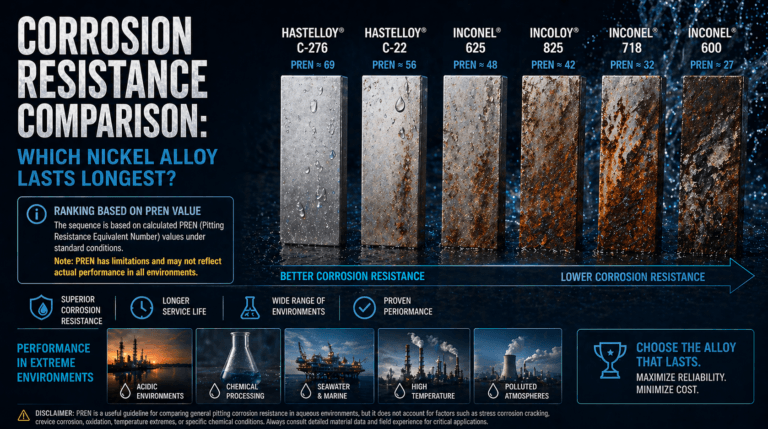
| Alloy | PREN (approx.) | Relative Cost | Zone 1 | Zone 2 | Zone 3 | Zone 4 | Zone 5 |
| 316L | ~24 | 1.0x | ✅ 10+ yr | ⚠️ 3–5 yr | ❌ 2–3 yr | ❌ <1 yr | ❌ |
| 317L | ~29 | 1.2x | ✅ 10+ yr | ✅ 5–8 yr | ⚠️ 3–5 yr | ❌ <2 yr | ❌ |
| 904L | ~35 | 1.8x | ✅ 10+ yr | ✅ 10+ yr | ⚠️ 5–7 yr | ❌ 2–3 yr | ❌ |
| 254SMO | ~46 | 2.5x | ✅ | ✅ | ✅ 10+ yr | ⚠️ 5–8 yr | ⚠️ |
| Inconel 625 | ~51 | 4.0x | ✅ | ✅ | ✅ | ✅ 10+ yr | ⚠️ 3–5 yr |
| Hastelloy C-22 | ~65 | 5.5x | ✅ | ✅ | ✅ | ✅ 15+ yr | ✅ 10+ yr |
| Hastelloy C-276 | ~69 | 6.0x | ✅ | ✅ | ✅ | ✅ 20+ yr | ✅ 15+ yr |
| Inconel 686 | ~76 | 8.0x | ✅ | ✅ | ✅ | ✅ 25+ yr | ✅ 20+ yr |
Reading this table: ✅ means the alloy achieves 10+ year service life in that zone. ⚠️ means marginal — 3–8 years depending on coal chloride content and operating practices. ❌ means premature failure expected.
Zone 1: Clean Gas Outlet (Low Severity)
Minimum specification: 316L (UNS S31603) is sufficient for Zone 1 in most plants. The gas is clean (SO₂ >90% removed), temperatures are below 80°C, and chloride concentrations are low because the mist eliminator removes most slurry droplets.
Upgrade justification: Upgrade to 317L or 904L only if the plant burns high-chloride coal (>0.1% Cl in coal) or if the mist eliminator is poorly maintained (slurry carryover increases chloride deposition).
Cost optimization: 316L at 18–22/kg for Zone 1 is the standard industry practice. Do not overspecify — the cost premium for 254SMO (45–55/kg) or C-276 ($100–120/kg) in Zone 1 yields no measurable life extension.
Zone 2: Mist Eliminator Region (Moderate Severity)
Minimum specification: 317L (UNS S31703) for plants with low-chloride coal (<0.05% Cl). 904L (UNS N08904) for plants with moderate chloride coal (0.05–0.15% Cl).
Key risk: Wet/dry cycling at the mist eliminator creates localized acidification under deposit. 316L fails here in 3–5 years due to pitting at the mist eliminator support structure and spray nozzle attachments.
Upgrade justification: 254SMO is the recommended upgrade for Zone 2 in plants burning coal with >0.15% Cl content. 254SMO’s PREN of 46 exceeds the seawater crevice threshold and provides reliable resistance to under-deposit acidification in the mist eliminator region.
Practical note: Many FGD systems use 254SMO for the mist eliminator structure and spray nozzles, while retaining 316L for the outlet duct downstream. This hybrid specification saves 30–40% on Zone 2 material cost compared to specifying C-276 throughout.
Zone 3: Absorber Mid-Section (Moderate–High Severity)
Minimum specification: 904L for low-chloride plants. 254SMO for moderate-to-high chloride plants.
Key risk: Continuous slurry immersion with under-deposit acidification. The absorber mid-section is wet all the time — no wet/dry cycling — so the passive film can stabilize. However, CaSO₄/CaSO₃ deposits create crevice conditions where local pH drops to 2–3. Alloys with PREN <35 (316L, 317L) fail by crevice corrosion under these deposits within 2–5 years.
Upgrade justification: 254SMO is the cost-effective choice for most absorber mid-sections. Its PREN of 46 and CCT of 35–45°C provide reliable crevice corrosion resistance at the 50–55°C operating temperature. The upgrade from 904L to 254SMO adds approximately $15–20/kg but extends service life from 5–7 years to 10–15 years.
For background on 254SMO vs 904L performance: See our 254SMO vs 904L comparison article for detailed corrosion data and cost analysis.
Zone 4: Absorber Inlet — The Critical Zone (High–Severe)
This is where the upgrade path becomes expensive, and where the alloy decision has the largest financial impact.
Minimum specification for 10+ year life: Inconel 625 (UNS N06625) for plants with <0.1% Cl coal. Hastelloy C-22 (UNS N06022) for plants with 0.1–0.3% Cl coal. Hastelloy C-276 (UNS N10276) for plants with >0.3% Cl coal or where fly ash Fe content is high (Fe₂O₃ >10% in ash).
Why 254SMO fails here: 254SMO (PREN 46) provides adequate resistance to continuous immersion (Zone 3) but not to wet/dry acid cycling (Zone 4). The cycling mechanism produces FeCl₃ in the condensate, which oxidizes the corrosion potential above 254SMO’s critical pitting potential. In ASTM G48 Method C (6% FeCl₃ + 1% HCl), 254SMO’s CPT drops from 65–75°C (in NaCl alone) to approximately 35–40°C — barely above the Zone 4 operating temperature of 55–70°C. Marginal.
Inconel 625 in Zone 4: 625 (PREN 51) was the FGD industry standard for Zone 4 from the 1980s through the early 2000s. It provides 10+ year service life in most absorber inlet environments, with one caveat: in high-chloride coal plants (>0.15% Cl in coal), 625 experiences localized pitting at the wet/dry interface after 7–10 years. The pitting is not catastrophic — it can be monitored and repaired — but it reduces the expected life from 10–15 years to 7–10 years.
Hastelloy C-22 vs C-276 in Zone 4: Both C-22 (PREN ~65) and C-276 (PREN ~69) were specifically developed for FGD service. They provide 15–20+ year service life in Zone 4 with zero reported pitting failures in the published literature. C-22 has a slight advantage over C-276 in oxidizing chloride environments (higher Cr content: 22% vs 16%) — it resists FeCl₃-driven pitting better. C-276 has a slight advantage in reducing acid environments (higher Mo: 16% vs 13%) — it resists HCl better.
For the detailed C-22 vs C-276 trade-off: See our Hastelloy C-22 vs C-276 guide for a full metallurgical comparison with FGD-specific corrosion data.
Inconel 686 in Zone 4: 686 (PREN 76) provides the ultimate Zone 4 corrosion resistance — 25+ year projected service life with zero failure risk. However, at 8x the cost of 316L, it is economically justified only for plants with extremely high chloride coal (>0.5% Cl) or for critical components where failure would force a unit shutdown (absorber inlet header, spray zone manifold).
For the 625 → 686 upgrade economics: See our Inconel 625 vs 686 analysis for the full upgrade justification framework.
Zone 5: Reheater / Bypass Duct (Severe)
Minimum specification: Hastelloy C-276 or Inconel 686. No stainless steel — including 254SMO — survives Zone 5.
Key risk: H₂SO₄ dew point corrosion at 120–160°C. At these temperatures, concentrated sulfuric acid (60–80% H₂SO₄) condenses on the metal surface. This is the same environment that causes car wash acid etching of automotive finishes — but at industrial concentration and temperature. Stainless steels (including 254SMO) rely on Cr₂O₃ passive films that dissolve in hot concentrated H₂SO₄. Only high-Ni, high-Mo nickel alloys maintain passive film stability under these conditions.
Practical specification: Most FGD systems use C-276 for the reheater bundle and bypass duct, with Inconel 686 reserved for the most aggressive reheater inlet sections. C-22 is an acceptable alternative if HCl is not a primary driver (C-22’s lower Mo content means less HCl resistance at elevated temperatures).
3. Hybrid Specification Strategy: Zone-Optimized Cost Reduction
The key to cost-effective FGD alloy specification is not using the same alloy throughout the system. A plant that specifies C-276 for the entire absorber (Zones 2–4) spends 30–40% more than necessary. A plant that specifies 316L throughout (Zones 1–4) replaces the absorber inlet every 2–3 years at a total cost that exceeds the C-276 premium within 8 years.
Recommended Hybrid Specification (Moderate Chloride Coal, 0.05–0.15% Cl)
| Zone | Alloy | Product Form | Estimated Life | Material Cost/kg | Zone Cost Share |
| Zone 1 | 316L | Plate, sheet | 10+ yr | $18–22 | 8% |
| Zone 2 | 254SMO | Plate, sheet | 10+ yr | $45–55 | 12% |
| Zone 3 | 254SMO | Plate, tube | 10–15 yr | $45–55 | 20% |
| Zone 4 | Inconel 625 | Plate, clad overlay | 10–12 yr | $80–100 | 35% |
| Zone 5 | Hastelloy C-276 | Plate, tube | 15+ yr | $100–120 | 25% |
Total system cost: Approximately 40% lower than specifying C-276 throughout, with no zone experiencing premature failure within the 10-year design window.
Recommended Hybrid Specification (High Chloride Coal, 0.15–0.30% Cl)
| Zone | Alloy | Estimated Life | Cost/kg |
| Zone 1 | 317L | 10+ yr | $20–25 |
| Zone 2 | 254SMO | 10+ yr | $45–55 |
| Zone 3 | 254SMO | 10+ yr | $45–55 |
| Zone 4 | Hastelloy C-22 | 15+ yr | $90–110 |
| Zone 5 | Hastelloy C-276 | 20+ yr | $100–120 |
The upgrade from 625 to C-22 in Zone 4 adds approximately $10–20/kg but extends Zone 4 life from 10–12 years to 15+ years — a net TCO reduction because it eliminates one mid-life replacement cycle.
Clad Overlay Economics
For Zone 4, a common cost-reduction strategy is to use clad plate — carbon steel base metal with a 2–3 mm nickel alloy overlay (typically 625 or C-22) rolled at the mill. Clad plate reduces the Zone 4 material cost by 50–60% compared to solid nickel alloy plate, while maintaining the same corrosion resistance at the wetted surface.
| Option | Zone 4 Cost (per m², 10 mm plate) | Corrosion Resistance | Weldability |
| Solid C-276 plate | $800–1,000/m² | Excellent | Excellent |
| CS + C-22 clad (2 mm overlay) | $350–450/m² | Excellent (overlay surface) | Requires dissimilar weld at clad boundary |
| CS + 625 clad (3 mm overlay) | $300–400/m² | Good (625 overlay) | Standard practice |
Clad overlay limitation: The overlay thickness (2–3 mm) provides corrosion resistance only on the wetted surface. The carbon steel backing has zero corrosion resistance and must be protected from any slurry contact on the back surface. In absorber tower construction, this means the clad plate must be oriented with the overlay facing the slurry — never reversed. Additionally, welds at plate edges and nozzle penetrations must be made with overlay-compatible filler metal to prevent galvanic corrosion at the clad/CS interface.
4. Coal Chloride Content: The Master Variable
The single most important variable in FGD alloy selection is chloride content in the coal. Everything else — SO₂ concentration, fly ash composition, slurry pH — can be managed through process adjustments. Chloride cannot. It enters the FGD system through the coal, concentrates in the recirculating slurry to 10,000–50,000 ppm, and drives both pitting and crevice corrosion at every wetted surface.
Coal Cl → Slurry Cl⁻ → Alloy PREN Threshold
| Coal Cl Content | Slurry Cl⁻ (typical) | Zone 4 Minimum PREN | Zone 4 Minimum Alloy |
| <0.05% | 10,000–20,000 ppm | ~35 | 904L (marginal), 254SMO (safe) |
| 0.05–0.15% | 20,000–30,000 ppm | ~46 | 254SMO (marginal), 625 (safe) |
| 0.15–0.30% | 30,000–40,000 ppm | ~50 | 625 (marginal), C-22 (safe) |
| 0.30–0.50% | 40,000–60,000 ppm | ~65 | C-22 (marginal), C-276 (safe) |
| >0.50% | >60,000 ppm | ~69 | C-276 (marginal), 686 (safe) |
This table provides a quick-reference specification starting point. The word “marginal” means the alloy will survive but with localized pitting after 7–10 years. “Safe” means zero reported pitting failures in comparable service.
Coal Chloride Testing
Accurate coal chloride data is essential for correct alloy specification. Unfortunately, coal chloride is often poorly characterized because standard coal analysis (proximate/ultimate analysis) does not include chlorine. Cl content must be specifically requested as an additional test (ASTM D4208 — chlorine in coal by bomb calorimetry, or ISO 587 — chlorine in coal by Eschka method).
Common specification error: Engineers who specify FGD alloys based on the design coal analysis without verifying actual coal chloride content often discover — after 3–5 years of operation — that the plant has switched to a higher-chloride coal source. The alloy that was correctly specified for 0.05% Cl coal fails catastrophically when the actual coal contains 0.2% Cl.
Recommendation: Specify alloys for the maximum expected chloride content, not the average. If the plant may switch coal sources, assume the worst-case chloride scenario and specify accordingly. The cost premium for overspecifying is 10–20% of the absorber material budget. The cost of underspecifying is a $2–5M absorber replacement in 5–8 years.
5. Fabrication & Welding Considerations
Welding Filler Metal Selection
The FGD scrubber contains multiple alloy transitions — 316L to 254SMO, 254SMO to 625, 625 to C-276. Each transition requires a specific filler metal strategy:
| Transition | Filler Metal | Reason |
| 316L to 316L | ER316L | Matching filler |
| 316L to 254SMO | ERNiCrMo-3 (Inconel 625) | Overmatching PREN; 254SMO filler (ER385) would create a weaker transition zone |
| 254SMO to 254SMO | ERNiCrMo-3 or ER385 | Both acceptable; ERNiCrMo-3 preferred for higher PREN at weld |
| 254SMO to 625 | ERNiCrMo-3 | Matching 625 side; overmatches 254SMO side |
| 625 to 625 | ERNiCrMo-3 | Matching filler |
| 625 to C-22 | ERNiCrMo-10 (C-22 filler) | Overmatches 625 side; matches C-22 side |
| C-22 to C-22 | ERNiCrMo-10 | Matching filler |
| C-276 to C-276 | ERNiCrMo-4 (C-276 filler) | Matching filler |
| 686 to 686 | ERNiCrMo-14 (686 filler) | Matching filler — never use ERNiCrMo-3 |
| CS clad (625 overlay) | ERNiCrMo-3 at overlay surface | Transition to CS backing via 309L buffer |
Critical warning: Never use ERNiCrMo-3 (625 filler) to weld Inconel 686 plate. The weld metal PREN from 625 filler is approximately 51 — far below the 686 base metal PREN of 76. The weld becomes the corrosion weak point, negating the entire purpose of specifying 686. Use ERNiCrMo-14 (686 filler) exclusively.
For comprehensive welding guidance, see our welding Inconel 625 article.
Dissimilar Metal Transition Joints
In hybrid FGD specifications, the most critical fabrication detail is the alloy transition joint — the weld where Zone 3 (254SMO) meets Zone 4 (625 or C-22). This joint must:
- Use overmatching filler metal (ERNiCrMo-3 or ERNiCrMo-10) to ensure the weld metal PREN is at least equal to the higher-alloy side
- Be located at a safe distance from the Zone 4 wet/dry interface — at least 300 mm upstream of the gas inlet point, so the transition joint is in Zone 3 (continuous immersion) rather than Zone 4 (cycling)
- Include a 50–100 mm “buffer zone” where the higher alloy extends into Zone 3, providing a corrosion margin at the transition
6. Real-World Service Life Data
Published FGD Alloy Performance (US DOE / EPRI Reports)
| Alloy | Zone 4 Service Life (0.1% Cl coal) | Zone 4 Service Life (0.3% Cl coal) | Failure Mode | Source |
| 316L | 1–3 years | <1 year | Pitting + crevice at wet/dry interface | EPRI CS-3564 |
| 317L | 3–5 years | 1–2 years | Crevice under deposit | EPRI CS-3564 |
| 904L | 5–7 years | 2–3 years | Pitting in FeCl₃ condensate | EPRI TR-103468 |
| 254SMO | 8–12 years | 5–7 years | Marginal pitting at wet/dry | DOE/EPRI FGD data |
| Inconel 625 | 10–15 years | 7–10 years | Localized pitting at gas inlet | EPRI TR-107140 |
| Hastelloy C-22 | 15–20+ years | 12–15 years | No reported failures | EPRI TR-107140 |
| Hastelloy C-276 | 20+ years | 15–20+ years | No reported failures | EPRI CS-5268 |
| Inconel 686 | >20 years projected | >15 years projected | No reported failures | Limited data (installed since ~2005) |
Key observation: The service life data shows a clear step function at PREN ~50. Alloys below PREN 50 (stainless steels) fail within 3–8 years. Alloys above PREN 50 (nickel alloys) survive 10–20+ years. The jump from 254SMO (PREN 46) to 625 (PREN 51) represents the single most important upgrade decision in FGD specification — it crosses the stainless/nickel boundary and adds 5–10 years of service life in Zone 4.
Failure Case Study: 316L Absorber Inlet (US Midwest, 0.2% Cl Coal)
A 500 MW coal-fired unit in the US Midwest specified 316L for the entire absorber tower in 1995, based on a design coal analysis showing 0.05% Cl. By 1998, the plant had switched to a lower-cost coal source containing 0.2% Cl. Within 18 months of the coal switch, the absorber inlet section experienced:
- 200+ pits per m², with average depth 3–5 mm (through-wall on 8 mm plate)
- Crevice corrosion at all bolted flange connections (100% of flanges leaking)
- General thinning of 0.5–1.0 mm/year at the gas inlet header
The plant replaced the absorber inlet with Hastelloy C-276 clad plate in 1999 at a cost of 3.2M — approximately 4x the original 316L material cost. If C-276 had been specified in the original design (at a premium of approximately 800K over 316L), the plant would have saved $2.4M in replacement costs and avoided 18 months of reduced unit availability.
7. Cost Comparison: 10-Year TCO by Specification Strategy
500 MW Unit, Moderate Chloride Coal (0.15% Cl), Absorber Tower Only
| Strategy | Zone 1–5 Alloy Spec | Initial Material Cost | Mid-Life Replacement | 10-Year TCO | Risk Level |
| Budget (all 316L) | 316L throughout | $1.2M | Zone 4 replace at yr 3 + yr 6 + yr 9 | $4.8M | Very High |
| Standard (hybrid) | 316L / 254SMO / 625 / C-276 | $2.8M | None within 10 yr | $2.8M | Low |
| Premium (all C-276) | C-276 throughout | $4.0M | None within 10 yr | $4.0M | Very Low |
| Optimized (hybrid + clad) | 316L / 254SMO / 625 clad / C-276 clad | $2.2M | None within 10 yr | $2.2M | Low |
The optimized hybrid + clad strategy delivers the lowest 10-year TCO (2.2M) with acceptable risk. The all-316L budget strategy delivers the highest TCO (4.8M) because the three Zone 4 replacements cost more than the initial C-276 premium.
Conclusion: Specifying below the Zone 4 minimum alloy (625 for 0.15% Cl coal) is not a cost savings — it is a cost multiplication. The replacement cost of a Zone 4 failure exceeds the alloy upgrade premium within 5–8 years.
FAQ
Q1: Can I use duplex stainless steels (2205, 2507) in FGD scrubbers?
Super Duplex 2507 (PREN 42) is acceptable for Zone 2 (mist eliminator) and Zone 3 (absorber mid-section) in low-chloride coal plants. However, duplex alloys have two critical limitations in FGD: (1) the 475°C embrittlement risk is irrelevant at FGD temperatures (50–70°C), but (2) the ferrite phase is susceptible to hydrogen embrittlement in acidic crevice environments, which can cause sudden brittle fracture at weld heat-affected zones. For Zone 4 and Zone 5, duplex steels are not recommended — the ferrite phase creates a directional corrosion vulnerability that austenitic nickel alloys do not have. For Zone 1–3 in low-chloride service, 2507 can replace 254SMO at a lower cost per kilogram, but verify that your welding procedure controls the ferrite/austenite balance correctly.
Q2: What happens if the plant switches to higher-chloride coal after construction?
This is the most common FGD specification failure mode. If the actual coal chloride content exceeds the design assumption, alloys that were correctly specified for the design coal become under-specified for the actual coal. The result is premature pitting and crevice corrosion in Zones 3–4, typically within 2–5 years of the coal switch. Mitigation options include: (1) specify alloys for maximum expected chloride content, not average; (2) install alloy-clad upgrade panels at critical Zone 4 locations during construction (even if current coal is low-chloride), providing future upgrade capability at 10–15% incremental cost; (3) maintain a coal chloride monitoring program and trigger alloy upgrade procedures when Cl exceeds 0.15%.
Q3: Is Inconel 686 ever justified for FGD service?
Inconel 686 (PREN 76) is justified in three specific scenarios: (1) coal chloride content >0.5% (e.g., some Indonesian and South African coal sources); (2) critical Zone 4 components where failure would force a full unit shutdown (absorber inlet header, spray manifold); and (3) plants that require >20-year uninterrupted service life without any mid-life maintenance access. In all other scenarios, C-276 (PREN 69) provides 15–20+ year service life at a 25–30% lower cost than 686. The upgrade from C-276 to 686 adds approximately $20–30/kg but extends Zone 4 projected life from 20 to 25+ years — a marginal benefit that is difficult to justify on a pure cost basis unless the failure consequence is extremely high.
Q4: How does the reheater (Zone 5) alloy selection differ from the absorber?
Zone 5 (reheater / bypass duct) operates at 80–180°C with H₂SO₄ dew point condensation. This is fundamentally different from the absorber environment (50–70°C, chloride-driven). In Zone 5, the corrosion driver is hot concentrated sulfuric acid, not chloride pitting. The alloy selection shifts from PREN-based (Mo + Cr + N for chloride resistance) to Cr + Ni-based (for sulfuric acid passive film stability). C-276 remains the standard choice for Zone 5 because its high Cr (16%) and high Ni (58%) provide excellent H₂SO₄ resistance, but C-22 (22% Cr) is actually superior in pure H₂SO₄ environments because higher Cr improves the Cr₂O₃ passive film stability in oxidizing acid. The trade-off: if Zone 5 has significant HCl in addition to H₂SO₄, C-276’s higher Mo is needed. If Zone 5 is primarily H₂SO₄ with low HCl, C-22 wins.
Q5: Can I use alloy-clad pipe instead of solid alloy for the absorber spray system?
Yes, and it is common practice. CS + 625 clad pipe (3 mm overlay) reduces the spray system material cost by 50–60% compared to solid 625 pipe, while maintaining identical corrosion resistance at the slurry-wetted surface. The key fabrication requirement is that all welds at pipe connections must use ERNiCrMo-3 filler metal and include a 309L buffer layer between the clad overlay and the CS backing at the weld root. This prevents carbon steel dilution into the corrosion-resistant weld metal, which would reduce the weld PREN below the Zone 4 threshold.