Introduction
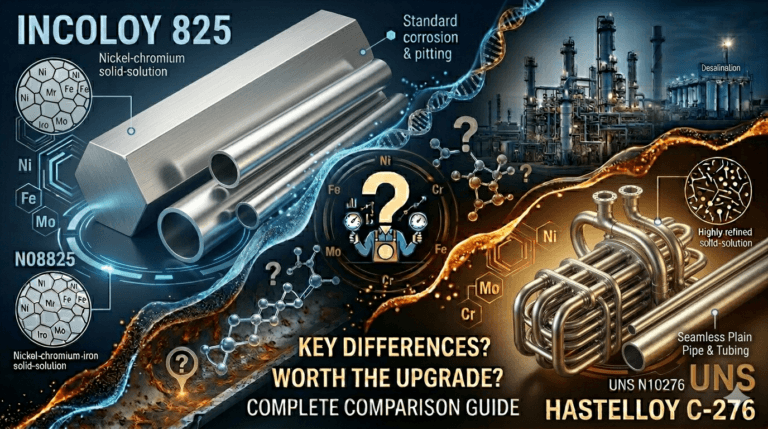
In industrial environments where “corrosion” isn’t just a word but a multi-million dollar threat, one material stands above the rest: Hastelloy C276 (UNS N10276). Often referred to as the “Universal Corrosion-Resistant Alloy,” C276 is a nickel-molybdenum-chromium superalloy with an addition of tungsten, designed to have excellent corrosion resistance in a wide range of severe environments.
Whether you are dealing with aggressive chlorides, sulfuric acid, or contaminated organic media, Hastelloy C276 from JA Alloy provides the structural security required for the world’s most demanding chemical processing plants and pollution control systems.
1. Chemical Composition: The “Universal” Formula
What makes C276 so resilient? The answer lies in its high Molybdenum and Chromium content, coupled with a strictly controlled Low-Carbon profile.
| Element | Content (%) | Technical Contribution |
| Nickel (Ni) | Balance | Provides the base for ductile strength and resistance to stress corrosion cracking (SCC). |
| Molybdenum (Mo) | 15.0 – 17.0 | Primary resistance against pitting and crevice corrosion in reducing environments. |
| Chromium (Cr) | 14.5 – 16.5 | Provides resistance to oxidizing media (e.g., ferric and cupric chlorides). |
| Tungsten (W) | 3.0 – 4.5 | Further enhances resistance to pitting in extremely aggressive salts. |
| Iron (Fe) | 4.0 – 7.0 | Balances the alloy’s structural properties and cost. |
| Carbon (C) | ≤ 0.01 | Extra-low carbon minimizes carbide precipitation during welding. |
The most critical feature of C276 is its low carbon content. In standard alloys, welding causes “sensitization” (carbide precipitation at grain boundaries), which leads to intergranular corrosion. C276 remains resistant to this even in the as-welded condition.
2. Why C276 Wins: Key Resistance Properties
For engineers at JA Alloy, we categorize C276’s performance into three “battlefields”:
A. Pitting and Crevice Corrosion
In stagnant seawater or chloride-rich solutions, standard stainless steels develop tiny holes (pitting). C276’s high Molybdenum and Tungsten levels give it one of the highest PREN (Pitting Resistance Equivalent Number) in the industry, typically exceeding 45.
B. Reducing vs. Oxidizing Media
Most alloys are good at one but bad at the other. C276 is unique; its Chromium handles oxidizing agents, while its Molybdenum handles reducing acids like Hydrochloric (HCl) and Phosphoric acid.
C. Stress Corrosion Cracking (SCC)
Nickel-based alloys are inherently more resistant to chloride-induced SCC than the 300-series stainless steels. C276 is virtually immune to this failure mode in most industrial environments.
3. Critical Applications
Because of its versatility, Hastelloy C276 is found in “mission-critical” equipment:
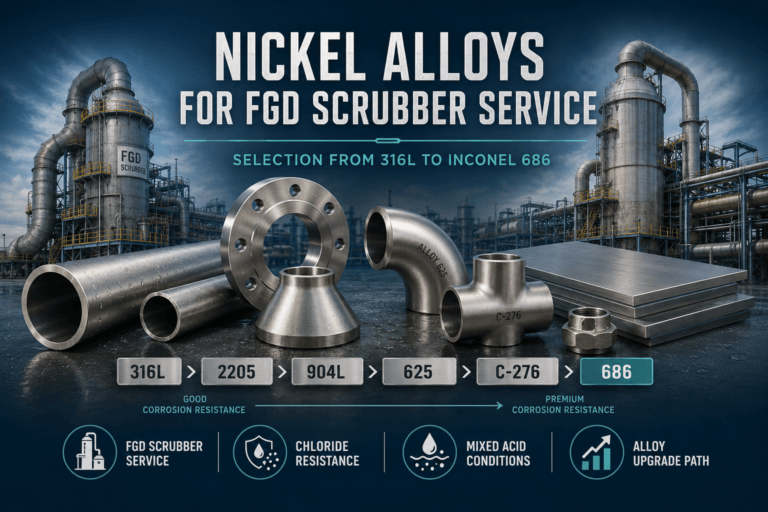
- Pollution Control (FGD): Scrubber liners, ducts, and dampers in coal-fired power plants where sulfuric acid dew point corrosion is rampant.
- Chemical Processing: Reactors, heat exchangers, and evaporators handling mixed acid streams.
- Waste Treatment: Hazardous waste incineration equipment and offshore “sour gas” production components.
- Pharmaceuticals: Multi-purpose reactors where different corrosive chemicals are used in batches.
4. Technical Comparison: C276 vs. C22
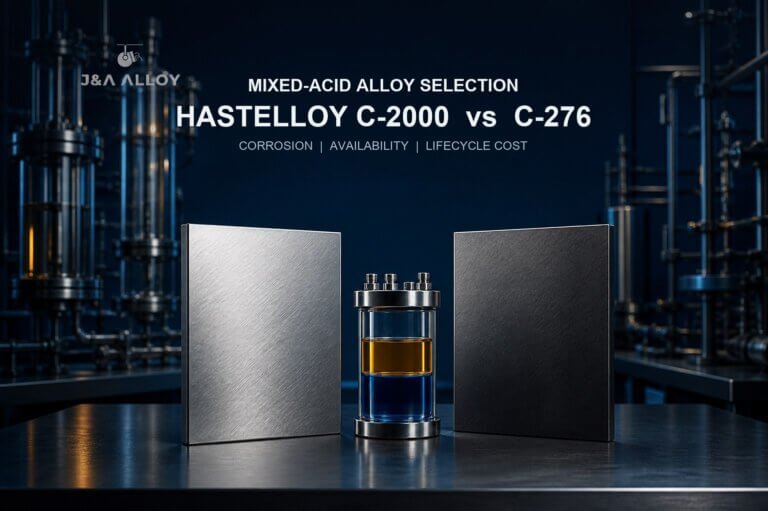
A common question from our B2B clients is: Should I use C276 or C22?
- Hastelloy C276 is generally better in reducing environments (like Hydrochloric acid).
- Hastelloy C22 (UNS N06022) has higher Chromium and is superior in highly oxidizing environments (like Nitric acid).
- Cost & Availability: C276 is the most widely stocked and commercially available “C-series” alloy, making it the practical choice for most projects.
5. Fabrication and Welding Guide
One of the reasons C276 is so popular is its excellent workability.
- Welding: It can be welded using GTAW (TIG), GMAW (MIG), and Shielded Metal Arc methods. Because it resists grain-boundary precipitation, it can be used in chemical processes without post-weld annealing.
- Forming: C276 has excellent ductility and can be cold-worked. However, it work-hardens quickly, so heavy forming may require intermediate annealing at 1121°C (2050°F).
6. Sourcing Hastelloy C276 from JA Alloy
Quality in C276 is defined by its purity. At JA Alloy, we provide C276 in multiple forms:
- Seamless & Welded Pipes: For high-pressure chemical transport.
- Sheets & Plates: Precision-cut for vessel lining.
- Forged Fittings: To ensure zero-leakage in corrosive pipelines.
All our materials are supplied with MTRs (Material Test Reports) certifying compliance with ASTM B575, NACE MR0175, and DIN 2.4819.
Conclusion
Hastelloy C276 remains the most reliable insurance policy against industrial corrosion. Its ability to survive where others fail makes it the cost-effective choice when considering the “Life Cycle Cost” of equipment.