Introduction
In the relentless pursuit of aerospace efficiency, the engineering challenge has always been one of temperature. To achieve greater thrust and lower fuel consumption, jet engines must operate at temperatures that would liquefy most conventional metals. This thermal frontier is conquered by a unique class of materials: Superalloys.
From the early days of jet propulsion to the cutting-edge turbofans of 2026, nickel-based, cobalt-based, and iron-nickel-based superalloys like Nimonic 901, Inconel 718, and Hastelloy X have become the backbone of aerospace engineering. At JA Alloy, we recognize that these materials are not just components; they are the enabling technology for modern aviation and space exploration. This article explores the metallurgical secrets, industrial applications, and future trends of superalloys in the aerospace sector.
1. The Physics of Flight: Why Temperature Equals Efficiency
The performance of a gas turbine engine is governed by the Brayton Cycle. According to thermodynamic principles, increasing the turbine entry temperature (TET) leads to higher thermal efficiency and specific thrust.
Modern jet engines operate at temperatures exceeding 1500°C (2730°F)—far above the melting point of the nickel-base alloys used in their construction (which typically melt around 1300°C). Superalloys manage this impossible feat through a combination of:
- Exceptional Creep Resistance: The ability to resist slow deformation under high stress at high temperatures.
- Oxidation and Corrosion Resistance: Forming a protective oxide layer that prevents the metal from “burning” in the high-pressure oxygen-rich environment.
- Phase Stability: Maintaining their microscopic crystal structure even after thousands of hours of thermal cycling.
2. The Metallurgy of Aerospace Superalloys
Superalloys are defined by their complex chemistry and precise microstructure. At JA Alloy, we categorize these based on their hardening mechanisms.
Gamma Prime (γ) Strengthening
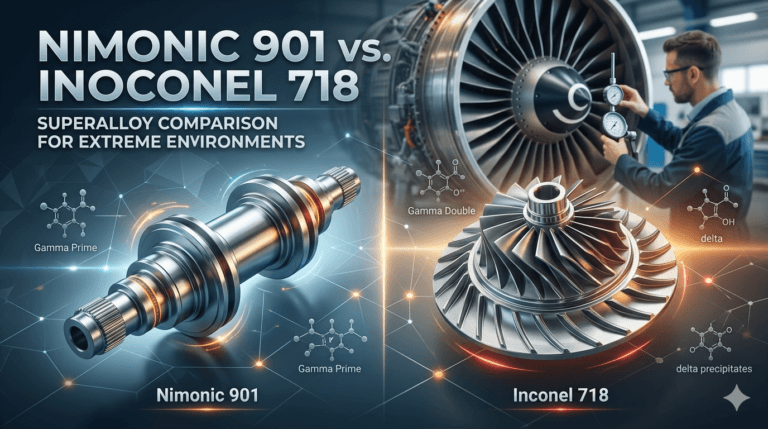
Most high-performance aerospace alloys, such as Nimonic 901 (UNS N09901), rely on the precipitation of the Gamma Prime phase. In these alloys, Titanium and Aluminum react with Nickel to form Ni3(Al, Ti) precipitates. These microscopic particles act as “speed bumps” for dislocations, preventing the metal’s atomic layers from sliding past each other under stress.
Solid Solution Strengthening
Elements with large atomic radii, such as Molybdenum (Mo) and Tungsten (W), are added to “strain” the crystal lattice. This internal tension makes it much harder for the metal to deform. For instance, the high Molybdenum content in Hastelloy X makes it a preferred choice for combustion liners where ductibility and heat resistance are paramount.
Grain Boundary Engineering
By adding trace elements like Boron (B) and Zirconium (Zr), metallurgists can strengthen the “seams” between metal crystals. This prevents intergranular cracking, a common failure mode in turbine discs.
3. Critical Aerospace Components and Their Materials
The environment inside a jet engine varies wildly, requiring different superalloys for different zones.
| Engine Section | Environmental Challenge | Preferred Superalloys |
| Combustion Chamber | Extreme oxidation, constant flame contact. | Hastelloy X, Inconel 617 |
| Turbine Discs | Massive centrifugal force, high thermal stress. | Nimonic 901, Inconel 718, Waspaloy |
| Turbine Blades | Highest temperature zone, centrifugal pull. | Single Crystal (SX) Alloys, Inconel 738 |
| Exhaust Systems | Rapid thermal cycling, corrosive gases. | Inconel 625, Nimonic 75 |
Spotlight: The Turbine Disc
The turbine disc is perhaps the most safety-critical part of an engine. It must hold the turbine blades while rotating at over 10,000 RPM at temperatures near 600°C. Nimonic 901 was specifically designed for this application, offering a high iron content to stabilize thermal expansion while maintaining the strength of a nickel-base superalloy.
4. Beyond the Atmosphere: Superalloys in Space Exploration
The transition from aerospace to “space-space” brings even harsher conditions. Rocket engines, such as those used in SpaceX’s Raptor or NASA’s SLS, face the “dual-threat” of cryogenic liquid fuels and volcanic exhaust temperatures.
- Cryogenic Strength: Unlike many steels that become brittle at -250°C, alloys like Inconel 718 maintain exceptional toughness, making them ideal for liquid oxygen and hydrogen tanks.
- Reusability: The new era of reusable rockets demands materials that can withstand repeated thermal shocks without fatigue. Advanced vacuum-melted superalloys from suppliers like JA Alloy are essential to this mission.
5. Manufacturing Challenges: Forging the Future
Superalloys are notoriously difficult to process. Their very strength at high temperatures makes them a nightmare to forge or machine.
Advanced Forging
At JA Alloy, we utilize specialized forging techniques to control grain size. A “fine-grain” structure is preferred for turbine discs to improve fatigue life, while “coarse-grain” structures are sometimes used for creep resistance in stationary components.
Additive Manufacturing (3D Printing)
The aerospace industry is shifting toward 3D printing complex cooling channels inside turbine parts. Alloys like Inconel 718 are particularly suited for laser powder bed fusion (LPBF), allowing for designs that were previously impossible to cast or machine.
6. The B2B Sourcing Advantage: Quality and Certification
In aerospace, there is zero room for error. A single inclusion or impurity in a batch of Nimonic 901 can lead to an engine failure. Sourcing from JA Alloy ensures:
- VIM/ESR Melting: Vacuum Induction Melting (VIM) followed by Electroslag Remelting (ESR) provides the ultra-pure chemistry required for aerospace-grade materials.
- Stringent Compliance: Our materials meet AMS (Aerospace Material Specifications), AECMA, and GE/Rolls-Royce internal standards.
- Non-Destructive Testing (NDT): Every forged bar is subject to ultrasonic and dye-penetrant inspection to ensure 100% internal integrity.
Conclusion
As the aerospace industry moves toward 2030, the demand for “higher, faster, and hotter” will only increase. Superalloys remain the only material class capable of meeting these demands. Whether it is the iron-stabilized reliability of Nimonic 901 or the versatile strength of Inconel 718, these critical materials continue to push the boundaries of what is humanly possible.
Are you developing the next generation of aerospace or energy technology? Contact JA Alloy’s Technical Experts for material selection advice and competitive B2B quotes on high-performance superalloys.