Introduction
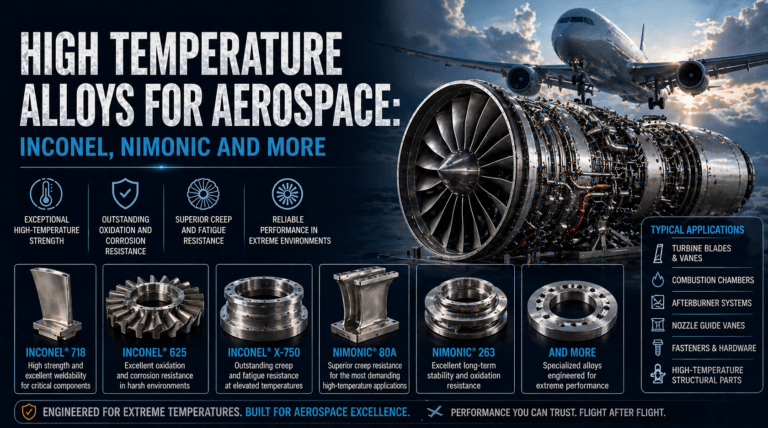
In the hot section of every gas turbine engine — whether turbofan, turboshaft, or industrial turbine — two precipitation-hardened nickel superalloys dominate the rotating hardware: Inconel 718 and Waspaloy. Both have been in continuous production since the 1960s. Both are qualified under dozens of AMS specifications. Both have powered aircraft from the Boeing 747 to the F-35. And yet, despite their shared nickel-base pedigree, they were engineered for fundamentally different temperature regimes — and choosing the wrong one for a turbine disk, combustor liner, or bolted joint can mean the difference between a 30,000-cycle service life and a premature failure.
The critical distinction is the precipitation-strengthening mechanism. Inconel 718 derives its strength from gamma-double-prime (γ″, Ni₃Nb) precipitates. Waspaloy derives its strength from gamma-prime (γ′, Ni₃(Al,Ti)) precipitates. That single metallurgical difference cascades into everything that matters to the design engineer: temperature capability, weldability, fracture toughness, fatigue crack growth rate, processing cost, and lead time.
This article provides a complete engineering comparison so you can make the right selection with data — not vendor folklore.
Composition: Two Strengthening Philosophies
Both alloys are nickel-base, but their chemistries reflect different strengthening strategies.
| Element | Inconel 718 (UNS N07718) | Waspaloy (UNS N07001) |
|---|---|---|
| Nickel (Ni) | 50–55% (bal.) | 58% (bal.) |
| Chromium (Cr) | 17–21% | 18–21% |
| Cobalt (Co) | ≤1.0% | 12–15% |
| Iron (Fe) | 17–21% | ≤2.0% |
| Molybdenum (Mo) | 2.8–3.3% | 3.5–5.0% |
| Niobium (Nb) | 4.75–5.50% | — |
| Titanium (Ti) | 0.65–1.15% | 2.75–3.25% |
| Aluminum (Al) | 0.20–0.80% | 1.20–1.60% |
| Zirconium (Zr) | — | 0.02–0.08% |
| Boron (B) | — | 0.003–0.010% |
| Carbon (C) | ≤0.08% | 0.02–0.10% |
Four compositional differences define the alloy behavior:
1. Niobium (5% in 718, none in Waspaloy). Niobium is the cornerstone of 718’s strengthening. It forms the metastable γ″ phase (Ni₃Nb, body-centered-tetragonal DO₂₂ structure) during aging. γ″ provides exceptional strengthening at temperatures up to ~650°C; above this, γ″ coarsens rapidly and converts to the stable δ phase (orthorhombic), losing strength.
2. Aluminum + Titanium (1.7–2.4% combined in Waspaloy; 0.85–1.95% combined in 718). Waspaloy’s higher Al+Ti content forms the γ′ phase (Ni₃(Al,Ti), L1₂ structure). γ′ is thermodynamically stable to ~800°C in Waspaloy, providing useful strength to 730°C and beyond in rotating applications.
3. Cobalt (13% in Waspaloy, <1% in 718). Cobalt in Waspaloy serves multiple functions: it raises the solvus temperature of γ′, slows diffusion (extending creep life), and stabilizes the matrix against γ′ overaging. Cobalt is the reason Waspaloy retains strength 50–80°C hotter than 718.
4. Iron (18% in 718, <2% in Waspaloy). 718’s high iron content is a cost-control measure — iron is cheaper than nickel. The trade-off is that iron reduces matrix stability and contributes to γ″ instability above 650°C. Waspaloy’s low-iron, high-nickel matrix is more stable but significantly more expensive.
The Metallurgy of γ″ vs γ′ Precipitation
Understanding the precipitation kinetics is essential for any engineer specifying these alloys, because heat treatment dictates whether the alloy reaches its design properties.
Inconel 718: The γ″ System
718’s precipitation sequence during standard aging (720°C × 8 hours + 620°C × 8 hours):
- Nucleation of γ″ (Ni₃Nb): Coherent BCT precipitates, ~10–30 nm diameter, forming as discs on {100} matrix planes
- Nucleation of γ′ (Ni₃(Al,Ti)): Smaller spherical precipitates, ~5–15 nm, forming simultaneously
- Co-precipitation strengthening: γ″ provides ~70% of strengthening; γ′ provides the remainder
The metastability of γ″ is the key limitation. Above ~650°C, γ″ coarsens rapidly (Ostwald ripening) and transforms to δ-Ni₃Nb, which is incoherent and provides no strengthening. This is why 718’s service temperature is capped at 650°C for rotating applications and 700°C for static applications.
Waspaloy: The γ′ System
Waspaloy’s precipitation sequence during standard aging (multiple steps: 1080°C solution + 845°C stabilizing + 760°C aging):
- Nucleation of γ′ (Ni₃(Al,Ti)): Coherent FCC precipitates, ~20–50 nm diameter, spherical morphology at low Ti/Al ratio, cuboidal at higher ratios
- Bimodal size distribution: Solution anneal + aging produces a bimodal γ′ distribution — large primary γ′ at grain boundaries (0.5–1.5 μm) and fine secondary γ′ in the matrix (50–100 nm)
- Grain boundary carbide stabilization: M₂₃C₆ and TiC carbides at grain boundaries provide grain boundary pinning and creep resistance
γ′ is thermodynamically stable to ~980°C (the γ′ solvus in Waspaloy). The operational limit is set not by γ′ coarsening but by matrix creep and fatigue considerations — typically 730°C for rotating components and 760°C for static components.
Heat Treatment Comparison
| Parameter | Inconel 718 | Waspaloy |
|---|---|---|
| Solution anneal | 980°C × 1 hr, AC | 1020–1040°C × 4 hr, OQ |
| Stabilization | — | 845°C × 4 hr, AC |
| First age | 720°C × 8 hr, FC | 760°C × 16 hr, AC |
| Second age | 620°C × 8 hr, AC | — |
| Total heat treatment time | ~17 hours | ~24 hours |
| Resulting hardness | 38–44 HRC | 38–46 HRC |
Waspaloy’s three-stage heat treatment is more complex and significantly more expensive than 718’s two-stage cycle. The 24-hour total cycle time versus 17 hours for 718 adds meaningful cost in production environments.
Mechanical Properties: Where Temperature Decides Everything
The mechanical property comparison reveals why both alloys coexist in the same engines.
| Property | Inconel 718 (Aged) | Waspaloy (Aged) |
|---|---|---|
| UTS (room temp) | 1240–1380 MPa | 1275–1450 MPa |
| Yield 0.2% (room temp) | 1035–1240 MPa | 930–1100 MPa |
| Elongation (room temp) | 12–25% | 15–25% |
| UTS at 540°C | 1100–1200 MPa | 1170–1280 MPa |
| UTS at 650°C | 965–1100 MPa | 1100–1240 MPa |
| UTS at 760°C | 690–830 MPa | 930–1035 MPa |
| UTS at 870°C | 280–380 MPa | 550–690 MPa |
Room Temperature: 718 Has Higher Yield
At ambient temperature, 718’s yield strength exceeds Waspaloy by 10–15%. This is because γ″ is a more potent room-temperature strengthener than γ′ on a per-volume basis — the BCT structure creates a larger lattice mismatch with the matrix, increasing the energy required for dislocation bypass.
Elevated Temperature: Waspaloy’s γ′ Wins
Above 650°C the picture reverses. 718’s γ″ begins to coarsen and convert to δ phase, causing rapid strength loss. By 760°C, 718 retains only ~55% of its room-temperature UTS, while Waspaloy retains ~75%. At 870°C, Waspaloy is roughly twice as strong as 718.
This is the fundamental selection rule: below 650°C, 718 is equal or superior; above 650°C, Waspaloy is the only valid choice for structural rotating components.
Creep and Stress Rupture
Creep performance diverges even more sharply than tensile strength:
| Condition | Inconel 718 | Waspaloy |
|---|---|---|
| 650°C / 690 MPa, hrs to 1% creep | 200–500 hr | 1,000–2,500 hr |
| 730°C / 310 MPa, hrs to rupture | 50–150 hr | 1,000–3,000 hr |
| 760°C / 240 MPa, hrs to rupture | 30–80 hr | 500–1,500 hr |
Waspaloy’s cobalt-stabilized matrix slows diffusion, slowing dislocation climb and grain boundary sliding. For components that must survive 10,000+ hours at 700°C (typical of industrial gas turbine disks), Waspaloy is the baseline; 718 is not qualified.
Fatigue and Fracture Toughness
| Property | Inconel 718 | Waspaloy |
|---|---|---|
| LCF at 427°C, ±0.6% strain, Nf | 50,000–100,000 cycles | 30,000–60,000 cycles |
| LCF at 650°C, ±0.6% strain, Nf | 20,000–50,000 cycles | 40,000–80,000 cycles |
| Fatigue crack growth rate (da/dN at ΔK=20 MPa√m) | 2.5 × 10⁻⁵ mm/cyc | 5.0 × 10⁻⁵ mm/cyc |
| Fracture toughness K_IC | 90–140 MPa√m | 70–100 MPa√m |
718 has superior fracture toughness and slower fatigue crack growth — both critical for damage-tolerant turbine disk design. Waspaloy’s higher crack growth rate is a known limitation, and disk designs in Waspaloy typically require more conservative inspection intervals.
This is the paradox of Waspaloy: higher temperature capability, but more brittle failure mode. Engine designers balance this by using Waspaloy only where temperature demands it, and 718 everywhere else.
Weldability: 718’s Decisive Advantage
Weldability is where Inconel 718 dominates the comparison — and the reason 718 is specified far more often than Waspaloy in repairable components.
Inconel 718 Welding
- Filler metal: AMS 5832 (ERNiFeCr-2), matching composition
- Weldability rating: Excellent — among the most weldable nickel superalloys
- Cracking resistance: Superior — niobium’s delayed precipitation gives 718 a wide “safe” welding window
- Repair welding: Commonly repair-welded in service (combustor liners, cases, frames)
- Post-weld heat treatment: Standard aging treatment restores full properties; no solution anneal required
- Process compatibility: GTAW, GMAW, EBW, laser, friction weld all widely qualified
The fundamental reason for 718’s weldability: γ″ precipitates slowly. After welding, the HAZ does not immediately harden, allowing residual stresses to relax before the alloy reaches full strength during subsequent aging.
Waspaloy Welding
Waspaloy is notoriously difficult to weld:
- Filler metal: AMS 5828 (ERNiCoCrSi-3) or matching composition
- Weldability rating: Poor to marginal — strain-age cracking is the primary risk
- Cracking mechanism: γ′ precipitates rapidly during the post-weld cooling and subsequent aging cycle. As γ′ forms, the matrix contracts (γ′ has lower lattice parameter than the matrix), generating tensile stress in the HAZ. Combined with residual weld stress, this causes strain-age cracking — typically occurring during post-weld heat treatment
- Repair welding: Generally not permitted for rotating components; limited repair allowed on static parts with stringent procedure qualification
- Process compatibility: GTAW with extreme care; EBW and laser welds have better success rates; GMAW rarely used
- Practical implication: Waspaloy components are typically manufactured from forgings and machined to final shape. Welded fabrications in Waspaloy are rare
The welding difference drives component design philosophy:
- 718: weldable superalloy — used for fabricated combustor liners, welded cases, repair-critical components
- Waspaloy: forged-only superalloy — used for disks, spacers, seal rings, and bolts where welding is not required
Physical Properties
| Property | Inconel 718 | Waspaloy |
|---|---|---|
| Density | 8.19 g/cm³ | 8.20 g/cm³ |
| Melting range | 1260–1336°C | 1290–1365°C |
| Electrical resistivity (20°C) | 1.15 μΩ·m | 1.24 μΩ·m |
| Thermal conductivity (20°C) | 6.5 W/m·K | 6.3 W/m·K |
| CTE (20–100°C) | 13.0 μm/m·°C | 12.7 μm/m·°C |
| CTE (20–700°C) | 16.6 μm/m·°C | 15.3 μm/m·°C |
| Magnetic permeability | 1.001 | 1.001 |
The two alloys have nearly identical densities and are both non-magnetic. Waspaloy’s lower CTE at elevated temperature gives it slightly better thermal fatigue resistance in constrained geometries.
Standards and Specifications
Inconel 718 (UNS N07718)
| Form | Standard |
|---|---|
| Bar, forging | AMS 5662 (solution anneal), AMS 5663 (solution + age), AMS 5664 (precipitation hardening) |
| Sheet, strip, plate | AMS 5596, AMS 5597 |
| Tubing | AMS 5589, AMS 5590 |
| Wire | AMS 5832 (welding), AMS 5962 (cold drawn) |
| Investment casting | AMS 5382, AMS 5383 |
| Fasteners | NASM 21151, various |
Waspaloy (UNS N07001)
| Form | Standard |
|---|---|
| Bar, forging | AMS 5704 (solution + age), AMS 5707 (double age), AMS 5708, AMS 5709 |
| Sheet, strip | AMS 5544 |
| Plate | AMS 5544 |
| Tubing | Limited standardization — typically custom |
| Wire | AMS 5828 (welding — limited use) |
| Fasteners | AMS 5727 (bolt stock) |
718’s standardization is dramatically broader than Waspaloy’s. 718 is available in virtually every product form — bar, plate, sheet, tube, wire, castings, fasteners, powders for additive manufacturing. Waspaloy is essentially a forged-bar and plate product with limited wire and no castings. For designers needing complex geometries or cast components, 718 is the only practical choice.
Cost Comparison: 718 Is Cheaper — Sometimes Significantly
Indicative raw material pricing (aerospace-grade, AMS-certified stock):
| Form | Inconel 718 | Waspaloy | Premium |
|---|---|---|---|
| Bar (50 mm, AMS 5663) | $45–65/kg | $80–115/kg | +75–85% |
| Forging (turbine disk blank) | $55–75/kg | $110–160/kg | +100–115% |
| Plate (12 mm, AMS 5597) | $50–70/kg | $90–125/kg | +75–80% |
| Wire (3 mm, weld wire) | $80–110/kg | $150–220/kg | +85–100% |
The Waspaloy premium reflects:
- Higher cobalt content (cobalt is 2–3× the price of nickel)
- Lower iron content (more expensive pure nickel required)
- More complex heat treatment (24-hour cycle vs 17-hour)
- Smaller production volumes (less economy of scale)
- Stricter chemistry control for aerospace rotating parts
Total component cost ratio: For a comparable turbine disk forging, Waspaloy is typically 1.8–2.2× the cost of 718. For complex machined components, the ratio can reach 2.5× due to higher scrap rates and slower machining.
Application Decision Guide
Choose Inconel 718 When:
✅ Service temperature is below 650°C continuous — the dominant regime for aircraft engine fan and LPC disks, compressor blades, cases, and frames
✅ Welded fabrication is required — combustor liners, welded cases, sheet metal fabrications, ducts
✅ Repair welding in service is anticipated — 718 components can be weld-repaired; Waspaloy generally cannot
✅ Castings or complex geometries — 718 is widely investment-cast; Waspaloy is rarely cast
✅ Cost is a primary driver — 718 is typically half the cost of Waspaloy
✅ Damage tolerance is critical — 718’s higher fracture toughness and slower crack growth support longer inspection intervals ✅ Additive manufacturing — 718 is the most widely-qualified nickel superalloy for LPBF and DED processes; Waspaloy is far more difficult
✅ Fasteners and bolts to 650°C — 718 fasteners dominate aerospace bolted joints
Choose Waspaloy When:
✅ Service temperature is 650–730°C continuous — HPT disks, seal rings, spacers in the hot section
✅ Creep life at 700°C+ is the design driver — Waspaloy’s creep rupture life at 730°C is 10–30× that of 718
✅ Tensile strength above 700°C is required — bolts, studs, and fasteners in the hot section
✅ Rotating components with long service life — Waspaloy disks are designed for 15,000–30,000 cycles between overhauls ✅ Industrial gas turbine disks — baseload IGT service with 25,000+ hour hot-section life
✅ Static hot-section components to 760°C — combustor liners (when 718 is insufficient), transition pieces, nozzles
Neither Alloy Is Adequate For:
❌ Service above 800°C continuous — use single-crystal nickel alloys (CMSX-4, Rene N5) for turbine blades
❌ Service above 760°C in rotating parts — use powder metallurgy superalloys (Rene 95, LSHR) or single-crystal alloys
❌ Highly oxidizing environments without coatings — both alloys require protective coatings above 700°C
❌ Cryogenic service — use Inconel 625 (see Article 29) or austenitic stainless steel
Common Engine Layouts: Where Each Alloy Goes
To make the selection tangible, here is a typical aircraft turbofan engine layout showing where each alloy is used:
| Engine Section | Temperature Range | Typical Alloy |
|---|---|---|
| Fan disk | <200°C | Titanium (Ti-6Al-4V) |
| LPC (low-pressure compressor) disk | 200–400°C | Inconel 718 |
| HPC (high-pressure compressor) disk, stages 1–6 | 400–550°C | Inconel 718 |
| HPC disk, stages 7–10+ | 550–620°C | Inconel 718 (sometimes Waspaloy for late stages) |
| Combustor liner | 700–900°C (gas path) | Inconel 718 (with thermal barrier coating), Haynes 230, or Waspaloy (premium engines) |
| HPT (high-pressure turbine) disk | 650–730°C | Waspaloy (or powder metallurgy Rene 95 for highest performance) |
| HPT bolts and clamps | 700°C | Waspaloy (AMS 5727 bolt stock) |
| LPT (low-pressure turbine) disk | 500–650°C | Inconel 718 |
| Turbine blades (HPT) | 900–1100°C (gas path) | Single-crystal nickel alloys (CMSX-4) |
| Cases and frames | 200–650°C | Inconel 718 (welded fabrications) |
Pattern: 718 dominates the front and rear of the engine (compressor and LPT sections) where temperatures are below 650°C. Waspaloy concentrates in the hot section center (HPT disk and bolts) where 650–730°C service is required.
Quick Comparison: Inconel 718 vs Waspaloy
| Property | Inconel 718 | Waspaloy | Advantage |
|---|---|---|---|
| Strength at 20°C | Higher yield | Lower yield | 718 |
| Strength at 650°C | Similar | Slightly higher | Tie |
| Strength at 760°C | Low | High | Waspaloy |
| Creep at 730°C | Poor | Excellent | Waspaloy |
| Weldability | Excellent | Poor | 718 |
| Fracture toughness | Higher | Lower | 718 |
| LCF life at 650°C | Moderate | Better | Waspaloy |
| Cost | Lower | +75–100% | 718 |
| Casting available | Yes | No | 718 |
| Repair welding | Yes | No | 718 |
| AMS standardization | Broad | Limited | 718 |
| Max rotating service temp | 650°C | 730°C | Waspaloy |
| Max static service temp | 700°C | 760°C | Waspaloy |
| Additive manufacturing | Mature | Limited | 718 |
Frequently Asked Questions
Q1: Can Inconel 718 be substituted for Waspaloy in a 700°C turbine disk application to save cost?
No — this substitution would result in premature disk failure. At 700°C, 718’s γ″ phase coarsens rapidly and converts to the stable δ phase, which provides no strengthening. 718’s creep rupture life at 730°C / 310 MPa is only 50–150 hours versus Waspaloy’s 1,000–3,000 hours — a 10–30× reduction. A 718 disk designed for 700°C service would yield, creep, and crack well before the required inspection interval. The cost saving would be trivial compared to the cost of an in-service disk failure. Waspaloy is specified for 650–730°C rotating applications precisely because 718 cannot survive this regime.
Q2: Why is Inconel 718 so much more weldable than Waspaloy?
The answer lies in the precipitation kinetics of the strengthening phases. 718’s γ″ (Ni₃Nb) precipitates slowly — full precipitation requires 8+ hours at 720°C. This slow kinetics gives welders a wide window where the HAZ remains soft and ductile after welding, allowing residual stresses to relax. Waspaloy’s γ′ (Ni₃(Al,Ti)) precipitates rapidly — significant γ′ forms during the post-weld cooling itself. As γ′ forms, the matrix lattice contracts (γ′ has a smaller lattice parameter than the surrounding matrix), generating tensile stress in the HAZ. Combined with residual weld stress, this causes strain-age cracking during post-weld heat treatment. The fundamental difference is precipitation kinetics, not chemistry per se.
Q3: Which alloy should I specify for combustor liner fabrication?
For most aircraft engine combustor liners operating at 700–900°C gas-path temperature with internal air cooling (metal temperature 650–750°C), Inconel 718 with a thermal barrier coating is the standard choice. 718’s weldability allows fabricated sheet metal construction with welded stiffeners, and the coating manages the temperature excursion above 718’s bare-metal limit. For the most demanding combustor designs (military engines, low-emission industrial turbines with higher metal temperatures), Waspaloy or Haynes 230 may be specified. Waspaloy combustor liners require machined or forged construction rather than welded sheet.
Q4: How does the cost difference affect total engine cost?
In a typical commercial turbofan, 718 represents 30–50% of total engine weight (compressor disks, cases, frames, fasteners), while Waspaloy represents 3–8% (HPT disk, hot-section bolts). The small fraction of Waspaloy by weight is justified by its critical function — without Waspaloy’s temperature capability, the engine’s pressure ratio and firing temperature would need to be reduced, dropping thermal efficiency by several percent. The 75–100% material premium for Waspaloy is repaid many times over in fuel savings across the engine’s 20,000+ hour life. Engineers do not “cost-reduce” by substituting 718 for Waspaloy in the hot section.
Q5: Are there newer alloys replacing 718 and Waspaloy?
Yes — for advanced engines. Powder metallurgy Rene 88DT replaces Waspaloy in many newer HPT disk applications, offering 30–50°C higher temperature capability with improved damage tolerance. For 718 applications, ATI 718Plus extends 718’s temperature capability to 700°C by adding Al+Ti and adjusting the precipitation response. However, 718 and Waspaloy remain the workhorses of the industry due to their mature supply chain, vast qualification database, and known behavior. New aircraft engine programs continue to specify 718 in 2025 because no other alloy offers its combination of cost, weldability, and performance below 650°C.
Conclusion
Inconel 718 and Waspaloy are not competing alloys — they are complementary technologies that together make modern gas turbine engines possible. They occupy adjacent but distinct temperature regimes, and the design engineer’s job is to recognize which regime the component operates in.
Inconel 718 is the universal nickel superalloy below 650°C. Its weldability, castability, broad standardization, damage tolerance, and relatively low cost make it the default choice for compressor disks, cases, frames, fasteners, and combustor liners (with coatings). When 718 works, no other alloy can match its combination of performance and economy.
Waspaloy is the dedicated hot-section alloy for 650–730°C service. Its γ′ strengthening, cobalt-stabilized matrix, and superior creep resistance justify its 75–100% cost premium in the small number of components where 718 simply cannot survive. Waspaloy is specified only where the application demands it — and in those applications, no substitute exists.
Selection rule of thumb: If the metal temperature is below 650°C, choose 718. If the metal temperature is 650–730°C and welding is not required, choose Waspaloy. If welding is required above 650°C, choose 718 with a thermal barrier coating, or step up to a more exotic alloy (Haynes 230, Rene 41). The temperature-mechanism boundary at 650°C is non-negotiable; γ″ metastability cannot be engineered around.
relative Links
- Inconel 625 vs Inconel 718: Strength vs Weldability — Comparing 718 against its solid-solution sister alloy 625 for applications requiring weldability over peak strength.
- Nimonic 901 vs Nimonic 105: Forged Superalloy Comparison — The Nimonic family occupies a similar temperature regime to Waspaloy; this article covers the precipitation-hardened Nimonic alternatives.
- Inconel 600 vs 601: High-Temp Oxidation & Furnace Selection — For non-rotating high-temperature applications where oxidation resistance matters more than creep strength.
- High-Temp Alloys for Aerospace: Selection Guide — The comprehensive pillar page covering the entire aerospace superalloy selection landscape.
J&A Alloy supplies Inconel 718 and Waspaloy in bar, forging, plate, and wire forms from AMS-certified stock, with full mill test reports, NADCAP-certified heat treatment, and full material traceability per aerospace requirements. Contact our metallurgical team for application-specific selection guidance and certified material pricing.