Inconel 625 and Inconel 718 are both difficult-to-machine nickel alloys, but the reason for difficulty is not identical. Alloy 625 is a solid-solution-strengthened nickel-chromium-molybdenum-niobium alloy with strong work-hardening behavior. Alloy 718 is precipitation hardenable, so its machinability changes sharply between the solution-treated and aged conditions.
The drawing may call both materials simply “Inconel,” yet a shop that quotes them as if they were the same can underestimate tool consumption, cycle time, distortion risk and inspection effort.
Important: Cutting data in this guide are planning principles, not a qualified machining procedure. Final parameters must be validated for the exact material condition, diameter, tool grade, insert geometry, machine rigidity, coolant system, feature and acceptance requirements.
The Short Answer
Machine Alloy 718 before aging whenever the specification and manufacturing sequence permit; solution-treated 718 normally gives longer tool life than aged material. For both 625 and 718, use a rigid setup, sharp tools, positive cutting action, continuous feed and enough depth of cut to get below the work-hardened layer. Never let the tool dwell or rub.
Inconel 625 vs 718 Machining Comparison
| Planning factor | Inconel 625 | Inconel 718 |
|---|---|---|
| UNS number | N06625 | N07718 |
| Strengthening mechanism | Mainly solid-solution strengthening from Mo and Nb | Precipitation hardening, principally through Nb-bearing strengthening phases |
| Condition sensitivity | Work hardening and prior cold work matter | Solution-treated versus aged condition is a major cost driver |
| Preferred stage for heavy machining | Annealed or solution-treated stock | Normally solution-treated stock before final aging |
| Typical shop difficulty | Heat concentration, work hardening, built-up edge and tool wear | The same problems, plus much higher strength after aging |
| Chip behavior | Tough, stringy chips can be difficult to control | Aged material may break chips more readily, although tool life is shorter |
| Main planning risk | Recutting a hardened surface or skin | Quoting without knowing the exact heat-treatment condition |
| Best control strategy | Rigid setup, positive cut, coolant and planned tool changes | Split rough machining, heat treatment and finish machining deliberately |
Why These Alloys Damage Cutting Tools
Low Thermal Conductivity Concentrates Heat
Nickel alloys carry heat away from the cutting zone less effectively than many carbon and alloy steels. More heat stays at the tool-chip interface, accelerating flank wear, notching and edge breakdown. Increasing speed without watching the wear mode can shorten tool life dramatically.
This is why productivity should be measured by stable parts per edge, not by spindle speed alone. A slower, repeatable cut that holds tolerance may cost less than an aggressive cut followed by insert failure, scrap or an unplanned stop.
Work Hardening Punishes Rubbing
The surface ahead of and below the tool can harden as it is deformed. A light finishing pass, a dwell at the shoulder or a drill that stops feeding may leave the next edge cutting a harder layer. The result can be rapid notch wear, chatter or loss of size.
Practical rules follow from this behavior:
- keep the tool engaged with a positive, continuous feed;
- avoid programmed dwell in the cut;
- use a depth of cut that places the edge below the previous hardened layer;
- replace a worn tool before it begins rubbing; and
- avoid repeated spring passes unless the process has been proven.
High Strength Loads the Cutting Edge
Alloy 625 retains useful strength across a wide temperature range. Alloy 718 becomes substantially stronger after precipitation hardening. Both generate high cutting forces, so weak workholding, excessive overhang or a flexible boring bar quickly becomes a vibration problem.
Machine capability should therefore be reviewed before selecting cutting data. Spindle torque at the intended speed, workholding stiffness, tool overhang, coolant delivery and chip evacuation can matter as much as nominal horsepower.
Material Condition Must Be on the Quote
“Inconel 718 bar” is not enough information for a machining quotation. The supplier and machine shop should know whether the material is solution treated, solution treated and aged, cold worked, directly aged, or supplied to a particular AMS, ASTM or customer condition.
Special Metals states that annealed 718 is easier to machine and provides longer tool life, while aged 718 may give a somewhat better finish and chip action. This distinction should drive the operation sequence.
For Alloy 625, confirm whether the stock is annealed, solution annealed or cold worked. Cold drawing can increase strength and hardness significantly, and surface scale or an as-forged skin may require a different first cut from peeled or ground bar.
Before releasing the job, record:
- alloy and UNS number;
- product specification and edition;
- heat number and certificate condition;
- heat-treatment history;
- hardness range when relevant;
- starting surface condition;
- amount of stock to remove; and
- final heat treatment, coating or surface requirements.
Plan the Manufacturing Sequence Before Cutting
A Common Route for Alloy 718
For many precision 718 components, the lowest-risk sequence is:
- Receive and verify solution-treated material.
- Saw or rough machine with enough stock for later cleanup.
- Stress relieve only when the drawing, material specification and approved process allow it.
- Complete the specified solution and aging treatment at the defined stage.
- Inspect for distortion and verify hardness or mechanical-property documentation.
- Finish machine critical diameters, faces, threads and sealing surfaces.
- Perform final NDE, dimensional inspection and surface treatment as required.
This is not universal. Some specifications require material to be purchased already aged; some parts need machining after aging; and some dimensions cannot tolerate heat-treatment movement. The drawing, material specification and approved manufacturing plan control.
Alloy 625 Usually Has a Simpler Heat-Treatment Decision
Alloy 625 commonly derives strength from solid-solution effects rather than a required aging treatment. That removes one major scheduling variable, but it does not make the alloy easy to cut. A buyer still needs to decide whether parts will be machined from annealed bar, forged preforms, plate or near-net-shape forgings.
Large stock removal from solid bar may look commercially simple while creating high chip volume, long cycle time and residual-stress movement. A forging or preform can reduce machining time, but only if its allowance, surface quality, ultrasonic inspection and traceability are properly specified.
Tooling Strategy by Operation
Turning and Facing
Coated carbide is the normal starting point for productive turning. Use a tough substrate and geometry intended for nickel-based heat-resistant superalloys. A sharp, positive edge reduces cutting force, but the edge must still be strong enough for the depth of cut and interruption level.
Keep the entry and exit controlled. When possible, avoid leaving the depth-of-cut line at exactly the same point for many passes because localized notching can develop. Program a stable feed and monitor spindle load, sound, surface finish and flank wear.
Special Metals publishes a broad turning range for Alloy 625 rather than one universal speed. That is the correct way to interpret any handbook value: as a starting window that must be narrowed for the tool, setup and part.
Milling
Milling repeatedly enters and exits the work, so thermal cycling and impact load the edge. Use the largest stable cutter the feature allows, minimize tool overhang and control radial engagement. Climb milling is often preferred on rigid CNC equipment, but the machine, workholding and cutter manufacturer’s guidance should govern.
Do not reduce feed until the insert merely rubs. When chatter starts, review rigidity, engagement, runout and tool path before automatically slowing the feed. Unequal insert loading from cutter runout can destroy one edge while the others appear unused.
Drilling and Holemaking
Holemaking combines high heat with poor chip evacuation. Use rigid, short drills with through-coolant when available. Maintain feed through the work-hardened skin and avoid dwelling at the bottom. Peck cycles should fully clear chips without allowing repeated rubbing on re-entry.
For deep holes, define allowable straightness, diameter, surface finish and inspection method before choosing the process. Pilot drilling, indexable drilling, carbide gundrilling, boring or reaming may be required depending on aspect ratio and tolerance.
Threading
Threading concentrates load at a small cutting edge. Use a process developed for the condition of the alloy and leave sufficient wall thickness behind the thread. For external threads, rolling can improve surface integrity and fatigue behavior, but it requires suitable material condition, blank diameter, tooling capacity and specification approval.
Do not assume threads can be rolled after 718 has been aged. Likewise, do not cut a final thread before heat treatment unless dimensional change, scale removal and property requirements have been considered.
Grinding and EDM
Grinding can achieve tight size and finish, but thermal damage, residual tensile stress and surface cracking must be controlled. Specify wheel, dressing, coolant, burn inspection and stock allowance for critical parts.
Electrical discharge machining is useful for complex or hardened 718 features. The recast layer, microcracking risk and required removal allowance should be addressed in the process specification. Aerospace or fatigue-critical parts may require polishing, chemical removal or another controlled finishing step after EDM.
Coolant and Chip Control
Flood coolant must reach the cutting edge rather than the outside of a chip bundle. High-pressure delivery can improve chip breaking and temperature control in turning and drilling, provided the tool and machine are designed for it.
Coolant concentration, filtration and cleanliness should be maintained. Long, tough chips can damage the part, block coolant or create a safety hazard. If chip control deteriorates, treat it as a process signal: check edge wear, feed, chipbreaker selection and material condition.
Dry cutting, minimum-quantity lubrication and ceramic machining can be valid in specific high-temperature superalloy operations, but they should not be copied from an unrelated job. Follow the tool supplier’s application window and validate surface integrity.
Do Not Copy One Speed-and-Feed Table Blindly
Two jobs with the same alloy designation may need different parameters because of:
- annealed versus aged condition;
- bar, plate, forging or cast starting form;
- hardness and prior cold work;
- interrupted versus continuous cut;
- machine stiffness and spindle torque;
- insert grade, coating and edge preparation;
- toolholder overhang;
- coolant pressure and nozzle position;
- stock allowance and scale; and
- required tolerance and surface integrity.
A good setup sheet records actual tool life and wear mode. Useful measures include minutes in cut, parts per edge, maximum flank wear, dimensional drift, insert failure location and surface-finish trend. This data is more valuable for the next quotation than a generic machinability rating.
Quality Risks After Machining
Dimensional conformity alone may not be enough. Depending on service, the buyer may need to control:
- grinding burn or abusive machining;
- laps, tears and smeared metal;
- tensile residual stress;
- white layer or EDM recast layer;
- burrs at intersecting holes;
- thread-root damage;
- iron contamination on corrosion-service surfaces; and
- traceability after cutting the original bar or forging.
Define NDE and surface-integrity requirements before manufacture. Fluorescent penetrant inspection, magnetic methods, etching, hardness checks or metallographic validation are not interchangeable and are not automatically included in a standard machining quotation.
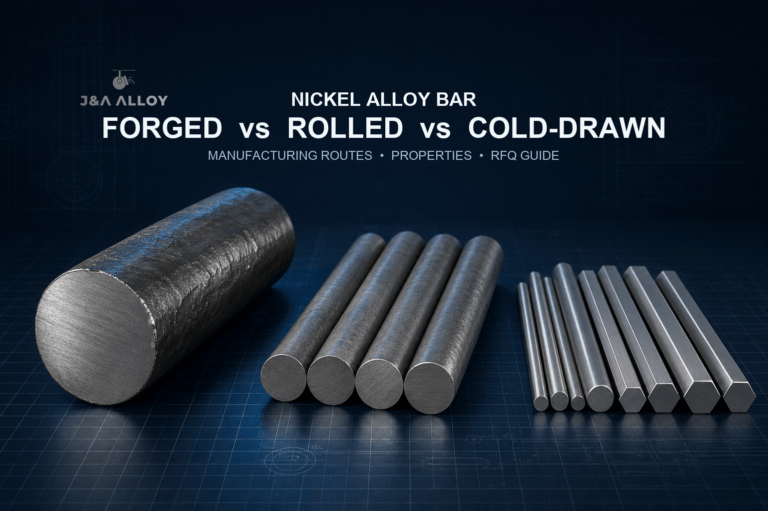
For traceability and inspection planning, see EN 10204 3.1 vs 3.2 Certificates and How to Inspect Nickel Alloy Materials. Buyers choosing starting stock may also use our guide to forged, rolled and cold-drawn nickel alloy bar.
Machining RFQ Checklist
- Drawing number, revision and 3D model format.
- Alloy, UNS number and governing material specification.
- Required material condition before machining.
- Required final heat-treatment condition and process responsibility.
- Starting product form, size, surface and permitted substitutions.
- Heat, lot and piece-level traceability.
- Critical dimensions, geometric tolerances and datum strategy.
- Surface-finish and surface-integrity requirements.
- Thread standard, class, forming or cutting restriction and gauging method.
- Machining allowance before and after heat treatment.
- Distortion-control and intermediate-inspection plan.
- Coolant or contamination restrictions.
- NDE method, stage, extent and acceptance criteria.
- Deburring, edge-break and cleanliness requirements.
- First-article, capability or production inspection requirements.
- EN 10204 certificate type and final document package.
- Quantity, delivery schedule and permitted split shipments.
Frequently Asked Questions
Is Inconel 718 harder to machine than Inconel 625?
Aged 718 is generally the more demanding condition because precipitation hardening raises strength and hardness. Solution-treated 718 may be easier to cut than aged 718, but both alloys work harden and concentrate heat at the tool edge.
Should Inconel 718 be machined before or after heat treatment?
Heavy machining is commonly performed in the solution-treated condition, followed by aging and controlled finish machining. The exact sequence depends on the governing specification, final properties, distortion allowance and feature tolerances.
Why do tools notch when machining Inconel?
Notching often develops at the depth-of-cut line where the edge meets a work-hardened surface or scale. Heat, chemical wear, repeated contact at the same line and insufficient rigidity can accelerate it.
Can carbide tools machine both 625 and 718?
Yes. Carbide is widely used for both, but grade, coating, geometry and edge preparation must match the alloy condition and operation. A grade that works for continuous turning may fail in an interrupted milling cut.
Is ceramic tooling suitable for Inconel 718?
Ceramics can be productive in selected high-speed continuous roughing operations, particularly on aged superalloys. They require adequate machine power, stable engagement and a toolmaker-approved application window; they are not a universal replacement for carbide.
What information has the greatest effect on a machining quote?
Material condition, stock form, removal volume, tolerance, surface integrity, inspection scope and production quantity are major cost drivers. For 718, whether machining occurs before or after aging is especially important.
Final Recommendation
Treat machining Inconel 625 vs 718 as a process-planning decision, not a simple material surcharge. Confirm the delivery condition first, keep the cut positive, design for rigidity and coolant access, and coordinate rough machining, heat treatment and finishing before production begins.
J&A Alloy can supply Alloy 625 and Alloy 718 bar, plate, forgings, rings and machining stock with the required material condition and inspection documentation. Send the drawing, specification, starting size, heat-treatment condition, quantity and testing requirements so we can align the material route with your machining plan.
References
- Special Metals, INCONEL Alloy 625 technical bulletin.
- Special Metals, INCONEL Alloy 718 technical bulletin.
- Sandvik Coromant, Machinability of heat-resistant superalloys.
- SAE International, AMS5662 – Alloy 718 solution-treated bars, forgings and rings.