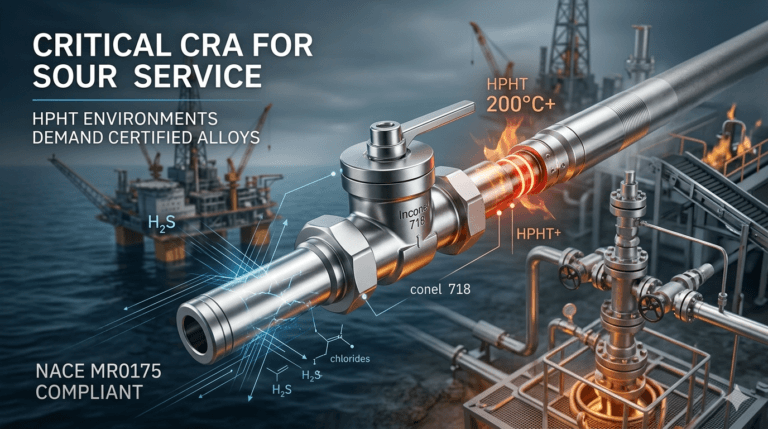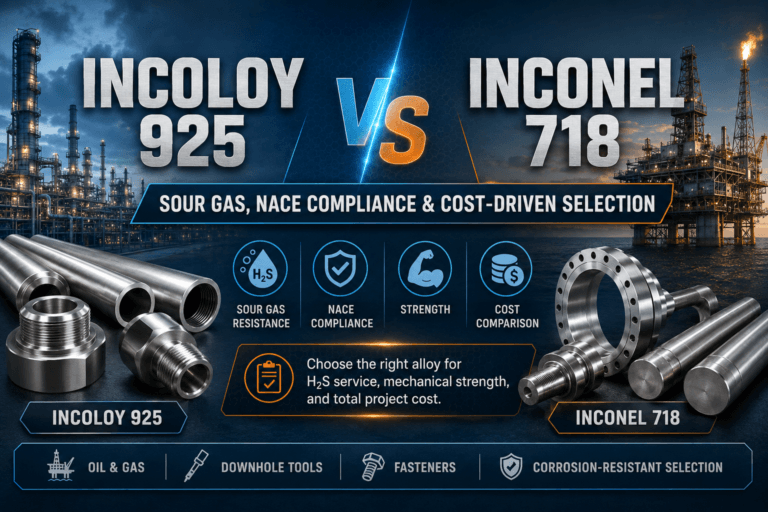
If you work in oil and gas — and specifically in fields where H₂S is part of the equation — you already know that picking the wrong alloy doesn’t just cost money. It costs downtime, integrity, and occasionally, safety.
Incoloy 825 and Hastelloy C-276 are both NACE MR0175/ISO 15156-compliant nickel alloys. Both can handle sour service. But they are not equals, and choosing between them requires understanding why each alloy behaves the way it does under H₂S, chlorides, and elevated temperature — the exact combination that defines a sour gas environment.
This article breaks down the chemistry, the corrosion performance, the compliance picture, and the cost argument. By the end, you’ll have a clear selection framework.
Quick Comparison: Incoloy 825 vs Hastelloy C-276
| Property | Incoloy 825 (UNS N08825) | Hastelloy C-276 (UNS N10276) |
|---|---|---|
| Alloy base | Fe-Ni-Cr | Ni-Mo-Cr |
| Nickel content | 38–46% | ~57% (balance) |
| Molybdenum content | 2.5–3.5% | 15–17% |
| PREN (standard) | ~31.5 | ~52.8 |
| PREN_W (with tungsten) | ~31.5 | ~74.5 |
| Yield strength (annealed) | ~241 MPa | ~310–355 MPa |
| Tensile strength | ~550 MPa | ~690 MPa |
| Max service temp (structural) | ~540°C | ~600°C |
| NACE MR0175 qualified | Yes | Yes |
| H₂S resistance (moderate) | Good | Excellent |
| H₂S resistance (high conc.) | Adequate | Superior |
| SCC resistance (chlorides) | Moderate | Excellent |
| Relative cost | 1× baseline | ~1.5–2× |
What Is Sour Gas, and Why Does It Matter for Alloy Selection?
“Sour gas” refers to natural gas or reservoir fluids containing hydrogen sulfide (H₂S) — one of the most aggressive corrosive agents in the oil and gas industry. When H₂S is present alongside CO₂, chlorides, water, and elevated pressure and temperature, the environment creates multiple simultaneous attack vectors:
- Sulfide stress cracking (SSC): H₂S causes atomic hydrogen to penetrate the metal lattice, leading to sudden brittle fracture — most dangerous in high-strength alloys or heat-affected zones
- Hydrogen-induced cracking (HIC): Hydrogen blisters form internally, especially in low-alloy steels and ferritic materials
- Chloride stress corrosion cracking (Cl-SCC): Chlorides attack passive films at elevated temperatures
- Pitting and crevice corrosion: In the presence of both H₂S and Cl⁻, pit initiation is dramatically accelerated
- CO₂ sweet corrosion: Even without H₂S, CO₂ + water forms carbonic acid, which attacks base metals
The governing standard is NACE MR0175 / ISO 15156, which defines qualification requirements for materials used in H₂S-containing environments. Any material specified for sour service must comply.
Both Incoloy 825 and Hastelloy C-276 meet this standard — but in very different ways and under different envelope conditions.
Chemical Composition: Where the Difference Begins
Understanding why these two alloys behave differently starts with what’s actually in them.
| Element | Incoloy 825 | Hastelloy C-276 |
|---|---|---|
| Ni | 38–46% | ~57% (balance) |
| Fe | Balance (~30–40%) | 4–7% |
| Cr | 19.5–23.5% | 14.5–16.5% |
| Mo | 2.5–3.5% | 15–17% |
| Cu | 1.5–3.0% | — |
| Ti | 0.6–1.2% | — |
| W | — | 3.0–4.5% |
| C | ≤0.05% | ≤0.01% |
Three differences matter most for sour service:
1. Molybdenum — the gap that defines everything
Incoloy 825 contains 2.5–3.5% Mo. Hastelloy C-276 contains 15–17% Mo. That’s nearly a 5× difference. Molybdenum is the primary element that resists pitting and crevice corrosion in chloride-bearing environments. It also stabilizes the passive film under reducing conditions — exactly what you encounter when H₂S is present. This single difference explains most of the performance gap in aggressive sour service.
2. Tungsten in C-276 — doubling down on pitting resistance
C-276 adds 3–4.5% tungsten, which works synergistically with molybdenum to further strengthen the passive layer against localized corrosion. This is why C-276’s PREN_W (which accounts for tungsten) reaches ~74.5, compared to ~31.5 for 825. In sour environments with concurrent chloride attack, this difference is decisive.
3. Carbon content — the welding factor
Incoloy 825 limits carbon to ≤0.05%. Hastelloy C-276 limits it to ≤0.01% — five times lower. Ultra-low carbon prevents chromium carbide precipitation at grain boundaries during welding, which means C-276 retains its full corrosion resistance in the heat-affected zone without post-weld heat treatment. For wellheads, manifolds, and downhole assemblies where field welding is common, this is a critical operational advantage.
PREN Values: The Corrosion Shorthand
PREN (Pitting Resistance Equivalent Number) is the industry’s standard metric for ranking alloys against localized corrosion. Higher PREN = greater resistance to pitting and crevice corrosion in chloride environments.
Standard PREN = %Cr + 3.3 × %Mo + 16 × %N
| Alloy | Cr (mid-range) | Mo (mid-range) | PREN |
|---|---|---|---|
| Incoloy 825 | 21.5% | 3.0% | ~31.5 |
| Hastelloy C-276 | 15.5% | 16.0% | ~52.8 |
With tungsten correction (PREN_W = %Cr + 3.3×%Mo + 1.65×%W):
| Alloy | PREN_W |
|---|---|
| Incoloy 825 | ~31.5 |
| Hastelloy C-276 | ~74.5 |
For context: duplex 2205 has a PREN of ~35, and super duplex 2507 reaches ~43. Both Incoloy 825 and C-276 exceed 316L (~23), but C-276 is in a different league entirely.
In practice, a PREN above 40 is considered necessary for seawater service at elevated temperature. For high-H₂S/high-chloride sour gas fields, C-276’s PREN provides substantial margin against the combined attack.
NACE MR0175 / ISO 15156 Compliance
Both alloys are qualified under NACE MR0175 / ISO 15156 for use in H₂S-bearing environments — but the conditions differ.
Incoloy 825:
Qualified for sour service under Part 3 of ISO 15156 as a nickel-based alloy. Key restrictions: hardness must remain within specified limits (typically hardness limits apply to the alloy condition and product form). Performs well in moderate H₂S environments — production tubing, separators, heat exchangers in fields with controlled H₂S partial pressure.
Hastelloy C-276:
Also qualified under Part 3. Fewer restriction conditions compared to 825, owing to its higher corrosion resistance and ultra-low carbon content. The “C-family” alloys (C-276, C-22, C-2000) have an extensive track record in sour service and are consistently specified for the most demanding downhole and surface environments.
Practical guidance: If your H₂S partial pressure is moderate (below 0.05 MPa) and chloride concentration is controlled, Incoloy 825 is likely sufficient and more cost-effective. As H₂S partial pressure rises, chloride concentration increases, or temperature climbs above 150°C, the balance shifts strongly toward C-276.
H₂S Corrosion Resistance: The Real-World Picture
Incoloy 825 in Sour Service
Incoloy 825’s resistance to sour environments is built around three mechanisms:
- High nickel (38–46%) suppresses chloride-induced stress corrosion cracking
- Chromium (19.5–23.5%) provides a stable passive oxide film
- Molybdenum + copper resist sulfuric acid and other reducing acid attack
In moderate sour service — gas production fields with H₂S < 1%, CO₂ co-presence, and chloride concentrations in the low-to-moderate range — 825 performs reliably. It is widely used for production tubing, wellhead components, gathering system fittings, and gas processing heat exchangers.
Its limitation emerges in severe sour service: high H₂S partial pressure, high chlorides, elevated temperature (>150°C), and high applied stress. Under these conditions, pitting initiation becomes likely, and SSC risk increases. Some published studies have documented localized corrosion of 825 in laboratory sour environments simulating deep sour wells.
Hastelloy C-276 in Sour Service
C-276’s sour service performance derives from a fundamentally different mechanism. Rather than relying primarily on chromium passivation (which can break down under reducing H₂S conditions), C-276 uses its massive molybdenum + tungsten content to maintain passive film stability across a far wider range of conditions.
Key advantages:
- Superior SSC resistance: High nickel content (~57%) dramatically reduces hydrogen embrittlement susceptibility
- Excellent pitting resistance: PREN ~52.8 (standard) / ~74.5 (with W correction) means the passive film resists breakdown even in high-chloride/high-H₂S co-exposure
- No sensitization at welds: Ultra-low carbon (≤0.01%) prevents carbide precipitation, eliminating weld-zone corrosion without PWHT
- Broad tolerance for mixed environments: In wellheads, subsurface safety valves, and choke bodies where the fluid chemistry varies and H₂S concentrations can spike, C-276 provides a wide safety margin
C-276 is the material of choice for: deep sour wells (H₂S > 1%), HPHT applications, subsea trees and christmas tree components, wellhead tubing hangers, and sour gas injection systems.
Stress Corrosion Cracking (SCC) Comparison
SCC is the failure mode that causes engineers to lose sleep in sour gas applications. Both SSC (sulfide-induced) and Cl-SCC can occur simultaneously.
| Failure mode | Incoloy 825 | Hastelloy C-276 |
|---|---|---|
| Sulfide stress cracking (SSC) | Good resistance — NACE qualified | Excellent — extensive field record |
| Chloride-SCC | Moderate resistance | Excellent resistance |
| Hydrogen-induced cracking (HIC) | Good | Excellent |
| Crevice corrosion under deposits | Moderate | Excellent |
| Pitting in H₂S + Cl⁻ co-exposure | Adequate (mild-moderate conditions) | Excellent (severe conditions) |
The critical variable is combined severity: H₂S partial pressure + chloride concentration + temperature + applied stress. As any of these parameters increases, 825’s margins erode faster than C-276’s. For safety-critical components — tree connectors, wellhead bolting, downhole completion tools — the superior SCC resistance of C-276 justifies its cost premium.
Mechanical Properties
For most sour gas applications, corrosion resistance drives selection — but mechanical properties are still relevant for pressure containment and load-bearing components.
| Property | Incoloy 825 (annealed) | Hastelloy C-276 (annealed) |
|---|---|---|
| Yield strength (0.2% offset) | ~241 MPa | ~310–355 MPa |
| Ultimate tensile strength | ~550 MPa | ~690 MPa |
| Elongation | 30–45% | ~40% |
| Max service temperature | ~540°C | ~600°C |
| Modulus of elasticity | ~196 GPa | ~205 GPa |
C-276 is moderately stronger in both yield and tensile strength. For thick-wall components or high-pressure applications, this allows slightly thinner walls and reduced weight — but the difference is secondary to corrosion performance in sour service selection decisions.
Weldability in Sour Gas Fabrication
Both alloys are weldable, but C-276 has a significant practical advantage for field fabrication.
Incoloy 825:
Welded using ERNiCrMo-3 (alloy 625) or matching 825 filler. Titanium stabilization reduces sensitization risk, but proper shielding and heat input control are essential. Post-weld heat treatment may be required for critical service.
Hastelloy C-276:
Welded using ERNiCrMo-4 (matching C-276) filler. The ultra-low carbon content (≤0.01%) prevents carbide precipitation in the HAZ — which means C-276 welds do not require post-weld annealing to maintain corrosion resistance. For offshore and downhole fabrication where PWHT is impractical, this is a decisive advantage.
Cost Analysis: Initial vs. Lifecycle
| Cost factor | Incoloy 825 | Hastelloy C-276 |
|---|---|---|
| Raw material (relative) | 1× baseline | ~1.5–2× |
| Fabrication complexity | Moderate | Higher (slower machining, more tool wear) |
| Post-weld heat treatment | Sometimes required | Not required |
| Replacement frequency (severe service) | Higher | Lower |
| Lifecycle cost (severe sour service) | Higher | Lower |
The surface-level conclusion — “825 is cheaper, C-276 is expensive” — reverses when you include lifecycle cost in severe sour service. A component that fails in 18 months and requires full shutdown for replacement generates costs far exceeding the premium paid for C-276 at the outset. For safety-critical or hard-to-access components (subsea, downhole), C-276’s lifecycle economics are consistently favorable.
For less severe applications where 825 provides adequate margins, the initial cost savings are real and justified. Don’t overspend on C-276 when the environment doesn’t demand it.
Application Guide: Who Uses What and Why
Where Incoloy 825 Excels
- Production tubing and casing in moderate sour wells (H₂S < ~1%, temperature < 150°C)
- Gas processing heat exchangers handling sour gas streams at controlled conditions
- Gathering system piping and fittings in onshore or shallow offshore fields
- Separator vessels and pressure vessels in moderate H₂S service
- Sulfuric acid and phosphoric acid service — 825’s copper content gives it a specific advantage here over C-276
Where Hastelloy C-276 Excels
- Deep sour wells with high H₂S partial pressure (> 0.05 MPa)
- Wellhead components and christmas trees — tubing hangers, valves, gate body seats
- Subsurface safety valves (SSSV) and downhole completion tools
- Sour gas injection systems — compressors, headers, injection wellheads
- HPHT (high pressure, high temperature) completions where both thermal and corrosion margins are needed simultaneously
- Flue gas desulfurization (FGD) equipment — wet scrubbers, ductwork, absorber towers
- Field-welded assemblies where PWHT is not feasible
Selection Decision Framework
Step 1: Define your H₂S partial pressure
- H₂S partial pressure < 0.01 MPa: standard NACE materials may suffice; 825 likely adequate
- H₂S partial pressure 0.01–0.05 MPa: evaluate chloride concentration and temperature
- H₂S partial pressure > 0.05 MPa: C-276 is the conservative, defensible choice
Step 2: Assess chloride concentration
- Chlorides < 50,000 ppm + moderate H₂S: 825 with inspection program
- Chlorides > 50,000 ppm or produced brine with variable chemistry: C-276
Step 3: Check temperature
- Service temperature consistently below 150°C: 825 provides adequate margins
- Service temperature > 150°C with any significant H₂S/Cl⁻: C-276
Step 4: Evaluate component criticality
- Safety-critical, hard-to-access, or high-consequence-of-failure components (downhole tools, subsea trees, wellhead connectors): select C-276 regardless of fluid severity — the cost of failure exceeds the material premium every time
Step 5: Factor in fabrication
- Field welding required with no PWHT: C-276
- Shop fabrication with full PWHT capability: either alloy, decision returns to Steps 1–4
Frequently Asked Questions
Q: Is Incoloy 825 approved by NACE MR0175 for sour service?
Yes. Incoloy 825 (UNS N08825) is qualified under NACE MR0175 / ISO 15156 Part 3 for sour gas environments, subject to specified conditions on hardness and heat treatment. It has an extensive service record in moderate sour applications.
Q: Can Hastelloy C-276 be used at very high H₂S concentrations?
Yes. C-276 is widely specified for high-H₂S environments — including sour gas injection and deep sour wells — precisely because its high molybdenum and tungsten content maintain passive film stability even under aggressive reducing conditions.
Q: Why does Incoloy 825 contain copper while C-276 does not?
The copper in 825 (1.5–3.0%) provides specific resistance to sulfuric and phosphoric acid in their reducing concentration ranges — a corrosion mechanism distinct from chloride pitting. C-276 does not target this environment; its formulation is optimized for halide/chloride resistance. This is why 825 actually outperforms C-276 in straight sulfuric acid service, while C-276 dominates in complex mixed environments.
Q: Which alloy is better for CO₂ + H₂S co-service (sweet-sour mixed wells)?
Both can handle CO₂/H₂S mixed service. The selection depends on relative H₂S and chloride concentrations. Low H₂S/high CO₂ with chlorides favors 825 (cost-effective). High H₂S or high chlorides with CO₂ favors C-276.
Q: Can these alloys be substituted for each other in an existing design?
In most cases, yes — they are both round bar, tube, pipe, and plate products available in similar dimensional ranges. However, never downgrade from C-276 to 825 without a formal material review against the actual service conditions. Upgrading from 825 to C-276 is generally conservative and safe, but verify that the higher cost is justified by the actual environment.
Summary
Incoloy 825 and Hastelloy C-276 occupy adjacent but distinct positions in sour gas material selection:
Choose Incoloy 825 when:
- H₂S partial pressure is moderate (< ~0.05 MPa)
- Chloride concentration is controlled
- Temperature remains below 150°C
- Sulfuric or phosphoric acid resistance is also required
- Budget optimization is a priority and risk profile allows it
Choose Hastelloy C-276 when:
- H₂S concentration is high or variable
- High chloride content co-exists with H₂S
- Temperature exceeds 150°C
- The component is safety-critical or hard to access for maintenance
- Field welding is required without PWHT
- Lifecycle cost matters more than initial material cost
Both alloys supply to ASTM / ASME standards — 825 to ASTM B424 (plate), B423 (tube), B425 (bar); C-276 to ASTM B575 (plate), B622 (tube), B574 (bar). Verify that your supplier provides full EN 10204 3.1 mill test reports with chemical, mechanical, and (where applicable) PMI data.
Ready to specify Incoloy 825 or Hastelloy C-276 for your next sour gas project? Contact our technical team with your service conditions — H₂S partial pressure, temperature, chloride concentration, and product form — and we’ll help you confirm the right alloy and form.