Stainless Steel 15-7Mo | UNS S15700
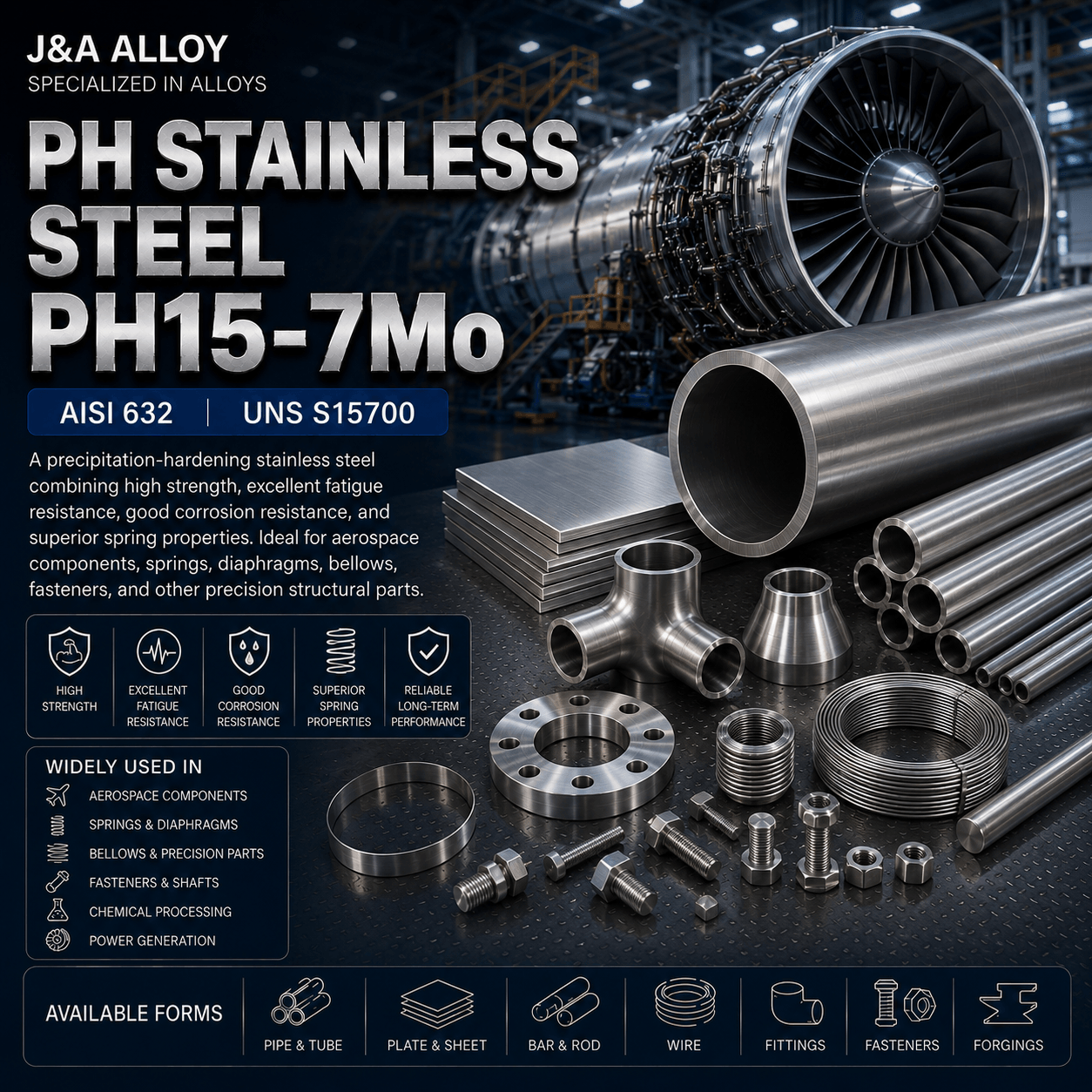
PH stainless steel 632, also known as 15-7Mo stainless steel or UNS S15700, is a semi-austenitic precipitation-hardening stainless steel designed for high strength, high hardness, good fatigue performance, and moderate corrosion resistance. It can be formed in the annealed condition and hardened by controlled heat treatment, making it suitable for aerospace parts, springs, diaphragms, bellows, fasteners, precision components, and high-strength sheet or strip applications.
PH Stainless Steel 15-7Mo | UNS S15700 | Alloy 632
PH stainless steel 632 is a chromium-nickel-molybdenum-aluminum semi-austenitic precipitation-hardening stainless steel. It is commonly known as 15-7Mo stainless steel, PH 15-7Mo, AISI Type 632, and UNS S15700. The alloy was developed to provide high mechanical strength, good hardness, useful corrosion resistance, and excellent formability before hardening.
Unlike fully martensitic precipitation-hardening grades, PH stainless steel 632 is relatively soft and formable in the annealed condition. After forming, it can be transformed and precipitation hardened through heat treatment to achieve high strength levels. This makes it especially useful for thin-gauge sheet, strip, springs, diaphragms, bellows, clips, aerospace hardware, and precision formed components.
Compared with 17-7PH stainless steel, PH 632 replaces part of the chromium content with molybdenum. This improves room-temperature and elevated-temperature strength while maintaining good formability and moderate corrosion resistance. For applications requiring high strength, fatigue resistance, and dimensional stability after heat treatment, PH stainless steel 632 is a reliable engineering material.
PH 15-7Mo At a Glance
| Key Attribute | Value |
|---|---|
| Material | PH Stainless Steel 632 / 15-7Mo Stainless Steel |
| UNS Number | S15700 |
| AISI Type | Type 632 |
| EN / W.Nr. | 1.4532 / 1.4574 references may be used depending on specification |
| Material Type | Semi-Austenitic Precipitation-Hardening Stainless Steel |
| Density | Approx. 7.80 g/cm³ |
| PREN | Approx. 21–22 |
| Main Advantage | High Strength, High Hardness, Good Formability and Moderate Corrosion Resistance |
| Typical Service Temperature | Up to approx. 480°C / 900°F depending on condition, load and exposure time |
| Main Industries | Aerospace, Precision Engineering, Springs, Bellows, Diaphragms, Fasteners, Instrumentation |
| Comparable Grades | 17-7PH, 301, 304, 15-5PH, 17-4PH |
Features of PH 15-7Mo
Semi-austenitic precipitation-hardening stainless steel with high strength after heat treatment.
Excellent formability in the annealed condition before final hardening.
High hardness and good fatigue resistance for springs, clips and precision components.
Molybdenum addition improves strength compared with 17-7PH in many applications.
Good dimensional stability after controlled heat treatment.
Moderate corrosion resistance in atmospheric, mild chemical and industrial environments.
Suitable for thin-gauge sheet, strip, foil and formed precision parts.
Can be processed to high-strength conditions such as TH1050, RH950 and CH900.
Good performance for aerospace heat shields, diaphragms, bellows and structural parts.
Available in sheet, strip, plate, bar, wire and custom processed forms.
Chemical Composition of PH 15-7Mo
| Element | Content (%) |
|---|---|
| Carbon (C) | ≤ 0.09 |
| Manganese (Mn) | ≤ 1.00 |
| Phosphorus (P) | ≤ 0.040 |
| Sulfur (S) | ≤ 0.030 |
| Silicon (Si) | ≤ 1.00 |
| Chromium (Cr) | 14.00–16.00 |
| Nickel (Ni) | 6.50–7.75 |
| Molybdenum (Mo) | 2.00–3.00 |
| Aluminum (Al) | 0.75–1.50 |
| Iron (Fe) | Balance |
Physical Properties of PH 15-7Mo
| Property | Typical Value |
|---|---|
| Density | Approx. 7.80 g/cm³ / 0.282 lb/in³ |
| Melting Range | Approx. 1400–1450°C / 2550–2640°F |
| Electrical Resistivity | Approx. 0.80–0.85 μΩ·m |
| Thermal Conductivity | Approx. 15.0–16.5 W/m·K at room temperature |
| Specific Heat Capacity | Approx. 460 J/kg·K |
| Modulus of Elasticity | Approx. 190–210 GPa / 27.5–30.5 × 10⁶ psi |
Mechanical Properties of PH 15-7Mo
Mechanical properties of PH stainless steel 632 vary significantly depending on product form, cold work level and heat treatment condition. In Condition A, the material offers good formability. After precipitation hardening, it develops high tensile strength, high yield strength and high hardness.
| Condition | Tensile Strength | Yield Strength | Elongation | Hardness |
|---|---|---|---|---|
| Condition A / Annealed | Approx. 900 MPa / 131 ksi | Approx. 380 MPa / 55 ksi | Approx. 25–30% | Approx. HRB 88 |
| TH1050 Condition | Approx. 1380–1450 MPa / 200–210 ksi | Approx. 1240–1310 MPa / 180–190 ksi | Approx. 3–6% | Approx. HRC 43–47 |
| RH950 Condition | Approx. 1550–1650 MPa / 225–240 ksi | Approx. 1450–1550 MPa / 210–225 ksi | Approx. 3–6% | Approx. HRC 45–49 |
| CH900 Condition | Approx. 1800–2000 MPa / 260–290 ksi | Approx. 1650–1850 MPa / 240–270 ksi | Limited ductility | Approx. HRC 48–52 |
Corrosion Resistance
PH stainless steel 632 provides moderate corrosion resistance in atmospheric, fresh water, mild chemical and industrial environments. Its corrosion resistance is generally similar to chromium-nickel stainless steels used in moderately corrosive service, but it is not intended to replace high-molybdenum austenitic stainless steels, duplex stainless steels or nickel alloys in severe chloride environments.
The alloy contains molybdenum, which helps improve resistance to localized corrosion compared with some lower-alloy precipitation-hardening stainless steels. However, PH 632 is still vulnerable to pitting and crevice corrosion in stagnant chloride solutions, seawater, high-salt environments or poorly cleaned fabricated parts. For marine or chloride-rich service, design should avoid tight crevices, deposits and stagnant zones.
Stress corrosion cracking resistance depends on heat treatment condition, stress level, environment and surface condition. In high-strength hardened conditions, precipitation-hardening stainless steels may be more sensitive to stress corrosion cracking than lower-strength austenitic stainless steels. For critical chloride or sour-service environments, corrosion testing and engineering review are recommended.
In acid environments, PH stainless steel 632 should be used with caution. It may perform adequately in selected mild oxidizing or weakly corrosive media, but it is not the preferred choice for strong sulfuric acid, hydrochloric acid, hot chloride acid media or aggressive chemical processing streams. For severe acid corrosion, grades such as 904L, 254SMO, Alloy 20, Hastelloy C-276 or Hastelloy C-22 may be more suitable.
High Temperature Performance
PH stainless steel 632 is valued for its ability to retain useful mechanical properties at moderately elevated temperatures. The molybdenum-containing design provides better elevated-temperature strength than 17-7PH in many applications, making it suitable for aerospace heat shields, engine-related formed parts, bellows, springs and high-temperature precision components.
The alloy is commonly considered for applications up to approximately 480°C / 900°F, depending on heat treatment condition, stress level and exposure time. For long-term service, engineers should evaluate relaxation, oxidation, toughness reduction and possible over-aging effects. Service temperatures should normally remain below the temperature range that may significantly alter the precipitation-hardened condition.
PH stainless steel 632 should not be selected as a substitute for dedicated high-temperature nickel alloys where long-term creep strength, oxidation resistance or thermal fatigue resistance is critical. For continuous high-temperature service above its practical range, alloys such as Inconel 600, Inconel 625, Inconel X-750, Incoloy 800H or Haynes alloys may be more appropriate.
Available Forms
- Sheet
- Strip
- Precision strip
- Foil
- Plate
- Round bar
- Flat bar
- Wire
- Rod
- Spring wire
- Forgings
- Rings
- Billets
- Cut-to-size blanks
- Precision stamped parts
- CNC machined parts
- Custom heat-treated components
Applications of PH 15-7Mo
Aerospace
- Heat shields
- Engine nacelle components
- Exhaust system parts
- Clips and brackets
- Fasteners and precision hardware
Springs & Elastic Components
- Flat springs
- Belleville washers
- Spring clips
- Retaining rings
- High-strength strip springs
Precision Instrumentation
- Diaphragms
- Bellows
- Sensor components
- Pressure control parts
- Thin-gauge precision elements
Industrial Engineering
- High-strength washers
- Formed brackets
- Mechanical locking components
- Wear-resistant precision parts
- High-fatigue components
Power Generation
- Heat-resistant formed parts
- Turbine-related auxiliary components
- High-strength spring elements
- Thermal shielding parts
Chemical & Process Equipment
- Light-duty corrosion-resistant components
- Instrument parts
- Springs and diaphragms in moderate environments
- Precision mechanical assemblies
PH Stainless Steel 632 vs 17-7PH vs 301 vs 17-4PH
| Grade | Main Advantage | Strength | Corrosion Resistance | Typical Application |
|---|---|---|---|---|
| PH Stainless Steel 632 / 15-7Mo | High strength, good formability and better elevated-temperature strength than 17-7PH | Very High | Moderate to Good | Aerospace springs, heat shields, diaphragms, bellows and precision strip parts |
| 17-7PH / UNS S17700 | Excellent spring properties and good formability | High | Moderate to Good | Springs, washers, clips, aerospace components and formed parts |
| 301 Stainless Steel | Excellent cold work hardening and economical cost | Medium to High after cold work | Good | General springs, clamps, clips and structural strip parts |
| 17-4PH / UNS S17400 | High strength and wide availability in bars and forgings | High | Good | Shafts, valve parts, fasteners, pump parts and machined components |
PH Stainless Steel 632 vs 316L Stainless Steel
| Item | PH Stainless Steel 632 | 316L Stainless Steel |
|---|---|---|
| Material Type | Semi-austenitic precipitation-hardening stainless steel | Austenitic stainless steel |
| Strength | Much higher after heat treatment | Lower, not precipitation hardenable |
| Formability | Good in annealed condition before hardening | Excellent |
| Corrosion Resistance | Moderate to good | Better in many chloride and general chemical environments |
| Magnetism | May become magnetic after hardening | Generally non-magnetic in annealed condition |
| Typical Use | High-strength springs, diaphragms and aerospace parts | General corrosion-resistant equipment, piping and fabrication |
Welding & Fabrication
PH stainless steel 632 can be welded using common welding processes, including GTAW, GMAW and SMAW, when appropriate procedures are used. Resistance welding can also be used for thin-gauge sheet and strip components. For critical parts, welding is usually preferred in the annealed condition, followed by the required heat treatment cycle to develop final mechanical properties.
GTAW is commonly used for precision welds, thin sections and aerospace components where control of heat input is important. GMAW may be used for suitable production welding when procedure qualification and shielding gas selection are controlled. SMAW can be used for repair or thicker sections, but it is less common for precision thin-gauge applications.
Post-weld heat treatment is often required when the final part must achieve specified strength and hardness. If the material is welded after hardening, the heat-affected zone may lose strength or show uneven properties. For critical aerospace or spring applications, the full forming, welding and heat treatment sequence should be validated by testing.
Machining is generally easier in the hardened condition than in the soft annealed condition. In the annealed state, the alloy can work harden during machining, so sharp tools, rigid setups and suitable cutting parameters are recommended. For formed components, PH 632 offers good formability before hardening, but springback and heat treatment distortion must be considered during tool design.
Standards & Equivalent Grades
| Category | Designation / Standard |
|---|---|
| UNS | S15700 |
| AISI | Type 632 |
| Common Names | PH 15-7Mo, 15-7Mo Stainless Steel, 15-7PH, Alloy 632 |
| ASTM | ASTM A693 Grade 632, ASTM A564 Grade 632, ASTM A579 Grade 632, ASTM A705 Grade 632 |
| AMS | AMS 5520, AMS 5657, AMS 5812, AMS 5813 |
| EN / W.Nr. | 1.4532 / 1.4574 references may be used depending on product form and specification |
| ASME | Equivalent ASME material requirements may apply by project specification |
| ISO | Equivalent ISO references may apply depending on product form and customer specification |
| NACE | Not a standard default NACE sour-service grade; project-specific review required |
| Material Family | Semi-Austenitic Precipitation-Hardening Stainless Steel |
Frequently Asked Questions
What is PH stainless steel 632?
PH stainless steel 632 is a semi-austenitic precipitation-hardening stainless steel also known as 15-7Mo stainless steel, AISI Type 632 or UNS S15700. It is designed for high strength, high hardness, good formability and moderate corrosion resistance.
What is the UNS designation for PH stainless steel 632?
The UNS designation for PH stainless steel 632 is UNS S15700.
Is PH stainless steel 632 the same as 15-7Mo?
Yes. PH stainless steel 632 is commonly known as 15-7Mo stainless steel or PH 15-7Mo. It is an AISI Type 632 precipitation-hardening stainless steel.
What is PH stainless steel 632 used for?
PH stainless steel 632 is used for aerospace components, heat shields, springs, bellows, diaphragms, clips, fasteners, washers, precision strip parts and high-strength formed components.
What is the main advantage of PH stainless steel 632?
The main advantage of PH stainless steel 632 is its combination of good formability in the annealed condition and high strength after precipitation hardening.
Can PH stainless steel 632 be welded?
Yes. PH stainless steel 632 can be welded using GTAW, GMAW, SMAW and resistance welding methods. For critical components, welding should be followed by suitable heat treatment to restore the required properties.
Does PH stainless steel 632 need post-weld heat treatment?
Post-weld heat treatment is often recommended when the final part requires high strength, uniform hardness and stable mechanical properties. The exact heat treatment depends on the required condition and specification.
Is PH stainless steel 632 magnetic?
In the annealed condition, PH stainless steel 632 is mainly austenitic and may be slightly magnetic. After transformation and precipitation hardening, it becomes more magnetic because of martensitic structure formation.
What temperature can PH stainless steel 632 withstand?
PH stainless steel 632 is commonly used at moderately elevated temperatures up to approximately 480°C / 900°F, depending on condition, load and exposure time. It should not be used as a substitute for dedicated high-temperature nickel alloys in severe long-term service.
Is PH stainless steel 632 corrosion resistant?
PH stainless steel 632 provides moderate to good corrosion resistance in atmospheric, fresh water and mild industrial environments. It is not recommended for severe chloride, seawater or strong acid service without engineering review.
What is the difference between PH stainless steel 632 and 17-7PH?
PH stainless steel 632 contains molybdenum and is designed to provide improved strength, especially at room and elevated temperatures, compared with 17-7PH. 17-7PH is more widely used for general spring applications, while PH 632 is selected when higher strength or thermal stability is needed.
What is the difference between PH stainless steel 632 and 316L?
PH stainless steel 632 offers much higher strength after heat treatment, while 316L provides better general corrosion resistance and weldability. PH 632 is selected for high-strength components, while 316L is selected for corrosion-resistant fabrication and piping.
What forms are available for PH stainless steel 632?
PH stainless steel 632 is available in sheet, strip, foil, plate, bar, wire, rod, forgings, rings, billets, cut-to-size blanks and custom machined components.
What standards apply to PH stainless steel 632?
Common standards include AMS 5520, AMS 5657, AMS 5812, AMS 5813, ASTM A693 Grade 632, ASTM A564 Grade 632, ASTM A579 Grade 632 and ASTM A705 Grade 632.
Why Choose J&A Alloy
Global Material Solutions
J&A Alloy supplies stainless steels, precipitation-hardening stainless steels, duplex stainless steels, super austenitic stainless steels, nickel alloys, titanium alloys and high-performance corrosion-resistant alloys for demanding industrial applications. For PH stainless steel 632, we support customers with sheet, strip, plate, bar, wire, forgings and custom processed parts according to project requirements.
Strict Quality Assurance
J&A Alloy provides strict quality control for chemical composition, mechanical properties, dimensional tolerance and surface condition. Available inspection and documentation services include PMI, chemical analysis, mechanical testing, hardness testing, ultrasonic testing, dimensional inspection and EN 10204 3.1 / 3.2 certification when required.
International Standards
Materials can be supplied according to ASTM, ASME, EN, ISO, AMS and customer-specific specifications. For PH stainless steel 632, we support common standards such as AMS 5520, AMS 5657, ASTM A693 Grade 632 and ASTM A564 Grade 632, depending on product form and technical requirement.
Value-added Services
J&A Alloy offers cutting, slitting, CNC machining, heat treatment coordination, grinding, polishing, custom fabrication and export packaging. We help customers reduce processing time, control material waste and receive ready-to-use or semi-finished materials for manufacturing.
Worldwide Supply
J&A Alloy serves customers in aerospace, chemical processing, oil and gas, marine engineering, power generation, precision manufacturing and industrial equipment markets. With experience in international logistics and export documentation, we support global buyers with reliable material supply and responsive technical communication.