Incoloy 800H & 800HT丨N08810 & N08811
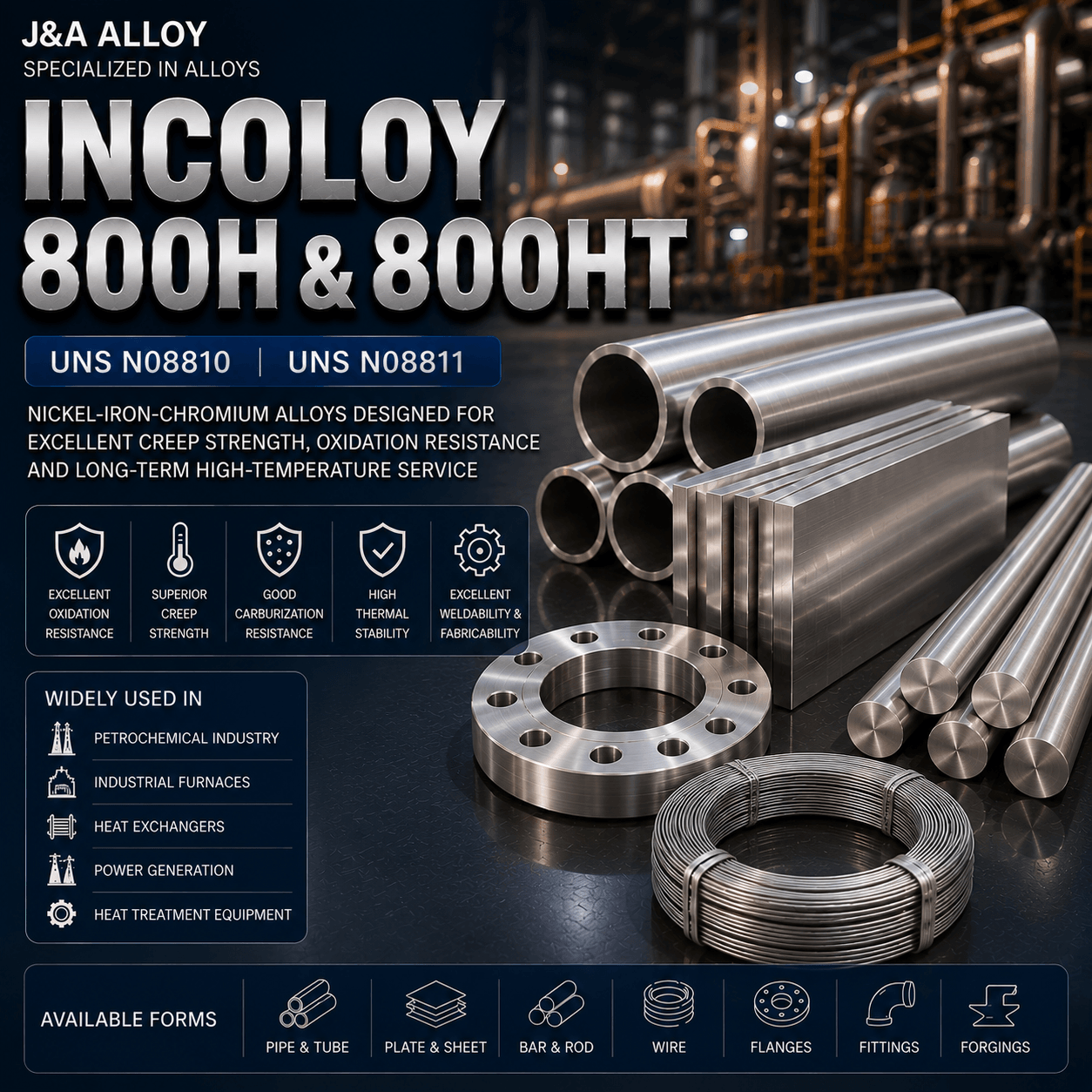
Incoloy 800H and 800HT are nickel-iron-chromium alloys specifically engineered for outstanding creep rupture strength, oxidation resistance, and long-term structural stability at elevated temperatures.
J&A Alloy supplies Incoloy 800H & 800HT pipe, tube, plate, sheet, bar, wire, and forgings for petrochemical, power generation, and industrial furnace applications.
✔ Excellent creep strength
✔ Outstanding oxidation resistance
✔ Superior carburization resistance
✔ Excellent fabrication and weldability
Quick Answer: Incoloy 800H (UNS N08810) and 800HT (UNS N08811) are controlled versions of Alloy 800 for long-term high-temperature and creep-limited service. 800H controls carbon and grain size; 800HT applies tighter carbon plus aluminum/titanium controls. They should not be interchanged solely by trade name—confirm the UNS grade, product standard, design temperature, allowable stress and mill certificate.
Incoloy 800H & 800HT Supplier & Manufacturer
Incoloy 800H (UNS N08810) and Incoloy 800HT (UNS N08811) are modified versions of Alloy 800 with controlled carbon, aluminum and titanium contents to optimize creep and stress rupture properties at temperatures above 600°C.
Unlike standard Alloy 800, these grades provide superior long-term stability under sustained thermal loading, making them ideal for petrochemical processing, ethylene cracking furnaces, heat exchangers and power generation systems.
J&A Alloy supplies Incoloy 800H & 800HT products with complete traceability and international certifications.
Incoloy 800 vs 800H vs 800HT
| Grade | UNS | Primary material control | Typical selection intent |
|---|---|---|---|
| Incoloy 800 | N08800 | Base nickel-iron-chromium chemistry | General corrosion and heat resistance where creep-rupture design does not require H/HT controls. |
| Incoloy 800H | N08810 | Controlled carbon and grain-size requirements | Long-term elevated-temperature equipment where creep and stress rupture matter. |
| Incoloy 800HT | N08811 | Tighter carbon plus combined aluminum/titanium control | Specification-controlled long-term high-temperature service requiring HT chemistry. |
Availability and dual certification depend on product form, chemistry, heat treatment, grain size and governing specification. Confirm acceptance from the actual MTC instead of assuming every 800H heat qualifies as 800HT.
Key Features of Incoloy 800H & 800HT
Excellent Creep Strength
Designed for long-term service under elevated temperatures and stresses.
Outstanding Oxidation Resistance
Resists oxidation and scaling up to approximately 1100°C.
Superior Carburization Resistance
Excellent performance in carbon-rich furnace atmospheres.
High Structural Stability
Maintains mechanical integrity during prolonged exposure.
Excellent Weldability
Can be fabricated using standard nickel alloy welding procedures.
Long Service Life
Widely used for critical thermal processing equipment.
Chemical Composition
| Element | 800H (%) | 800HT (%) |
|---|---|---|
| Nickel (Ni) | 30.0-35.0 | 30.0-35.0 |
| Chromium (Cr) | 19.0-23.0 | 19.0-23.0 |
| Iron (Fe) | Balance | Balance |
| Carbon (C) | 0.05-0.10 | 0.06-0.10 |
| Al + Ti | 0.30-1.20 | 0.85-1.20 |
| Manganese (Mn) | ≤1.50 | ≤1.50 |
| Silicon (Si) | ≤1.00 | ≤1.00 |
| Copper (Cu) | ≤0.75 | ≤0.75 |
| Sulfur (S) | ≤0.015 | ≤0.015 |
Mechanical Properties
| Property | Typical Value |
|---|---|
| Tensile Strength | ≥ 450 MPa |
| Yield Strength (0.2%) | ≥ 180 MPa |
| Elongation | ≥ 30% |
| Hardness | ≤ 85 HRB |
| Density | 7.94 g/cm³ |
| Melting Range | 1357-1385°C |
Corrosion Resistance
Incoloy 800H & 800HT provide excellent resistance to:
- Oxidation
- Carburization
- Sulfidation
- Nitriding atmospheres
- Steam environments
- Organic acids
- High-temperature corrosion
The high nickel content also provides excellent resistance to chloride stress corrosion cracking.
High Temperature Performance
Typical Service Characteristics
- Oxidation resistance up to approximately 1100°C
- Excellent creep rupture strength
- Outstanding thermal stability
- Good fatigue resistance
- Superior long-term structural integrity
800H/800HT Temperature, Creep and Atmosphere Selection Guide
| Design question | Why it matters | Required project information |
|---|---|---|
| Oxidation exposure | Surface scale behavior depends on temperature, time and atmosphere | Continuous/peak temperature, oxygen potential and shutdown cycling. |
| Load-bearing high-temperature service | Creep and stress rupture—not room-temperature tensile strength—can govern | Design stress, operating hours, section size and applicable code. |
| Thermal cycling | Expansion, restraint and scale spalling can control life | Heating/cooling rate, cycle count and joint geometry. |
| Carburizing or reducing atmosphere | Carbon activity and oxygen potential affect alloy attack | Gas chemistry, dew point, carbon activity and temperature. |
| ASME pressure equipment | Allowable stress and grade recognition are code-edition dependent | Design code, edition, temperature, pressure and product specification. |
Available Forms
J&A Alloy supplies Incoloy 800H & 800HT in:
- Pipe
- Tube
- Plate
- Sheet
- Coil
- Strip
- Round Bar
- Rod
- Wire
- Flanges
- Fittings
- Forgings
Custom sizes available.
Incoloy 800H/800HT Product Forms and ASTM/ASME Standards
| Product form | Common starting standard | RFQ information |
|---|---|---|
| Bar and rod | ASTM B408 / ASME SB-408 | UNS grade, diameter, length, grain size, condition and testing. |
| Plate, sheet and strip | ASTM B409 / ASME SB-409 | Thickness, width, length, condition, grain size and flatness. |
| Seamless pipe and tube | ASTM B407 / ASME SB-407 | NPS/OD, wall or schedule, length, grade and examination. |
| Welded pipe | ASTM B514 / ASME SB-514 | Dimensions, weld route, heat treatment and code tests. |
| Welded tube | ASTM B515 / ASME SB-515 | OD, wall, length, heat treatment and examination. |
| Forgings, flanges and fittings | ASTM B564 / ASME SB-564 | Drawing, pressure class, machining allowance, grain size and NDT. |
Applications of Incoloy 800H & 800HT
Petrochemical Industry
- Ethylene cracking tubes
- Transfer piping
- Steam reformers
Industrial Furnaces
- Radiant tubes
- Retorts
- Furnace baskets
Power Generation
- Superheater tubing
- Heat exchangers
Chemical Processing
- Pressure vessels
- Process heaters
Heat Treatment Equipment
- Conveyor systems
- Fixtures
Petrochemical and Furnace Component Selection
| Component / service | Why 800H or 800HT is considered | RFQ note |
|---|---|---|
| Ethylene pyrolysis and process-heater components | Long-term heat exposure and creep resistance | Provide tube/plate/forging form, design temperature and operating hours. |
| Furnace fixtures, baskets and supports | Oxidation, carburization and structural stability | Provide atmosphere, load, cycle and fabrication drawing. |
| High-temperature piping and manifolds | Thermal stability with code-controlled pressure design | Provide ASME code, pressure, temperature, size and weld examination. |
| Power-generation hot components | Creep strength and oxidation resistance | Provide stress, temperature cycle and inspection requirements. |
| Industrial furnace components | Heat, atmosphere and cycling resistance | Provide gas chemistry, peak temperature and expected life. |
Incoloy 800H & 800HT vs Inconel 600
| Property | 800H / 800HT | Inconel 600 |
|---|---|---|
| UNS | N08810 / N08811 | N06600 |
| Main Alloy System | Ni-Fe-Cr | Ni-Cr |
| Creep Strength | Excellent | Good |
| Oxidation Resistance | Excellent | Excellent |
| Carburization Resistance | Excellent | Good |
| Maximum Service Temperature | ~1100°C | ~1175°C |
| Primary Applications | Petrochemical Furnaces | Chemical Processing |
| Weldability | Excellent | Excellent |
Welding & Fabrication
Incoloy 800H & 800HT exhibit excellent fabrication properties.
Recommended Welding Methods
- GTAW (TIG)
- GMAW (MIG)
- SMAW
Fabrication Notes
- Excellent hot and cold workability
- Conventional nickel alloy machining methods
- ERNiCr-3 filler metal commonly recommended
Welding, Heat Treatment and Procurement Controls
Welding consumable and procedure selection must follow the base grade, service temperature, atmosphere and construction code. Control contamination, heat input and interpass temperature, and verify whether post-fabrication heat treatment or solution treatment is required by the product specification or design.
- Grade: state N08810 or N08811 explicitly; do not request only “Alloy 800.”
- Design basis: provide continuous/peak temperature, stress, operating hours, pressure and code edition.
- Material controls: specify chemistry, grain size, heat treatment and mechanical/creep requirements.
- Inspection: request EN 10204 3.1 MTC, PMI, grain-size report, NDT and third-party inspection as required.
Standards & Equivalent Grades
| Standard | Grade |
|---|---|
| UNS | N08810 / N08811 |
| Werkstoff | 1.4958 / 1.4959 |
| ASTM | B407 (Tube) |
| ASTM | B408 (Rod, Bar) |
| ASTM | B409 (Plate, Sheet, Strip) |
| ASME | SB407 / SB408 / SB409 |
| Common Trade Name | Incoloy 800H / 800HT |
Frequently Asked Questions
What is the difference between Incoloy 800H and 800HT?
800HT has tighter control of aluminum and titanium contents, providing improved creep rupture strength.
What are Incoloy 800H & 800HT used for?
They are widely used in petrochemical furnaces, steam reformers, heat exchangers and power generation equipment.
Can Incoloy 800H be welded?
Yes. It offers excellent weldability using conventional nickel alloy welding procedures.
What temperature can Incoloy 800H withstand?
It provides excellent oxidation resistance up to approximately 1100°C.
Is Incoloy 800H resistant to carburization?
Yes. It performs exceptionally well in carbon-rich furnace atmospheres.
What forms are available?
Pipe, tube, plate, sheet, bar, rod, wire, flanges, fittings, and forgings.
Why Choose J&A Alloy
✔ ASTM / ASME certified materials
✔ PMI and third-party inspection
✔ EN 10204 3.1 MTC available
✔ OEM machining capability
✔ Global export experience
✔ Fast delivery
✔ Competitive factory pricing
✔ Complete material traceability