Incoloy 800 and Incoloy 825 are the workhorses of high-temperature petrochemical service — and they are also two of the most commonly misapplied alloys in the industry. Both are iron-nickel-chromium alloys designed for elevated-temperature strength and oxidation resistance. Both appear on piping specifications for steam reformers, cracker furnaces, and process heat exchangers worldwide. And both are frequently specified interchangeably by engineers who haven’t taken the time to understand the critical differences between them.
The substitution sounds reasonable on paper. They have similar names, similar chemistries, and both are “high-temperature nickel alloys.” But in practice, applying Incoloy 825 in place of Incoloy 800 where 800 is sufficient means paying a significant cost premium for no benefit. And applying Incoloy 800 in a strongly corrosive environment where 825 is required means risking premature tube failure, unplanned shutdowns, and potentially catastrophic leaks.
This article provides a rigorous technical comparison of Incoloy 800 and Incoloy 825, with a specific focus on heat exchanger tube selection criteria for petrochemical applications. The goal is to give process engineers, materials engineers, and procurement teams the technical basis to make defensible, cost-effective alloy selections.
Incoloy 800: Composition and Metallurgy
Incoloy 800 (UNS N08800, ASTM B163/B407/B514/B515, ASME SB-163/SB-407) is an iron-nickel-chromium alloy with the following nominal composition:
| Element | Weight % |
|---|---|
| Nickel (Ni) | 30.0–35.0 |
| Chromium (Cr) | 19.0–23.0 |
| Iron (Fe) | 39.5 min |
| Carbon (C) | ≤0.10 |
| Manganese (Mn) | ≤1.50 |
| Copper (Cu) | ≤0.75 |
| Aluminum (Al) | 0.15–0.60 |
| Titanium (Ti) | 0.15–0.60 |
| Silicon (Si) | ≤1.0 |
| Sulfur (S) | ≤0.015 |
Incoloy 800 is fundamentally a solid solution strengthened alloy. The combination of nickel (30–35%) and chromium (19–23%) provides the austenitic matrix with oxidation resistance and elevated-temperature strength, while the balanced iron content provides dimensional stability and cost efficiency. The small additions of aluminum and titanium contribute to surface oxide stability but do not form a dominant precipitation-hardening phase in standard service conditions.
The result is an alloy with:
- Excellent resistance to oxidation and carburization up to ~900°C in intermittent service and ~1,000°C in continuous service.
- Good mechanical properties at elevated temperatures, with a maximum recommended service temperature of 815°C for stress rupture applications.
- Excellent resistance to carbonizing and nitriding atmospheres, making it the standard choice for ethylene production furnace tubes.
- Good resistance to steam and steam-carbon environments.
Incoloy 800 Mechanical Properties (Solution Annealed)
| Property | 20°C | 400°C | 600°C | 800°C |
|---|---|---|---|---|
| Ultimate Tensile Strength | 520–750 MPa | 400–500 MPa | 300–400 MPa | 100–150 MPa |
| Yield Strength (0.2%) | 210–350 MPa | 150–200 MPa | 100–150 MPa | 50–80 MPa |
| Creep Rupture (100 MPa) | — | — | ~10,000 h | ~1,000 h |
| Creep Rupture (50 MPa) | — | — | ~50,000 h | ~5,000 h |
| Max Service Temperature | — | — | — | 815°C |
| Density | 7.94 g/cm³ | — | — | — |
Incoloy 800 is delivered in the solution-annealed condition (typically 1,100–1,175°C, water quenched or rapidly air cooled). No precipitation hardening treatment is required or typical. The annealed microstructure is a stable austenitic matrix with minimal secondary phases.
Incoloy 800H and 800HT
Two important variants of Incoloy 800 are worth noting, as they are often confused with the base grade:
Incoloy 800H (UNS N08810): A controlled-carbon variant (C 0.05–0.10%) designed to improve creep rupture strength at temperatures above 600°C. The higher carbon content increases the volume fraction of grain boundary carbides (M₂₃C₆), providing creep rupture enhancement. ASME Code stress values for 800H are higher than for 800.
Incoloy 800HT (UNS N08811): Further controlled-carbon variant (C 0.06–0.10%) with tighter aluminum and titanium ranges (Al + Ti = 0.85–1.20%). The controlled Al+Ti ensures consistent precipitation behavior and optimizes high-temperature creep performance. 800HT has the highest allowable stress values in the 800 family and is frequently specified for steam superheater tubes and catalyst reformer tubes.
For heat exchanger tube applications above 600°C, 800HT is typically the correct specification rather than base 800. Engineers should verify which grade is actually referenced on piping classes and data sheets.
Incoloy 825: Composition and Metallurgy
Incoloy 825 (UNS N08825, ASTM B163/B423/B424/B705, ASME SB-423/SB-424) is a titanium-stabilized wrought nickel-iron-chromium alloy with substantial molybdenum and copper additions:
| Element | Weight % |
|---|---|
| Nickel (Ni) | 38.0–46.0 |
| Chromium (Cr) | 19.5–23.5 |
| Iron (Fe) | Balance |
| Molybdenum (Mo) | 2.50–3.50 |
| Copper (Cu) | 1.50–3.00 |
| Titanium (Ti) | 0.60–1.20 |
| Aluminum (Al) | ≤0.20 |
| Carbon (C) | ≤0.05 |
| Manganese (Mn) | ≤1.00 |
| Silicon (Si) | ≤0.50 |
| Sulfur (S) | ≤0.030 |
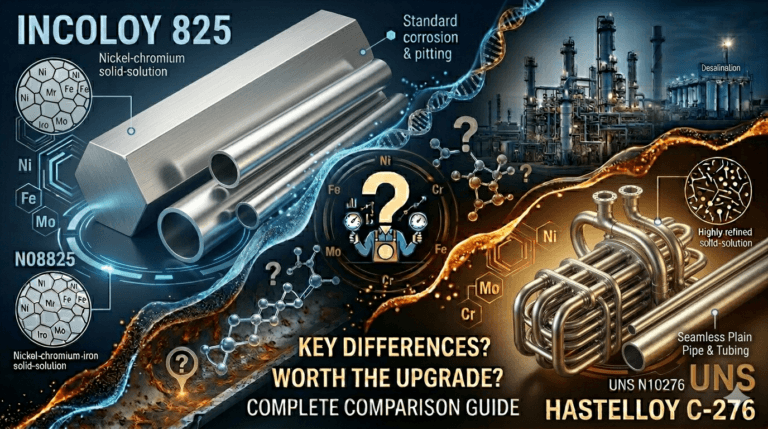
The key differences from Incoloy 800 are immediately apparent:
- Higher nickel (38–46% vs 30–35%) — provides superior chloride stress corrosion cracking (SCC) resistance and general corrosion stability.
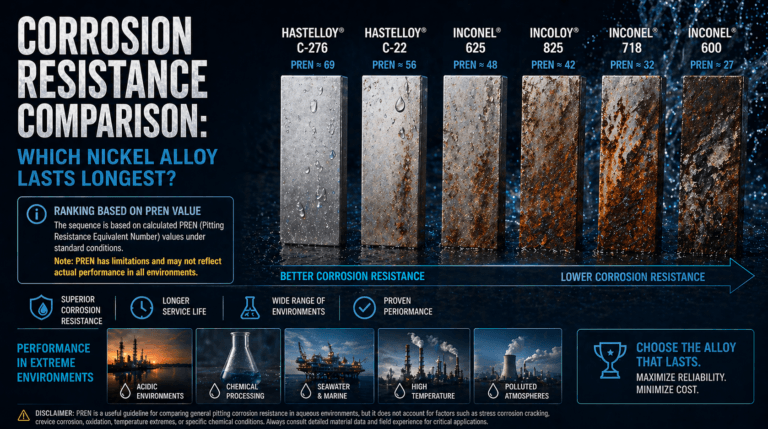
- Molybdenum (2.5–3.5%) — dramatically improves resistance to pitting and crevice corrosion in acidic environments.
- Copper (1.5–3.0%) — specifically added to resist sulfuric acid corrosion, one of the most common aggressive media in chemical processing.
- Lower carbon (≤0.05%) — reduces susceptibility to intergranular corrosion after welding or long-term elevated-temperature exposure.
The titanium addition in Incoloy 825 serves a dual purpose: it provides solid solution strengthening and, more importantly, it acts as a stabilizer against intergranular corrosion by preferentially combining with carbon to form TiC rather than Cr₂₃C₆ grain boundary carbides. This mechanism prevents chromium depletion at grain boundaries — the root cause of sensitized stainless steel failures.
Incoloy 825 Mechanical Properties (Solution Annealed)
| Property | 20°C | 200°C | 400°C | 600°C |
|---|---|---|---|---|
| Ultimate Tensile Strength | 550–750 MPa | 450–600 MPa | 380–480 MPa | 250–350 MPa |
| Yield Strength (0.2%) | 220–350 MPa | 180–250 MPa | 140–200 MPa | 100–150 MPa |
| Elongation | 25–40% | 25–35% | 25–35% | 25–35% |
| Max Service Temperature | — | — | — | 540°C (strength) / 1,000°C (oxidation) |
| Density | 8.14 g/cm³ | — | — | — |
Unlike Incoloy 800, Incoloy 825 is specified primarily for its corrosion resistance, not its elevated-temperature strength. The alloy maintains a stable austenitic microstructure at temperatures up to ~540°C for mechanical loading applications, but its true value proposition is chemical resistance rather than high-temperature mechanical performance.
Corrosion Resistance Profile of Incoloy 825
Incoloy 825’s corrosion resistance is its defining feature:
- Sulfuric acid: Excellent resistance across a wide concentration range (up to 80% H₂SO₄ at moderate temperatures). This is the primary driver for its use in acid cooling and chemical processing.
- Phosphoric acid: Good resistance in processing and handling applications.
- Chlorides and seawater: Superior resistance to chloride SCC compared to Incoloy 800. Approved for seawater service under ASTM G48 and NACE MR0175.
- Nitric acid: Good resistance in oxidizing acid environments.
- Organic acids: Excellent resistance to formic acid, acetic acid, and propionic acid.
- Sour service (H₂S): Incoloy 825 is approved for sour media per NACE MR0175/ISO 15156, making it suitable for oil and gas produced water and acid gas handling.
- Reducing acids: Superior to Incoloy 800 in HCl and H₂SO₄ environments due to Mo and Cu additions.
Head-to-Head Comparison
Temperature Capability
This is the most fundamental difference between the two alloys:
Incoloy 800 / 800H / 800HT are designed for thermally demanding service — furnace tubes, steam superheaters, catalyst tubes, and reformer applications where the tube wall temperature regularly exceeds 600°C and creep rupture life is the primary design criterion. The 800 family comfortably operates up to 815°C (800HT) with acceptable stress rupture life.
Incoloy 825 is designed for corrosive service — its maximum recommended temperature for mechanical loading is 540°C. Above this temperature, the alloy’s yield strength drops significantly and its corrosion advantage diminishes in many environments. Incoloy 825 is never the right choice for a furnace tube operating at 800°C.
| Criterion | Incoloy 800 | Incoloy 825 |
|---|---|---|
| Max temp (stress rupture) | 815°C (800HT) | 540°C |
| Max temp (oxidation only) | 1,000°C | 1,000°C |
| Creep strength at 700°C | Good (800HT) | Poor |
| Thermal cycling resistance | Excellent | Good |
Corrosion Resistance
| Environment | Incoloy 800 | Incoloy 825 |
|---|---|---|
| Oxidizing acids (HNO₃) | Good | Good |
| Reducing acids (H₂SO₄, HCl) | Fair | Excellent |
| Seawater / chlorides | Fair (SCC risk) | Excellent |
| Sour service (H₂S) | Limited | Excellent (NACE approved) |
| Carburizing atmospheres | Excellent | Limited |
| Steam / steam-CO₂ | Excellent | Good |
| High-temp oxidation | Excellent (up to 1,000°C) | Good (up to 1,000°C) |
Cost
Incoloy 825’s higher nickel content (38–46% vs 30–35%) and molybdenum addition make it significantly more expensive than Incoloy 800 — typically 40–60% higher on a per-kilogram basis. For large tube bundles in process heat exchangers, this premium can represent millions of dollars on a project. Specifying 825 where 800 is adequate is a costly engineering mistake.
Petrochemical Application Guide
Use Incoloy 800 / 800HT When:
Primary drivers: High tube wall temperature, creep life requirement, or exposure to carburizing/nitriding atmospheres.
- Steam reformer furnace tubes — Incoloy 800HT is the industry-standard material for radiant zone reformer tubes, operating at 800–900°C with 100,000+ hour design life requirements.
- Ethylene cracking furnace tubes — Carburizing atmosphere at 1,000–1,050°C requires Incoloy 800’s superior carbon diffusion resistance.
- Steam superheater tubes — Incolel 800/800HT handles steam temperatures up to 750°C in utility and process applications.
- Pyrolysis heaters — High-temperature hydrocarbon cracking environments favor Incoloy 800’s carbon resistance.
- Catalyst reformer tubes — Hydroprocessing and catalytic reforming units at elevated temperatures.
- Heat recovery steam generators (HRSG) — When tube metal temperatures exceed 600°C, 800HT provides the necessary creep performance.
Use Incoloy 825 When:
Primary drivers: Aggressive aqueous corrosion, acid media, chloride-containing process fluids, or sour service requirements.
- Sulfuric acid coolers — The defining application for Incoloy 825. Acid concentration 10–80% H₂SO₄ at temperatures where 316L and even 904L fail.
- Seawater-cooled heat exchangers — When seawater is the cooling medium and chloride SCC is a concern, Incoloy 825 tube sheets and tubesheets provide superior service life.
- Sour water stripper condensers — Ammonia and H₂S-bearing process streams in refinery service.
- Acid gas coolers — Handling gas streams containing CO₂ and H₂S at elevated pressure.
- Phosphoric acid service — Fertilizer production and wet-process phosphoric acid cooling.
- Nuclear fuel reprocessing — Incoloy 825’s corrosion resistance to nitric acid and radiation-induced corrosion makes it suitable for fuel reprocessing plant heat exchangers.
- Produced water heaters (oil & gas) — High-chloride produced water at elevated temperatures.
- Hydrometallurgical leaching circuits — Leaching, precipitation, and washing operations in nickel and copper extraction.
The 316L Confusion
One of the most common specification errors in petrochemical heat exchanger design is the use of 316L stainless steel in corrosive service where neither 800 nor 825 is truly needed but 316L is inadequate.
The typical failure sequence: 316L tubes are specified to save cost in a seawater condenser. The tubes pass factory acceptance testing. Within 18 months, pitting corrosion initiates at weld heat-affected zones (HAZ). Within 3 years, tube leaks appear. Emergency shutdown, tube plugging, and eventual full bundle replacement — at a cost many times the original material premium for 825.
For seawater and chloride-bearing service above 50°C, Incoloy 825 is the minimum acceptable specification. 316L may be acceptable for seawater above 50°C only in very specific low-velocity, low-chloride conditions with full cathodic protection — and even then, service life is limited.
JAAlloy recommends always consulting with our technical team when specifying tube materials for seawater or brackish water service.
Heat Exchanger Design Considerations
Beyond material selection, heat exchanger tube material decisions should account for:
Tube wall temperature calculation — The tube metal temperature (TMT) in service is always higher than the bulk fluid temperature. For fired heaters, the TMT in the radiant zone can exceed the process fluid temperature by 50–150°C. Specifying 800HT based on process fluid temperature alone is correct; specifying based on fluid temperature alone and using 316L would be catastrophically wrong.
Tube sheet material — The tube sheet often operates at a lower temperature than the tube itself, but it must be galvanically compatible with the tube material. In seawater service, welding 825 tubes to a carbon steel tube sheet requires careful weld overlay procedures. Specify weld overlay (typically 625 or 276) on the tube sheet to prevent galvanic attack.
Baffle material — In corrosive service, the baffle material must match or exceed the corrosion resistance of the tube material. 316L baffles in an 825 tube bundle will fail first.
Expansion joint and bellows — For U-tube or expansion joint designs, verify that the bellows material is compatible with the process stream and operating temperature.
Conclusion
The Incoloy 800 vs 825 decision is fundamentally a “temperature or corrosion?” question.
If the tube operates above 540°C with mechanical loading — reformer furnaces, steam superheaters, cracker tubes — the answer is unequivocally Incoloy 800 / 800HT. This is what the alloy was designed for, and no substitution can match its combination of elevated-temperature strength, oxidation resistance, and carbon resistance in this service.
If the tube operates below 540°C in aggressive aqueous or acid service — acid coolers, seawater condensers, sour media — the answer is Incoloy 825. Its molybdenum-copper-nickel system provides corrosion resistance that neither 800 nor 316L can match in these environments.
The most costly error is the inverse substitution: using Incoloy 825 in a high-temperature furnace tube application. 825 cannot provide the creep rupture life needed at 800°C, and its molybdenum content provides no benefit in a dry, oxidizing furnace atmosphere — only the higher price. Conversely, using 800 in a seawater-cooled acid exchanger is an even more dangerous error, because the resulting tube leaks can cause unit shutdowns, environmental spills, and safety incidents.
Know the tube metal temperature. Know the process fluid chemistry. Match the alloy to the actual service conditions.
J&A Alloy supplies both Incoloy 800/800HT and Incoloy 825 in tube, pipe, bar, and plate forms, with full mill test reports to ASTM and ASME specifications. Contact our technical team for material selection guidance and RFQ support.