Introduction
Few material selection decisions in aerospace and oil & gas engineering generate more debate than Inconel 718 versus Inconel 625. Both are workhorse nickel-chromium superalloys. Both carry the Inconel name and benefit from decades of established supply chains, fabrication know-how, and design codes. Both appear on the same purchase requisitions and often get confused by engineers who haven’t worked closely with both materials.
The confusion is understandable. The naming convention is identical, the base chemistry is similar, and both alloys deliver excellent corrosion resistance and high-temperature strength. But the differences matter enormously when you push into specific operating conditions. Inconel 718’s niobium-stabilized gamma double prime (γ″) precipitation system gives it superior yield strength and creep resistance at moderate temperatures, while Inconel 625’s molybdenum-niobium solid solution strengthening delivers unmatched fabricability and corrosion resistance in the most demanding chemical environments.
Choosing the wrong alloy means paying a premium for performance you don’t need — or, worse, specifying a material that fails prematurely in service. This article cuts through the marketing noise to deliver a rigorous, practical comparison that engineering teams can use to make confident selection decisions.
Inconel 718: Composition and Metallurgy
Inconel 718 (UNS N07718, AMS 5662/5663, ASTM B637) is a precipitation-hardening nickel-chromium alloy with the following nominal composition:
| Element | Weight % |
|---|---|
| Nickel (Ni) | 50.0–55.0 |
| Chromium (Cr) | 17.0–21.0 |
| Iron (Fe) | Balance |
| Niobium (Nb) | 4.75–5.50 |
| Molybdenum (Mo) | 2.80–3.30 |
| Titanium (Ti) | 0.65–1.15 |
| Aluminum (Al) | 0.20–0.80 |
| Manganese (Mn) | ≤0.35 |
| Silicon (Si) | ≤0.35 |
| Carbon (C) | ≤0.08 |
| Cobalt (Co) | ≤1.00 |
| Boron (B) | ≤0.006 |
The alloy’s remarkable strength derives from a two-phase precipitation system:
Gamma double prime (γ″) — The dominant strengthening phase. Ni₃Nb with a body-centered tetragonal (BCT) crystal structure, coherently precipitating as disc-shaped particles (typically 10–20 nm diameter, 2–5 nm thick) on the {100} planes of the austenitic matrix. The coherency strain between γ″ and the matrix is the primary source of Inconel 718’s exceptional yield strength.
Gamma prime (γ′) — Ni₃(Al, Ti), a face-centered cubic (FCC) intermetallic that provides supplementary strengthening and improves thermal stability.
The standard heat treatment for Inconel 718 (AMS 5663 condition) is a two-step precipitation hardening cycle:
- Solution treatment: 925–1,010°C for 1 hour, air cool or water quench.
- Precipitation aging (double aging): 720°C for 8 hours, furnace cool to 620°C, hold 8 hours, air cool.
This double-aging treatment precipitates both γ″ and γ′ phases sequentially, achieving peak tensile strength and creep resistance. The result is an alloy that routinely delivers yield strengths of 1,000–1,200 MPa — among the highest of any wrought nickel alloy.
Inconel 718 Mechanical Properties (Peak Aged)
| Property | Value |
|---|---|
| Ultimate Tensile Strength | 1,240–1,380 MPa |
| Yield Strength (0.2% offset) | 1,030–1,180 MPa |
| Elongation at Fracture | 12–20% |
| Hardness | 36–44 HRC |
| Creep Rupture (650°C, 690 MPa) | ~300 h to rupture |
| Creep Rupture (650°C, 500 MPa) | ~2,000 h to rupture |
| Max Service Temperature | 650°C (γ″ stability limit) |
| Density | 8.19 g/cm³ |
The 650°C temperature ceiling is fundamental. Above this temperature, the γ″ phase coarsens rapidly and transforms to the equilibrium δ phase (Ni₃Nb, orthorhombic), losing the coherency strain that drives Inconel 718’s strength. Engineers designing for service above 650°C must look to alloys with γ′-dominated strengthening systems, such as Inconel 625 or Waspaloy.
Inconel 625: Composition and Metallurgy
Inconel 625 (UNS N06625, AMS 5666, ASTM B443/B444) is a solid solution strengthened nickel-chromium alloy with molybdenum and niobium additions:
| Element | Weight % |
|---|---|
| Nickel (Ni) | 58.0 min |
| Chromium (Cr) | 20.0–23.0 |
| Molybdenum (Mo) | 8.0–10.0 |
| Niobium (Nb) | 3.15–4.15 |
| Iron (Fe) | ≤5.0 |
| Titanium (Ti) | ≤0.40 |
| Aluminum (Al) | ≤0.40 |
| Manganese (Mn) | ≤0.50 |
| Silicon (Si) | ≤0.50 |
| Carbon (C) | ≤0.10 |
| Cobalt (Co) | ≤1.00 |
| Tantalum (Ta) | ≤0.05 |
| Phosphorus (P) | ≤0.015 |
| Sulfur (S) | ≤0.015 |
Unlike Inconel 718, Inconel 625 derives its strength almost entirely from solid solution strengthening. The high chromium content (20–23%) provides the primary solution strengthening effect, while molybdenum (8–10%) and niobium (3.15–4.15%) add supplementary strengthening and enhance corrosion resistance. A small amount of γ′ precipitation (Ni₃Al) occurs but does not dominate the alloy’s mechanical behavior.
This absence of a major precipitation hardening system means Inconel 625 is delivered in the solution-annealed condition (typically 1,090–1,200°C, air cooled or water quenched). There is no mandatory aging heat treatment, which significantly simplifies fabrication and reduces the risk of distortion during heat treatment.
Inconel 625 Mechanical Properties (Solution Annealed)
| Property | Value |
|---|---|
| Ultimate Tensile Strength | 760–930 MPa |
| Yield Strength (0.2% offset) | 350–450 MPa |
| Elongation at Fracture | 25–40% |
| Hardness | 20–30 HRC |
| Creep Rupture (650°C, 300 MPa) | ~1,000 h to rupture |
| Creep Rupture (760°C, 100 MPa) | ~1,000 h to rupture |
| Max Service Temperature | 980°C (oxidation), 760°C (strength) |
| Density | 8.44 g/cm³ |
Inconel 625’s lower yield strength compared to Inconel 718 is the trade-off for its superior high-temperature capability and fabricability. The alloy maintains meaningful mechanical integrity well above 650°C, making it the preferred choice for hot-section components where thermal stability is critical.
Head-to-Head: Critical Differences
Strength and Creep Performance
The most commonly misunderstood comparison: Inconel 718 is stronger at moderate temperatures; Inconel 625 is stronger at elevated temperatures.
At room temperature to 500°C, Inconel 718’s γ″ precipitation delivers yield strengths roughly 2× those of Inconel 625 in the standard condition. For static structural components in this temperature range — compressor discs, turbine wheels, structural brackets — Inconel 718 is the obvious choice.
Above 650°C, the picture reverses. Inconel 718’s γ″ phase destabilizes, and the alloy loses its precipitation strengthening advantage. Inconel 625, with its solid solution strengthening mechanism, maintains its mechanical properties progressively through this temperature range. At 750°C and above, Inconel 625 remains viable while Inconel 718 does not.
| Temperature | Inconel 718 Yield Strength | Inconel 625 Yield Strength |
|---|---|---|
| 20°C | 1,030–1,180 MPa | 350–450 MPa |
| 400°C | 900–1,000 MPa | 290–350 MPa |
| 600°C | 700–850 MPa | 270–320 MPa |
| 700°C | Rapid strength loss | 240–290 MPa |
| 800°C | Not recommended | 180–230 MPa |
Corrosion Resistance
Inconel 625 is the corrosion-resistant champion. Its higher chromium (20–23% vs 17–21%) and dramatically higher molybdenum (8–10% vs 2.8–3.3%) content provide superior resistance to:
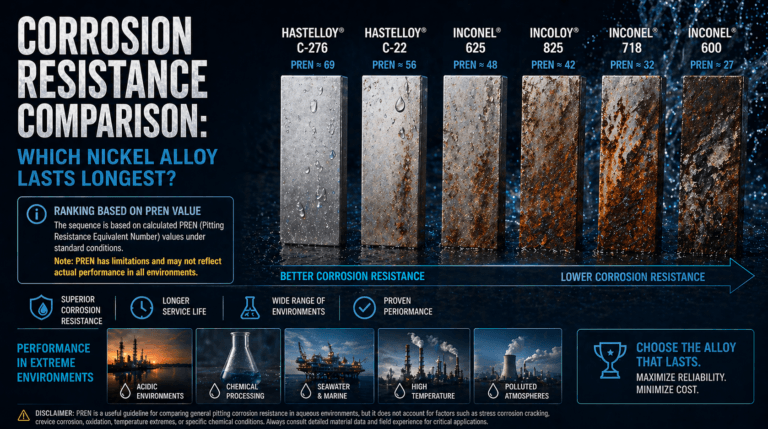
- Pitting and crevice corrosion: Inconel 625’s PREN (Pitting Resistance Equivalent Number) is approximately 38–44, compared to Inconel 718’s ~28–32. In chloride-bearing environments, this is a decisive difference.
- Reducing acids: Excellent resistance to hydrochloric acid, sulfuric acid, and phosphoric acid across a wide concentration range.
- Oxidizing environments: The high chromium content provides outstanding resistance to high-temperature oxidation and nitriding.
- Sour service (H₂S): Inconel 625 is widely approved for NACE MR0175/ISO 15156 sour service applications. Inconel 718 is also approved but with more restrictive conditions.
Inconel 718’s corrosion resistance, while good, is fundamentally limited by its lower Cr and Mo content. It performs well in mildly corrosive environments but is not designed for aggressive chemical service.
Weldability and Fabricability
This is where the alloys diverge most practically:
Inconel 625 welds with exceptional ease. The solution-annealed base material has low yield strength and high ductility, minimizing residual stress during welding. Standard TIG/GTAW and MIG/GMAW processes work well with ERNiCrMo-3 filler (Inconel 625 filler). Post-weld heat treatment is not required for most applications, though PWHT can improve stress relaxation if needed. The alloy is also highly resistant to strain-age cracking during welding, a common problem with precipitation-hardened alloys.
Inconel 718 presents more fabrication challenges. While still readily weldable in the solution-treated condition, Inconel 718 is susceptible to strain-age cracking (also called post-weld heat treatment cracking) in the HAZ if the weldment is subjected to precipitation aging without proper stress relief. Key requirements:
- Weld in the solution-treated condition only.
- Use ERNiFeCr-2 (Inconel 718 filler) or ERNiCrMo-3 for matching composition welds.
- Perform post-weld solution treatment + aging if maximum strength is required in the weld zone.
- Alternatively, use a complete post-weld heat treatment cycle (solution + double age) to restore properties.
For complex fabrications with extensive welds, Inconel 625’s simpler thermal requirements can reduce fabrication cost and schedule significantly.
Cost and Availability
Both alloys are commercially mature with well-established supply chains. Inconel 718 typically commands a 10–25% price premium over Inconel 625, driven by higher niobium content (Nb is expensive) and more complex heat treatment requirements. For large-volume applications where the mechanical properties of 718 aren’t fully utilized, 625 offers a cost-effective alternative.
Application-Specific Recommendations
Choose Inconel 718 When:
- Operating temperatures are 500–650°C with sustained loads — the γ″ phase is optimized for this range.
- Maximum yield strength is required — 1,000+ MPa yield strength is available and often necessary for rotating components.
- Aerospace turbine disc and wheel applications — Inconel 718 is the dominant alloy in this sector, with a proven track record in jet engines and rocket motors.
- NASA and aerospace-grade specifications apply — AMS 5662/5663, ASTM B637, GE B50T65 are Inconel 718-dominated specifications.
- Cryogenic temperatures are also a concern — Inconel 718 maintains excellent toughness at cryogenic temperatures (-253°C liquid hydrogen service), while Inconel 625’s toughness is good but not as exceptional.
- Long-term creep resistance at 600°C matters — for 10,000+ hour design life, Inconel 718 outperforms Inconel 625 at this temperature.
Choose Inconel 625 When:
- The application exceeds 650°C — this is the most important criterion. If your component sees temperatures above 650°C routinely, Inconel 718’s γ″ strengthening will degrade.
- Complex welding is required — the absence of precipitation hardening eliminates strain-age cracking risk and simplifies post-weld heat treatment.
- Aggressive corrosion environments are present — seawater, strong acids, sour gas, and oxidizing media favor Inconel 625’s superior alloying.
- Oxidation resistance at high temperature is critical — Inconel 625’s higher Cr + Mo + Nb combination resists oxidation up to ~980°C.
- Flexibility in fabrication processing is needed — solution-annealed material is easier to bend, form, and machine without risk of over-aging.
- ASME Section VIII pressure vessel applications — Inconel 625 has extensive ASME B16.34 and Code Case approvals for pressure boundary applications.
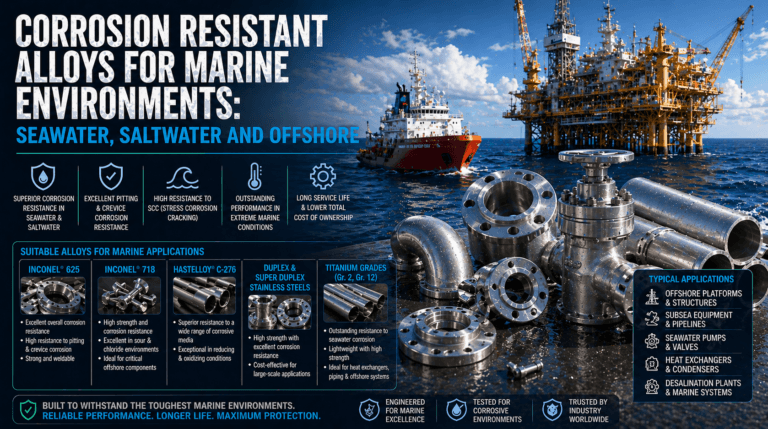
- Marine or offshore environments — Inconel 625’s pitting resistance (PREN ~40) makes it suitable for seawater handling when duplex stainless steel is insufficient.
The Third Option: Inconel X-750
Before concluding, it’s worth noting that neither 718 nor 625 is always the right answer. Inconel X-750 (UNS N07750) occupies an intermediate position — it is a precipitation-hardened γ′-strengthened alloy (Ni₃Al, Ti) with no niobium, giving it better thermal stability than 718 at elevated temperatures while maintaining higher strength than 625. For applications in the 650–750°C range where both creep resistance and fabricability matter, X-750 is often the forgotten-but-correct choice.
This article focuses on 718 vs 625 because they are the most commercially significant, but material specifiers working in the overlap zone should evaluate X-750 with the same rigor.
Conclusion
The Inconel 718 vs 625 decision is ultimately a temperature-and-load decision:
- Below 650°C with high load requirements → Inconel 718. Its γ″ precipitation system delivers the highest yield strength available in any wrought superalloy for this temperature range.
- Above 650°C or in aggressive corrosion environments → Inconel 625. Its solid solution strengthening and superior corrosion resistance make it the workhorse of the hot section and chemical processing industries.
- Complex fabrication or limited heat treatment capability → Inconel 625, every time. The elimination of mandatory PWHT is a practical advantage that translates directly to cost and schedule savings.
The alloy that wins is the one that matches the actual service conditions. Engineers who default to “Inconel 718 is stronger, so use 718” are making the same mistake as those who specify Inconel 625 for a cryogenic rotating component that needs maximum yield strength. Know your temperatures, know your loads, know your environment — and the right answer becomes clear.
J&A Alloy stocks both Inconel 718 and Inconel 625 in bar, billet, ring, forged disc, and plate forms, with full traceability and mill test reports. Contact our technical sales team for material selection support, RFQ pricing, or technical data sheets.