If you work with high-performance nickel alloys long enough, you’ll eventually face the same question: Hastelloy or Inconel?
Both are nickel-based superalloys. Both are expensive. Both handle conditions that would destroy conventional stainless steel. And yet they are fundamentally different materials, engineered for different failure modes — and choosing the wrong one can mean premature equipment failure, costly downtime, or worse.
The one-sentence version: Inconel is optimized for high-temperature strength. Hastelloy is optimized for corrosion resistance in aggressive chemical media. But the full answer is more nuanced — some grades overlap in capability, specific alloy selection matters enormously, and there are environments where one is clearly superior and others where either could work.
This guide covers the full comparison: alloy families, chemical composition, mechanical properties, corrosion resistance, typical grades, applications, weldability, and cost — so you can make an informed decision for your specific application.
The One-Line Answer (and Why It’s Not Enough)
Inconel → High temperature. Aerospace, gas turbines, exhaust systems. Hastelloy → Corrosive chemicals. Chemical processing, acid service, offshore.
That distinction holds as a starting point, but it collapses quickly when you look at the details. Inconel 625, for example, is one of the most corrosion-resistant alloys available — used extensively in offshore and marine applications. Hastelloy C-276 performs reasonably well at elevated temperatures. The real answer requires understanding the specific grade, the environment, and which failure mode is your primary concern.
Quick Comparison: Hastelloy vs Inconel Families
| Dimension | Hastelloy | Inconel |
|---|---|---|
| Developer / Brand owner | Haynes International | Special Metals (Inco) |
| Primary alloying philosophy | Ni + Mo + Cr (high molybdenum) | Ni + Cr (+ Nb, Al, Ti depending on grade) |
| Primary design goal | Corrosion resistance (chemical media) | High-temperature strength and oxidation resistance |
| PREN range (typical grades) | 40–70+ | 25–50 |
| Max service temperature | Up to ~600–800°C (grade-dependent) | Up to ~1093°C (grade-dependent) |
| Key industries | Chemical processing, oil & gas, pharmaceuticals | Aerospace, gas turbines, nuclear, marine |
| Relative cost | Generally higher | High, but varies widely by grade |
| Common grades | C-276, C-22, B-2, B-3, X, G-30 | 625, 718, 600, 601, 825 |
Alloy Families: Who Makes What
Hastelloy — The Haynes International Brand
“Hastelloy” is a registered brand name owned by Haynes International, applied to their line of nickel-based corrosion-resistant and heat-resistant alloys. The “H” grades (Hastelloy X, Hastelloy N) are heat-resistant; the “C” grades (C-276, C-22, C-2000) and “B” grades (B-2, B-3) are primarily corrosion-resistant.
Key grades and their primary strengths:
| Grade | Ni | Cr | Mo | Key Feature |
|---|---|---|---|---|
| C-276 | ≥57% | 14.5–16.5% | 15–17% | Broadest corrosion resistance; the most widely used grade |
| C-22 | ≥56% | 20–22.5% | 12.5–14.5% | Better oxidizing acid and pitting resistance than C-276 |
| B-2 | ≥69% | ≤1% | 26–30% | Superior resistance to HCl at all temperatures/concentrations |
| B-3 | ≥65% | 1–3% | 27–32% | Improved B-2 with better thermal stability |
| G-30 | ≥43% | 28–31.5% | 4–6% | Excellent phosphoric and sulfuric acid resistance |
| Hastelloy X | ~47% | 20.5–23% | 8–10% | High-temperature oxidation resistance; aerospace use |
Inconel — The Special Metals Brand
“Inconel” is a registered trademark of Special Metals Corporation (now part of PCC), applied to their nickel-chromium alloys. The family spans from highly corrosion-resistant grades (625) to age-hardenable high-temperature alloys (718) to simpler oxidation-resistant grades (600).
Key grades and their primary strengths:
| Grade | Ni | Cr | Mo | Nb | Key Feature |
|---|---|---|---|---|---|
| 625 | ≥58% | 20–23% | 8–10% | 3.15–4.15% | Outstanding corrosion resistance + high strength |
| 718 | 50–55% | 17–21% | 2.8–3.3% | 4.75–5.5% | Age-hardenable; highest strength of common Inconel grades |
| 600 | ≥72% | 14–17% | — | — | High temperature oxidation; simpler, cost-effective |
| 601 | 58–63% | 21–25% | — | — | Superior high-temp oxidation resistance (alumina former) |
| 825 | 38–46% | 19.5–23.5% | 2.5–3.5% | — | Technically an “Incoloy”; strong corrosion resistance |
Chemical Composition: The Mo Difference
The single most important compositional difference is molybdenum content:
| Alloy | Mo Content | Effect |
|---|---|---|
| Hastelloy C-276 | 15–17% | Exceptional resistance to pitting, crevice corrosion, and reducing acids |
| Hastelloy B-2 | 26–30% | Maximum possible resistance to hydrochloric acid |
| Inconel 625 | 8–10% | Good chloride and pitting resistance |
| Inconel 718 | 2.8–3.3% | Limited corrosion-specific enhancement |
| Inconel 600 | ~0% | No corrosion enhancement from Mo |
Molybdenum is the primary element responsible for resistance to reducing acid attack and pitting corrosion. Hastelloy grades are specifically formulated around high molybdenum to maximize corrosion performance. Inconel grades use molybdenum more sparingly because their design priority is high-temperature mechanical performance, which is driven by chromium content (for oxidation resistance) and niobium/aluminum/titanium additions (for precipitation hardening and creep resistance).
The second key difference is how chromium is used:
- Hastelloy C-22 and C-276: Moderate Cr (14.5–22.5%) — enough for oxidizing acid resistance, but Mo is the primary corrosion-fighting element
- Inconel 601: High Cr (21–25%) + aluminum — this is an alumina-forming alloy optimized for extreme oxidation resistance at temperatures beyond what any Hastelloy grade is designed for
Corrosion Resistance: Hastelloy Wins in Aggressive Media
In Reducing Acids (HCl, H₂SO₄, H₃PO₄)
This is Hastelloy’s strongest domain:
| Environment | Hastelloy C-276 | Inconel 625 |
|---|---|---|
| 20% HCl at 38°C | Corrosion rate <0.05 mm/yr | Unacceptable |
| 40% H₂SO₄ at 49°C | Corrosion rate <0.03 mm/yr | Limited resistance |
| Phosphoric acid (various) | Excellent | Moderate |
Hastelloy B-2 / B-3 take this further still — they are specifically formulated for hydrochloric acid service at all concentrations and temperatures, including boiling HCl. No other commercially available wrought alloy approaches their performance in this environment.
In Chloride Environments (Seawater, Brines)
Here the comparison is closer — both families have capable grades:
| Alloy | PREN (typical) | Chloride Performance |
|---|---|---|
| Hastelloy C-276 | ~70–75 | Excellent — no pitting in standard 6% FeCl₃ tests |
| Hastelloy C-22 | ~65–70 | Excellent, better oxidizing acid resistance than C-276 |
| Inconel 625 | ~50–52 | Very good — widely used in offshore, subsea |
| Inconel 718 | ~25–28 | Moderate — not primarily a corrosion-resistant alloy |
For most marine and offshore applications, Inconel 625 is a practical choice that balances corrosion resistance with high strength and good weldability. Hastelloy C-276 offers superior corrosion performance but at a higher cost — specified when the environment is particularly aggressive.
In High-Temperature Oxidizing Environments
Inconel grades designed for oxidation resistance (600, 601, 625) outperform Hastelloy here, because high molybdenum content does not enhance oxidation resistance and can actually accelerate high-temperature degradation in certain oxidizing atmospheres (Mo forms volatile MoO₃ above approximately 700°C).
High-Temperature Performance: Inconel Wins Above 600°C
| Alloy | Max Service Temp (approx.) | Primary High-Temp Application |
|---|---|---|
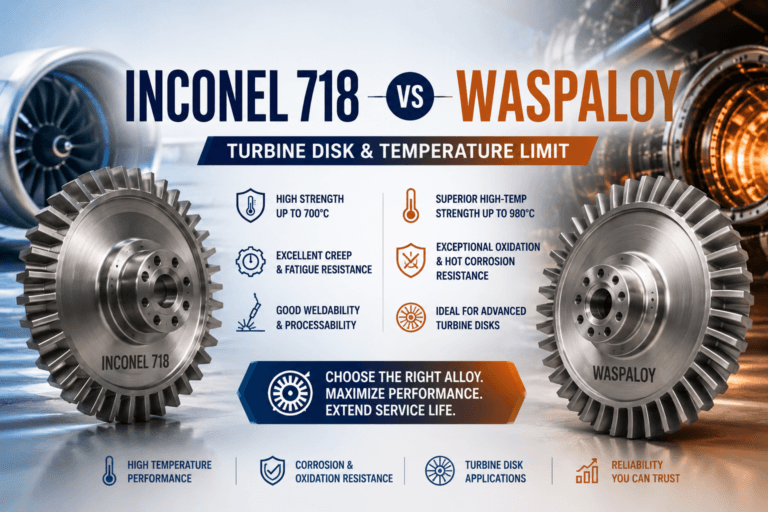
| Inconel 718 | ~650°C (age-hardened) | Aerospace turbine discs, fasteners |
| Inconel 625 | ~980°C (annealed) | Exhaust systems, furnace components |
| Inconel 601 | ~1200°C | Furnace baskets, radiant tubes |
| Hastelloy X | ~1090°C | Gas turbine combustion zones |
| Hastelloy C-276 | ~600°C practical limit | Chemical processing (not a high-temp alloy) |
The reason Inconel grades handle higher temperatures comes down to alloy design:
- Chromium-rich oxide scale: High Cr content in Inconel 601 forms a stable, adherent Cr₂O₃ layer that protects against oxygen attack at temperatures exceeding 1000°C
- Precipitation hardening (γ” and γ’ phases): Inconel 718’s Nb, Ti, and Al additions form strengthening precipitates (Ni₃Nb, Ni₃Al) that maintain high strength at elevated temperatures through a mechanism unavailable to solid-solution alloys like C-276
- Creep resistance: The precipitate microstructure in Inconel 718 makes it the standard aerospace alloy for turbine discs and other components where sustained load at temperature is the primary concern
Hastelloy X is the exception — it is genuinely a high-temperature alloy and is used in gas turbine combustion chambers and afterburner liners. But it is positioned as a heat-resistant rather than a corrosion-resistant grade.
Mechanical Properties: Inconel 718 Leads the Field
| Alloy | Tensile Strength | Yield Strength (0.2%) | Elongation |
|---|---|---|---|
| Inconel 718 (aged) | 1240–1450 MPa | 1035–1170 MPa | ≥12% |
| Inconel 625 (annealed) | 827–1000 MPa | 414–580 MPa | ≥30% |
| Hastelloy C-276 (annealed) | 690–830 MPa | 275–415 MPa | ≥35% |
| Hastelloy C-22 (annealed) | 690–790 MPa | 310–380 MPa | ≥45% |
| Inconel 600 (annealed) | 550–700 MPa | 240–350 MPa | ≥35% |
Key takeaways:
- Inconel 718 in the aged (heat-treated) condition is the strongest of all common nickel superalloys in this comparison — substantially so. This is why it dominates aerospace structural applications.
- Hastelloy grades in annealed condition are moderate-strength alloys; they are not specified for structural performance.
- Inconel 625 occupies an interesting middle ground — good corrosion resistance combined with meaningfully higher strength than Hastelloy C-276.
Weldability: Both Require Care
| Factor | Hastelloy C-276 | Inconel 625 | Inconel 718 |
|---|---|---|---|
| Weldability | Good | Good | Fair (requires PWHT) |
| Primary concern | Mo-rich segregation in HAZ | Laves phase in weld | Age hardening response after weld |
| PWHT required | Usually no | Usually no | Yes (for full strength) |
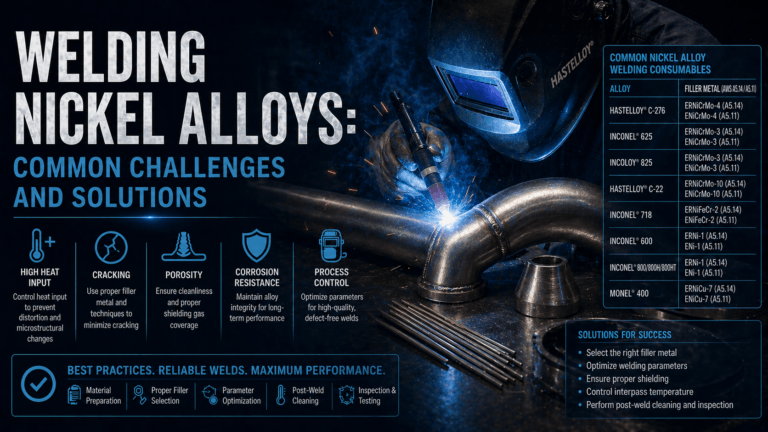
| Filler metal | ERNiCrMo-4 (C-276 filler) | ERNiCrMo-3 (625 filler) | ERNiFeCr-2 (718 filler) |
| Sensitization risk | Low (low C) | Low (low C) | Low (low C) |
A practical note: Inconel 625 filler wire (ERNiCrMo-3) is one of the most commonly used nickel alloy filler metals in industry — it is regularly used not just for welding 625 base metal but for overlaying carbon steel or stainless steel to impart corrosion resistance, and for joining dissimilar alloy combinations. Its versatility as a filler is significant.
Inconel 718 is the most challenging to weld in this group. It must be welded in the annealed (solution-treated) condition and subjected to post-weld aging heat treatment to develop its full mechanical properties. Improper heat treatment results in significant strength degradation.
Applications Side by Side
Choose Hastelloy When:
| Scenario | Recommended Grade |
|---|---|
| Hydrochloric acid at any concentration / temperature | B-2 or B-3 |
| Broad chemical resistance (mixed acid/chloride) | C-276 |
| Mixed oxidizing + reducing acid service | C-22 |
| Phosphoric and sulfuric acid processing | G-30 |
| Flue gas desulfurization (FGD) scrubbers | C-276 or C-22 |
| Pharmaceutical equipment (aggressive solvents) | C-22 |
| Seawater + aggressive chemistry (highly corrosive) | C-276 |
Choose Inconel When:
| Scenario | Recommended Grade |
|---|---|
| Jet engine components, turbine hardware | 718 |
| Offshore / subsea piping and structural components | 625 |
| High-temperature furnace components, heat treatment baskets | 601 |
| Nuclear reactor components | 600 or 690 |
| Exhaust manifolds, cryogenic service | 625 |
| High-strength fasteners and hardware in corrosive environments | 718 or 625 |
| Gas turbine combustion chambers | Hastelloy X |
Overlap Zone: When Either Could Work
There are real situations where both Hastelloy and Inconel alloys are technically qualified, and the decision comes down to cost, fabrication, and supplier availability:
| Application | Why Both Could Work | Typical Choice |
|---|---|---|
| Offshore seawater systems | Inconel 625 is strong and corrosion-resistant; C-276 is more corrosion-resistant | Inconel 625 (better value, wider availability) |
| Chemical plant heat exchangers (moderate service) | 625 handles most chemical environments; C-276 only needed for worst cases | Inconel 625 if chemistry is moderate; C-276 if aggressive |
| Flue gas scrubbers with moderate acid | C-276 is standard; 625 may handle lighter duty | C-276 for safety margin |
| Sour gas (H₂S/CO₂) oil & gas service | Both have grades qualified to NACE MR0175 | Evaluate specific H₂S partial pressure and temperature |
Cost Comparison
Neither family is cheap. Both require expensive raw materials (nickel, molybdenum, chromium) and specialized production. That said, some general patterns hold:
| Factor | Hastelloy | Inconel |
|---|---|---|
| Raw material cost driver | Very high Mo content (especially B-grades) | High Ni; Nb adds cost in 718 |
| Market availability | Good for C-276; specialty for B-grades | Excellent for 625; good for 718 |
| Price premium vs 316L | 5–15× | 4–10× (grade-dependent) |
| Fabrication cost | High (machining, welding require care) | High for 718; moderate for 625 |
In practice, Hastelloy C-276 and Inconel 625 are the most commonly compared grades, and C-276 typically commands a 20–40% premium over Inconel 625 due to its higher molybdenum content. However, pricing fluctuates significantly with nickel and molybdenum spot prices.
FAQ
Q1: Is Hastelloy stronger than Inconel?
It depends on the specific grade. Hastelloy C-276 and C-22 are moderate-strength alloys — designed for corrosion performance, not structural strength. Inconel 718 is dramatically stronger (yield strength 3–4× that of C-276 in the aged condition). Inconel 625 is also stronger than C-276. If strength is the design criterion, Inconel grades generally lead.
Q2: Can Hastelloy and Inconel be welded together?
Yes. ERNiCrMo-3 (Inconel 625 filler) or ERNiCrMo-4 (C-276 filler) are both used for dissimilar nickel alloy joints, depending on the service environment. A qualified welding procedure is required. The choice of filler should favor the alloy with the higher corrosion resistance requirement if the weld will be exposed to the process environment.
Q3: Which is more widely available?
Inconel 625 is among the most commonly stocked nickel alloy products globally — available as plate, sheet, pipe, tube, bar, and fittings from multiple global distributors. Hastelloy C-276 is also widely stocked, though less ubiquitous than 625. B-grade Hastelloys and specialty grades may require mill order with longer lead times.
Q4: Are “Hastelloy” and “Inconel” generic terms?
No — both are registered trademarks. “Hastelloy” belongs to Haynes International; “Inconel” belongs to Special Metals Corporation. Other manufacturers produce materials to the same chemical compositions under different trade names or simply as UNS-numbered alloys (e.g., N10276 for C-276, N06625 for Inconel 625). When ordering, always specify by UNS number and applicable ASTM standard to ensure you receive material meeting the correct specification, regardless of the trade name.
Q5: Which has better performance in seawater?
Both are capable in seawater. Inconel 625 is more commonly specified for offshore and subsea applications — it has an excellent track record in marine environments, is available in a wide range of product forms, and has a well-established fabrication and inspection ecosystem in the oil and gas industry. Hastelloy C-276 offers marginally better pitting and crevice corrosion resistance but at a meaningful cost premium. For most marine applications, Inconel 625 is the pragmatic choice.
Summary Decision Guide
| Your Primary Challenge | Recommended Direction |
|---|---|
| Reducing acids (HCl, H₂SO₄) | Hastelloy B-3 or C-276 |
| Mixed oxidizing/reducing acid | Hastelloy C-22 or C-276 |
| High-temperature service (>800°C) | Inconel 601, 625 (high temp), or Hastelloy X |
| Aerospace / turbine hardware | Inconel 718 |
| Offshore / subsea piping | Inconel 625 |
| Highest strength requirement | Inconel 718 |
| Broadest corrosion coverage with one grade | Hastelloy C-276 |
| Best value in corrosive marine environments | Inconel 625 |
Both Hastelloy and Inconel represent the upper tier of engineering alloy performance. The right choice depends on whether your primary threat is chemical attack (Hastelloy’s domain) or high-temperature mechanical degradation (Inconel’s domain) — or in the overlap zone, the specific combination of temperature, chemistry, and mechanical load that your equipment must survive.
Have a specific application in mind? Contact our technical team — we supply both Hastelloy and Inconel grades and can help match the right alloy to your requirements.