Introduction
Walk into any petrochemical facility, ask three engineers which nickel alloy to specify for a new heat exchanger, and you’ll likely get three different answers. One says Hastelloy C-276. Another recommends Inconel 625. The third insists Incoloy 825 is more than enough — and half the cost.
All three could be right. They could also all be wrong.
Nickel alloys are a family, not a single material. Within that family, there are more than 30 commercially significant grades across five major product lines — each designed for a specific combination of corrosion type, temperature range, and mechanical load. Choosing the wrong grade isn’t just a cost problem. It’s a safety problem.
This guide cuts through the confusion with a structured selection framework. We’ll cover the five major nickel alloy families, the 12 most widely used grades, the corrosion–temperature–industry selection matrix, and the questions you need to answer before placing a material order.
1. Why Nickel Is the Key Element
Before we compare grades, we need to understand why nickel itself matters.
Nickel’s unique contribution to alloy performance:
- Passive film stability: Nickel stabilizes the chromium oxide passive layer against attack by both oxidizing and reducing acids — a balance that iron-based stainless steels cannot achieve.
- Austenite stability: High nickel content maintains the face-centered cubic (FCC) crystal structure at all temperatures, eliminating the ductile-to-brittle transition that affects ferritic steels.
- SCC resistance: Nickel contents above approximately 30% provide dramatic resistance to chloride stress corrosion cracking (Cl-SCC), which destroys austenitic stainless steels in hot chloride environments.
- Hydrogen embrittlement resistance: Critical for sour gas and hydrogen service where stainless steels fail by sulfide stress cracking (SSC).
Alloying element roles:
| Element | Effect |
|---|---|
| Chromium (Cr) | Forms passive oxide layer; base corrosion resistance; oxidation resistance at high temperature |
| Molybdenum (Mo) | Key to pitting and crevice corrosion resistance; multiplier effect (PREN coefficient 3.3×) |
| Tungsten (W) | Synergistic effect with Mo; enhances localized corrosion resistance |
| Copper (Cu) | Resistance to non-oxidizing acids (H₂SO₄, HF, H₃PO₄); seawater resistance |
| Iron (Fe) | Cost reduction element; reduces Ni content while maintaining austenite structure |
| Niobium/Tantalum (Nb/Ta) | Precipitation strengthening; also prevents sensitization in welds |
| Aluminum (Al) + Titanium (Ti) | Precipitation hardening (γ’ phase); high-temperature strength and creep resistance |
| Carbon (C) | Low carbon essential for welding without sensitization |
Understanding these elements is the foundation for understanding why different nickel alloy families excel in different environments.
2. The Five Nickel Alloy Families: A System-Level Overview
Family 1: Pure Nickel (Nickel 200 / 201)
What it is: >99% nickel with minimal alloying additions.
Why you’d choose it: Pure nickel is the go-to material for caustic (alkaline) environments. In hot concentrated sodium hydroxide (NaOH) or potassium hydroxide (KOH) — where most alloys fail — pure nickel maintains its passive film exceptionally well. It also resists fluorine gas and dry fluorine compounds.
Nickel 200 vs 201: The only difference is carbon content. Nickel 200 (≤0.15% C) is for use below 315°C. Above that, carbon precipitates as graphite along grain boundaries, destroying ductility. Nickel 201 (≤0.02% C) is the high-temperature grade, usable up to 600°C.
Where it doesn’t work: Oxidizing acids (HNO₃), strongly oxidizing environments, and any application requiring high strength.
Family 2: Monel® — Nickel-Copper Alloys
What it is: 63-70% Ni + 28-34% Cu, with small additions of Fe and Mn.
The copper effect: Copper fundamentally changes the alloy’s corrosion chemistry. The Ni-Cu combination resists hydrofluoric acid (HF) better than almost any other metallic alloy — which is why Monel is essentially the standard material for HF service. The combination also provides exceptional seawater resistance through a mechanism different from chromium-based passivation.
Key grades:
| Grade | UNS | Key Feature | Best Use |
|---|---|---|---|
| Monel 400 | N04400 | Base Ni-Cu alloy | Seawater systems, HF equipment, crude oil piping |
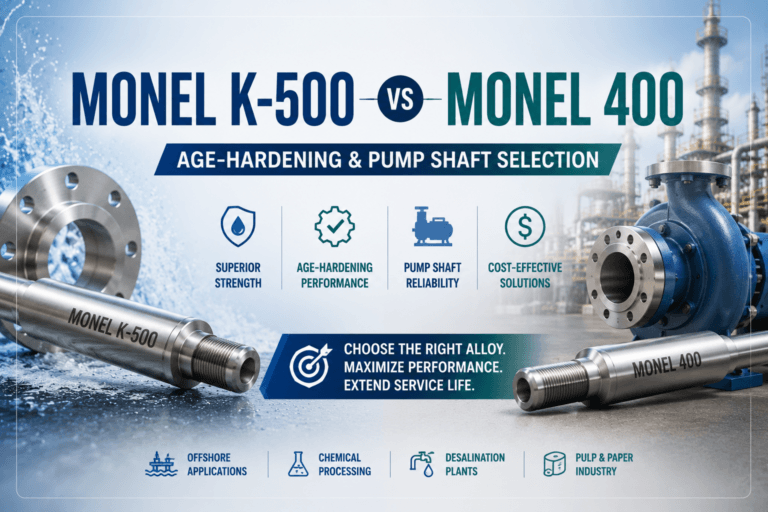
| Monel K-500 | N05500 | Age-hardenable (+Al, Ti) | High-strength seawater service; pump shafts, valve stems |
| Monel R-405 | N04405 | Added sulfur for machinability | Machined components, bolting, instrumentation |
Monel’s weakness: Poor resistance to oxidizing acids and strong oxidizers. Nitric acid will aggressively attack Monel grades.
Family 3: Inconel® — Nickel-Chromium Alloys
What it is: A diverse family united by nickel-chromium as the base system, with varying additions of molybdenum, iron, niobium, and aluminum.
The family divide: Inconel contains both “high-temperature” grades (600, 601) focused on oxidation resistance, and “corrosion-resistant” grades (625) and “high-strength” grades (718). They are quite different materials despite sharing the Inconel brand name.
Key grades:
| Grade | UNS | Ni (%) | Cr (%) | Mo (%) | Key Addition | Best For |
|---|---|---|---|---|---|---|
| Inconel 600 | N06600 | 72 | 15.5 | — | — | High-temperature oxidation; nuclear steam generators |
| Inconel 601 | N06601 | 60 | 23 | — | Al 1.4% | Above-980°C oxidation; furnace fixtures |
| Inconel 625 | N06625 | 58 | 21 | 9 | Nb 3.6% | Marine corrosion; welding overlay; cryogenic service |
| Inconel 718 | N07718 | 52 | 19 | 3 | Nb 5.1% | Aerospace turbines; highest-strength nickel alloy |
| Inconel X-750 | N07750 | 73 | 15.5 | — | Nb 1%, Al 0.7%, Ti 2.5% | Springs, bolts at 650°C; cost-effective turbine hardware |
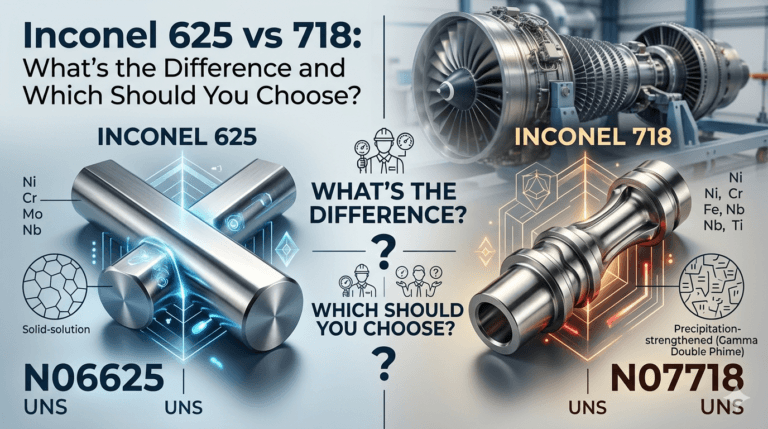
The Inconel 625 / 718 misconception: Many engineers assume 718 is a “better” 625 because it has higher strength. Wrong. They solve different problems. 625 is primarily a corrosion-resistant alloy (PREN ~51). 718 is primarily a high-strength alloy (UTS 1,100–1,400 MPa) with only moderate corrosion resistance (PREN ~30). Specifying 718 for corrosion resistance wastes money; specifying 625 where 718’s strength is needed creates safety risks.
For a detailed comparison, see: Inconel 625 vs 718: What’s the Difference and Which Should You Choose?
Family 4: Incoloy® — Nickel-Iron-Chromium Alloys
What it is: Higher iron content (typically 30-50% Fe) than Inconel, with nickel content between 25-45%. Lower cost than pure Inconel grades.
The value proposition: Incoloy occupies the “middle market” of nickel alloys — more corrosion resistant than stainless steel, less expensive than high-nickel Hastelloy or Inconel. The iron content makes Incoloy more economical to produce.
Key grades:
| Grade | UNS | Ni (%) | Fe (%) | Key Additions | Best For |
|---|---|---|---|---|---|
| Incoloy 800H | N08810 | 32 | 42 | Al 0.15-0.60%, Ti 0.15-0.60% | High-temperature process piping; steam reformers |
| Incoloy 800HT | N08811 | 32 | 42 | Al+Ti ≥0.85% | Elevated creep resistance; petrochemical furnace tubes |
| Incoloy 825 | N08825 | 42 | 30 | Mo 3%, Cu 2% | Sour gas; sulfuric acid; phosphoric acid service |
| Alloy 20 | N08020 | 35 | 37 | Mo 2.5%, Cu 3.5% | Sulfuric acid handling; pharmaceutical equipment |
Incoloy’s sweet spot: Phosphoric and sulfuric acid service. The combination of nickel + copper + molybdenum in Incoloy 825 creates specific resistance to these acids that pure chromium-molybdenum alloys cannot match efficiently. This is why H₂SO₄ plant operators frequently specify 825 or Alloy 20.
Family 5: Hastelloy® — Nickel-Molybdenum-Chromium Alloys
What it is: The highest molybdenum-content nickel alloys, optimized purely for maximum corrosion resistance in the most aggressive chemical environments.
Why molybdenum matters: Molybdenum is the single most effective element for resisting pitting, crevice corrosion, and chloride attack. The PREN formula weights Mo at 3.3× the value of chromium. Hastelloy grades push Mo content to 15-30%, versus 2-10% in stainless steels.
Key grades:
| Grade | UNS | Ni (%) | Mo (%) | Cr (%) | W (%) | PREN | Best For |
|---|---|---|---|---|---|---|---|
| Hastelloy C-276 | N10276 | 57 | 16 | 15.5 | 3.75 | ~74.5 | Broadest chemical resistance; the “all-environment” choice |
| Hastelloy C-22 | N06022 | 56 | 13 | 22 | 3 | ~68 | Oxidizing environments; more chromium for HNO₃ resistance |
| Hastelloy B-3 | N10675 | 65 | 28.5 | 1.5 | 3 | N/A | Hydrochloric acid; reducing environments only |
| Hastelloy X | N06002 | 47 | 9 | 22 | — | ~52 | High-temperature oxidizing environments; gas turbines |
C-276 vs C-22 — the critical difference:
This is one of the most common selection errors. Both are excellent alloys, but their chromium content tells the story:
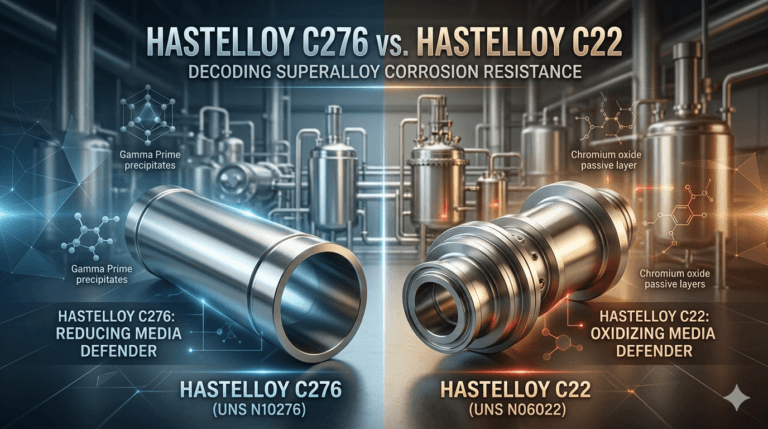
- C-276 (16% Cr): Optimized for reducing environments. Excels in HCl, wet chlorine, mixed reducing acids. The combination of Mo+W at the expense of some Cr makes it the best for reducing corrosion conditions.
- C-22 (22% Cr): Optimized for environments mixing oxidizing and reducing conditions. The higher chromium handles oxidizing components (HNO₃, ferric/cupric ions), while Mo+W handle the reducing attack. Best for variable chemistry or mixed acids.
For a deep-dive: Hastelloy C-276 vs C-22: Which Alloy Offers Better Corrosion Resistance?
3. The Master Selection Matrix
Use this matrix as your starting point. Identify your primary corrosion environment (row) and operating temperature (column), then use the resulting cell as your initial grade shortlist.
Corrosion Type × Temperature Matrix
| Corrosion Environment | ≤300°C | 300–600°C | 600–1000°C |
|---|---|---|---|
| Seawater / marine (low chloride) | Monel 400, Inconel 625 | Inconel 625 | Inconel 625 |
| Hot concentrated chlorides | Hastelloy C-276, C-22 | Hastelloy C-276, Inconel 625 | Hastelloy X |
| Hydrofluoric acid (HF) | Monel 400, Monel K-500 | Monel 400 | Not recommended |
| Hydrochloric acid (HCl) | Hastelloy C-276, B-3 | Hastelloy C-276 | Hastelloy X |
| Sulfuric acid (H₂SO₄) | Incoloy 825, Alloy 20 | Incoloy 825, Hastelloy C-276 | — |
| Phosphoric acid (H₃PO₄) | Incoloy 825, Alloy 20 | Incoloy 825 | — |
| Nitric acid (HNO₃) | Hastelloy C-22, Inconel 600 | Inconel 600, C-22 | Inconel 601 |
| Mixed acids (oxidizing+reducing) | Hastelloy C-22, C-276 | Hastelloy C-22 | Hastelloy X |
| Sour gas (H₂S + CO₂ + Cl⁻) | Incoloy 825, Inconel 625, C-276 | Hastelloy C-276, 625 | — |
| Caustic / NaOH | Nickel 200/201, Monel 400 | Nickel 201 | Inconel 600 |
| High-temperature oxidation (no corrosion) | Any | Inconel 625, 718 | Inconel 600, 601, Hastelloy X |
| High-temperature + high strength | Inconel 718 | Inconel 718, 625 | Inconel 718, X-750, Hastelloy X |
4. Grade Comparison by Key Properties
For the 8 most commonly specified grades:
| Grade | UNS | Yield Str. (MPa) | Tensile Str. (MPa) | Max Temp (°C) | PREN | Relative Cost |
|---|---|---|---|---|---|---|
| Monel 400 | N04400 | 170–310 | 490–620 | 480 | N/A* | 2×316 |
| Incoloy 825 | N08825 | 240–310 | 585–690 | 550 | ~31.5 | 3×316 |
| Inconel 600 | N06600 | 240–310 | 550–760 | 1095 | ~24 | 4×316 |
| Inconel 625 | N06625 | 415–550 | 830–1030 | 980 | ~51 | 6×316 |
| Inconel 718 | N07718 | 1035–1100 | 1240–1480 | 700 | ~30 | 7×316 |
| Hastelloy C-276 | N10276 | 310–355 | 760–870 | 1040 | ~74.5 | 10×316 |
| Hastelloy C-22 | N06022 | 310–380 | 750–900 | 1040 | ~68 | 10×316 |
| Hastelloy X | N06002 | 345–380 | 690–800 | 1200 | ~52 | 9×316 |
Monel 400’s corrosion resistance is governed by Ni-Cu chemistry, not the chromium-based PREN mechanism.
5. Industry Application Guide
Oil & Gas
The oil and gas industry uses more nickel alloys than any other sector, driven by sour service (H₂S + CO₂ + chlorides), high pressure, and NACE MR0175 / ISO 15156 compliance requirements.
| Component | Recommended Grade | Why |
|---|---|---|
| Wellhead equipment (sour) | Hastelloy C-276, Inconel 625 | Max H₂S and chloride resistance |
| Subsurface safety valves | Inconel 718 | High strength + corrosion resistance |
| Flexible riser inner liner | Inconel 825, 625 | Corrosion + fatigue in dynamic service |
| Downhole tubing (HPHT sour) | Hastelloy C-276 | Extreme environment; zero failure tolerance |
| Gas processing heat exchangers | Incoloy 825, Inconel 625 | Sulfur-bearing streams |
See also: Incoloy 825 vs Hastelloy C-276: Which Is Better for Sour Gas Environments?
Chemical Processing
Chemical plants are defined by variety — different chemicals, concentrations, and temperatures in every unit operation. One alloy is rarely the answer for an entire facility.
| Process | Recommended Grade | Key Environment |
|---|---|---|
| HCl production / handling | Hastelloy C-276, B-3 | Reducing HCl, wet chlorine |
| H₂SO₄ concentration | Incoloy 825, Alloy 20 | Sulfuric acid, various concentrations |
| Phosphoric acid production | Incoloy 825 | Wet process phosphoric acid + fluorides |
| HNO₃ + HCl mixtures (aqua regia) | Hastelloy C-22, C-276 | Highly oxidizing + reducing simultaneously |
| Chlorine / bleach handling | Hastelloy C-276 | Wet chlorine gas; NaOCl |
| Caustic soda / NaOH | Nickel 200/201, Monel 400 | Strong alkaline environments |
Aerospace
Aerospace selection is driven by the highest strength-to-weight at elevated temperature, combined with oxidation and hot corrosion resistance for engine components.
| Application | Recommended Grade | Why |
|---|---|---|
| Turbine discs / compressor discs | Inconel 718 | Highest strength; fatigue resistance |
| Combustion chambers | Hastelloy X, Inconel 617 | High-temperature oxidation |
| Turbine blades (first stage) | Inconel 738 (cast), René alloys | Creep resistance above 980°C |
| Afterburner components | Inconel 625, Hastelloy X | High temperature + moderate corrosion |
| Exhaust systems / nozzles | Inconel 625, 601 | Oxidation + thermal cycling |
Marine & Offshore
Marine environments combine seawater chloride, biological fouling, and mechanical loading. The passive film stability of nickel alloys in high-velocity seawater is the key performance requirement.
| Application | Recommended Grade | Why |
|---|---|---|
| Seawater heat exchanger tubes | Inconel 625, Alloy 28 | High-velocity seawater + biofouling |
| Offshore structural clad plate | Inconel 625 (overlay) | Protection of structural carbon steel |
| Propeller shafts and fixtures | Monel K-500 | Strength + seawater + non-magnetic |
| Submarine hull penetrations | Monel 400, Inconel 625 | Pressure-tight seawater service |
| Desalination plant tubing | Inconel 625, Hastelloy C-276 | Hot brine + chlorine dosing |
Power Generation
Power plants use nickel alloys primarily for heat recovery, steam generation at high temperatures, and flue gas desulfurization (FGD) systems where wet SO₂ is exceptionally corrosive.
| Application | Recommended Grade | Why |
|---|---|---|
| Superheater / reheater tubes | Incoloy 800H/HT, Inconel 617 | Creep at 600–900°C steam |
| FGD absorber lining | Hastelloy C-276, C-22 | Wet SO₂ + HCl in flue gas |
| Gas turbine combustor liners | Hastelloy X, Inconel 617 | High-temperature combustion gas |
| Waste incinerator heat recovery | Inconel 625, Hastelloy C-22 | Chlorinated combustion products |
6. The 5-Step Selection Process
Use this systematic process for any nickel alloy specification decision:
Step 1: Define the Corrosion Environment
List every chemical species present, including:
- Primary acids or bases (type and concentration)
- Halides, especially chloride concentration (in ppm or g/L)
- Dissolved gases (H₂S, CO₂, O₂ — partial pressures matter for sour gas)
- Oxidizing species (dissolved oxygen, Fe³⁺, Cu²⁺, HNO₃)
- Temperature (bulk and wall temperature, not just bulk fluid)
- Velocity (affects erosion-corrosion at welds and bends)
Step 2: Identify the Dominant Corrosion Mechanism
| Mechanism | Trigger Conditions | Alloy Strategy |
|---|---|---|
| Pitting / crevice corrosion | Chlorides + stagnant flow | Maximize PREN; use C-276 or 625 |
| Stress corrosion cracking (SCC) | Chloride + tensile stress + temperature | High Ni content (>45%); avoid stainless |
| Sulfide stress cracking (SSC) | H₂S + tensile stress | NACE MR0175 compliance; C-276, 825, 625 |
| General acid corrosion | Low pH; reducing acids | Match alloy to acid type — see matrix above |
| High-temperature oxidation | >500°C + oxygen | High Cr alloys; Inconel 600/601, Hastelloy X |
| Intergranular corrosion | Sensitized welds | Low-carbon grades; Inconel 625 (Nb-stabilized) |
| Erosion-corrosion | High velocity + particulates | Hard alloys; Monel K-500, Inconel 718 |
Step 3: Apply the Temperature Filter
Every alloy has a maximum application temperature for both corrosion resistance and mechanical integrity:
- <400°C: Monel 400, Incoloy 825, Alloy 20, Hastelloy C-276 all suitable. Choose based on corrosion chemistry.
- 400–700°C: Inconel 625, 718 for strength; Hastelloy X for high-temperature oxidation.
- 700–1000°C: Inconel 600, 601, Hastelloy X; creep resistance becomes the design-limiting property.
- >1000°C: Specialized casting alloys (Inconel 738, René 41, Waspaloy); beyond the scope of wrought products.
Step 4: Evaluate Mechanical Requirements
Some applications demand both corrosion resistance and high mechanical strength. This narrows the field significantly:
| Strength Level | Typical Grade | Yield Strength |
|---|---|---|
| Standard | Hastelloy C-276, Inconel 625 | 310–550 MPa |
| High | Inconel 718 (annealed) | 1,035 MPa |
| Very high | Monel K-500 (aged) | 690–790 MPa |
| Ultra-high | Inconel 718 (fully aged) | 1,100+ MPa |
Step 5: Consider Fabrication and Cost
Even after identifying the technically correct alloy, practical fabrication considerations can shift the decision:
| Consideration | Impact |
|---|---|
| Welding | Hastelloy C-276 and Inconel 625 are excellent. Inconel 718 requires post-weld heat treatment in critical applications. |
| Machining | Nickel alloys work-harden rapidly. C-276 and 625 are manageable. 718 requires carbide tooling and slow speeds. |
| Forming | Inconel 625 and Monel 400 have good formability. C-276 is moderate. 718 requires elevated-temperature forming. |
| Lead time | Standard grades (625, C-276) are stock items. Specialty grades may require mill orders with 8–16 week lead times. |
| Cost | See relative cost index in Section 4. When budgets are constrained, evaluate whether duplex stainless 2507 (at ~4× 316L) covers the corrosion requirement before defaulting to nickel alloys at 6–15× cost. |
7. Common Selection Mistakes and How to Avoid Them
Mistake 1: Specifying Inconel 718 for corrosion resistance Inconel 718’s PREN (~30) is lower than duplex 2205. It is primarily a high-strength alloy. Use Inconel 625 or Hastelloy C-276 when corrosion resistance is the primary requirement.
Mistake 2: Using Hastelloy C-276 in strongly oxidizing environments without checking C-276’s relatively low chromium content (16%) means it can be outperformed by C-22 (22% Cr) in environments containing nitric acid or strong oxidizers. Always confirm whether the environment is reducing, oxidizing, or mixed.
Mistake 3: Specifying Monel for environments containing oxidizing acids Monel alloys are excellent for non-oxidizing acids and seawater, but nitric acid and other oxidizers attack them rapidly. Monel’s resistance mechanism depends on a passive copper-rich layer that breaks down under oxidizing conditions.
Mistake 4: Ignoring carbon content for welded assemblies In welded structures, high-carbon alloys can sensitize — chromium carbides precipitate at grain boundaries, depleting the surrounding area of chromium and creating susceptibility to intergranular corrosion. Always specify low-carbon or stabilized grades (625 with Nb, L-grades for stainless) for welded components in corrosive service.
Mistake 5: Treating all “Hastelloy” as equivalent Hastelloy B-3 (28% Mo, 1.5% Cr) is specifically designed for reducing HCl environments. Put it in an oxidizing environment and it will fail rapidly. Hastelloy X is designed for high-temperature oxidation, not aqueous corrosion. The Hastelloy brand covers fundamentally different alloys.
8. Quick Reference: Alloy Family Selector
| If your primary need is… | Start here |
|---|---|
| Maximum resistance to wet chlorine / chloride pitting | Hastelloy C-276 |
| Resistance to both oxidizing and reducing mixed acids | Hastelloy C-22 |
| Marine seawater resistance on a budget | Monel 400 |
| High-strength seawater service | Monel K-500 or Inconel 625 |
| Aerospace high-temperature strength | Inconel 718 |
| Furnace / combustion components above 980°C | Inconel 601 or Hastelloy X |
| Sulfuric or phosphoric acid service | Incoloy 825 or Alloy 20 |
| Sour gas (H₂S + chloride) at moderate severity | Incoloy 825 or Inconel 625 |
| Sour gas at high severity (HPHT) | Hastelloy C-276 |
| Caustic / NaOH environments | Nickel 200/201 |
| Hydrogen fluoride (HF) service | Monel 400 |
| Maximum high-temperature oxidation resistance | Inconel 600 or 601 |
| Broadest chemical compatibility (“works everywhere”) | Hastelloy C-276 |
Frequently Asked Questions
Q: What is the difference between Hastelloy and Inconel? A: Hastelloy and Inconel are both nickel alloy brands (both developed by Special Metals / Haynes International), but they optimize for different properties. Hastelloy prioritizes corrosion resistance through high molybdenum and chromium content. Inconel prioritizes high-temperature strength through chromium and precipitation-hardening additions. The brands overlap in some grades (both make corrosion-resistant and high-temperature alloys), so compare specific grades rather than brand names.
See: Hastelloy vs Inconel: Key Differences Every Engineer Should Know
Q: Is Incoloy cheaper than Inconel? A: Generally yes. Incoloy grades contain more iron (25-45%) and less nickel (30-45%) than true Inconel grades (nickel 50-76%), which reduces raw material cost. Incoloy 825 typically costs 40-60% less than Inconel 625 on a per-kilogram basis.
Q: What does the UNS number tell me? A: The UNS (Unified Numbering System) number is the chemical composition identifier. Unlike trade names (Hastelloy, Inconel), UNS numbers are standardized — N10276 always means Hastelloy C-276’s composition, regardless of manufacturer. When ordering, specify both the trade designation and UNS number to avoid substitution errors.
See: Understanding UNS Numbers: A Complete Guide for Alloy Material Identification
Q: How do I verify I’m getting the right alloy? A: Request a Mill Test Report (MTR) with every order. The MTR must show chemical composition (verify against the grade’s specification limits), mechanical properties (yield strength, tensile strength, elongation), heat number traceable to the melt, and the applicable standard (ASTM, ASME). For critical applications, require third-party positive material identification (PMI) testing on receipt.
Q: Can I weld Hastelloy to stainless steel? A: Yes, and it’s a common practice in chemical plant construction — using less expensive stainless where conditions permit, with Hastelloy only at the most corrosive points. The typical filler metal for Hastelloy C-276 to stainless steel welds is ERNiCrMo-4 (C-276 filler), which slightly over-alloys the joint. Pre-heat is generally not required, but heat input should be controlled to minimize HAZ sensitization on the stainless side.
Conclusion
Nickel alloy selection is not a guessing game — it’s a systematic process. The five-family framework (Pure Nickel → Monel → Inconel → Incoloy → Hastelloy) combined with the corrosion–temperature–industry matrix gives you the shortlist. The 5-step process eliminates the wrong choices. The grade-level comparison tables validate the final decision.
Remember the hierarchy:
- Identify the corrosion mechanism, not just the fluid
- Apply the temperature filter
- Evaluate mechanical requirements
- Factor in fabrication constraints and lifecycle cost
- Specify UNS number + trade name + applicable standard on every order
If you’re unsure, start conservatively (Hastelloy C-276 or Inconel 625 cover most aqueous corrosion scenarios) and consider downgrading once corrosion rate data from service confirms you have margin.
JA Alloy supplies all major nickel alloy grades — Hastelloy, Inconel, Incoloy, and Monel — in sheet, plate, bar, pipe, tube, and custom cut sizes. Request a quote