Introduction: When Inconel 625 Is Not Enough
Inconel 625 (UNS N06625) is the workhorse nickel-chromium-molybdenum alloy for corrosive service. It is the single most widely specified nickel alloy for seawater, chemical processing, and oil & gas applications. If you work in any industry that handles chlorides, you have almost certainly specified, welded, or repaired Inconel 625.
But 625 has a ceiling. Its molybdenum content — 8.0–10.0% — is deliberately balanced to maintain weldability and formability. That balance means that in mixed-acid service, chloride-oxidizing environments, and aggressive FGD scrubber zones, 625 eventually hits a performance wall. Pitting initiates. Crevice corrosion propagates. The corrosion allowance you calculated at Year 0 is consumed by Year 7.
Enter Inconel 686 (UNS N06686). With 16.0–18.0% molybdenum — literally double the molybdenum of 625 — and intentional nitrogen addition (0.20–0.40%), Inconel 686 pushes the Pitting Resistance Equivalent Number (PREN) from approximately 51 to approximately 76. That is not a marginal improvement. That is stepping from “resistant to seawater” to “resistant to seawater with free chlorine, hypochlorite, and mixed oxidizing chlorides.”
This article breaks down exactly when 625 is sufficient, when it is marginal, and when 686 is the correct specification. We will cover the metallurgy, the corrosion data, the mechanical properties, the welding implications, and the cost premium — so that you can defend your alloy selection with data, not guesswork.
For a broader comparison of 625 against other nickel alloys, see our Inconel 625 vs Hastelloy C-276 article.
1. Chemical Composition: Molybdenum Doubles, Performance Jumps
| Element | Inconel 625 (N06625) | Inconel 686 (N06686) | Role |
|---|---|---|---|
| Ni | ≥ 58.0% | ≥ 50.0% | Matrix (686 allows lower Ni due to higher Mo+W) |
| Cr | 20.0–23.0% | 19.0–23.0% | Passive film stability |
| Mo | 8.0–10.0% | 16.0–18.0% | Core difference — 2× Mo |
| Fe | ≤ 5.0% | ≤ 2.0% | 686 tighter Fe control |
| Nb + Ta | 3.15–4.15% | ≤ 0.50% | 625 uses Nb for strength; 686 omits it |
| W | ≤ 0.50% | 3.0–4.0% | Added in 686 for PREN boost |
| N | ≤ 0.10% | 0.20–0.40% | 686 is nitrogen-alloyed |
| Co | ≤ 1.0% | ≤ 1.0% | — |
| C | ≤ 0.010% | ≤ 0.010% | Both are low-carbon (weldable) |
| Mn | ≤ 0.50% | ≤ 1.0% | — |
| Si | ≤ 0.50% | ≤ 1.0% | — |
| P / S | ≤ 0.015 / ≤ 0.015% | ≤ 0.040 / ≤ 0.030% | — |
Three compositional changes separate 686 from 625:
- Molybdenum: 8–10% → 16–18% — This is the defining change. Molybdenum is the element most responsible for resistance to chloride pitting and crevice corrosion. Doubling it fundamentally changes the alloy’s electrochemical behavior in chloride solutions.
- Tungsten: ≤ 0.5% → 3–4% — Tungsten contributes to PREN (with a factor of approximately 1.0–1.3× Mo equivalence in pitting resistance) and provides solid-solution strengthening at elevated temperatures. Its addition in 686 is a deliberate move to push PREN even higher while maintaining high-temperature strength.
- Nitrogen: ≤ 0.10% → 0.20–0.40% — Like 254SMO among stainless steels, Inconel 686 is intentionally nitrogen-alloyed. Nitrogen contributes 16× its weight to PREN and also acts as an austenite stabilizer, allowing the high Mo+W content to be retained in solution after welding.
- Niobium: 3.15–4.15% → ≤ 0.50% — Inconel 625 uses Nb to form γ″ (Ni₃Nb) precipitates that provide age-hardening capability. Inconel 686 omits Nb because its design intent is corrosion resistance first, strength second. The higher Mo+W already provides adequate strength without Nb.
2. PREN and Critical Pitting Temperature: The Quantitative Leap
PREN Calculation
Using the standard formula for nickel alloys (N contributes 16×, Mo contributes 3.3×, Cr contributes 1.0×):
| Alloy | Cr | Mo | W | N | PREN |
|---|---|---|---|---|---|
| Inconel 625 | 21.5 | 9.0 | 0.2 | 0.05 | ~51 |
| Hastelloy C-276 | 16.0 | 16.0 | 4.0 | — | ~69 |
| Inconel 686 | 21.0 | 17.0 | 3.5 | 0.30 | ~76 |
| Hastelloy C-22 | 22.0 | 13.0 | 3.0 | — | ~59 |
Two observations:
- Inconel 686 has the highest PREN of any commonly available nickel alloy — higher than C-276 (~69) and significantly higher than 625 (~51). This is not a small difference; it is a step-change.
- The PREN advantage over 625 is approximately 25 points — enough to shift the critical pitting temperature (CPT) upward by 40–60 °C in ASTM G150 testing.
Critical Pitting Temperature (CPT) — ASTM G150
| Alloy | CPT (°C, ASTM G150, 1 M NaCl) |
|---|---|
| Inconel 625 | 60–80 |
| Hastelloy C-276 | > 95 |
| Inconel 686 | > 110 |
In practice, 686 does not pit in 1 M NaCl even at the boiling point (108 °C). The test becomes limited by the solution boiling point, not by the alloy. This means that for neutral-to-acid chloride service, 686 has a safety margin that is difficult to exhaust.
Critical Crevice Temperature (CCT) — ASTM G48 Method D
Crevice corrosion is the practical limiting factor. In real equipment — flanges, gasketed joints, under-deposit zones — crevices are unavoidable.
| Alloy | CCT (°C, ASTM G48-D) |
|---|---|
| Inconel 625 | 45–65 |
| Hastelloy C-276 | 75–90 |
| Inconel 686 | > 95 |
This is the key performance differentiator. In seawater with oxidizing species (e.g.,added hypochlorite for biofouling control), 625 may pit at crevices within 1–2 years. Inconel 686 remains immune to crevice corrosion even in chlorinated seawater at temperatures up to approximately 50–60 °C.
For a detailed comparison of how PREN translates to real-world seawater performance across alloy families, see our marine corrosion resistant alloys article.
3. Mixed Acid Service: Where 686 Dominates
“Mixed acid” service — process streams containing two or more acidic species, often with chlorides and oxidizing agents — is where the 625-to-686 upgrade delivers the most value.
Sulfuric + Hydrochloric Acid Mixtures
In H₂SO₄-HCl mixtures (common in chemical regeneration, metal pickling, and spent-acid recovery), 625 suffers accelerated attack because the HCl provides chloride pitting initiation while the H₂SO₄ provides the bulk acid exposure. Inconel 686’s PREN of 76 provides adequate resistance where 625 would pit in weeks.
Nitric + Hydrochloric Acid Mixtures
HNO₃-HCl mixtures (used in some metal recovery and etching processes) are particularly aggressive because the nitric acid acts as an oxidizer, breaking down the passive film, while the chloride initiates pitting. Inconel 686’s high Mo+W content stabilizes the passive film even in the presence of oxidizing chlorides.
Phosphoric Acid with Chloride Impurities
Wet-process phosphoric acid contains chlorides, fluorides, and sulfates as impurities. Inconel 625 is routinely used in H₃PO₄ service, but in the evaporator sections where chloride concentration is highest, 686 provides a significant life-extension. Field data from phosphate fertilizer plants show 686 tubing lasting 2–3× longer than 625 in the final evaporator effects.
Acetic Acid with Chlorides
In chemical plants processing acetic acid with chloride contaminants (from feedstock or water), 625 can suffer pitting at acetate concentrations above approximately 50% and temperatures above 80 °C. Inconel 686 remains passive in these conditions and is increasingly specified for acetate reactor vessels and heat exchangers.
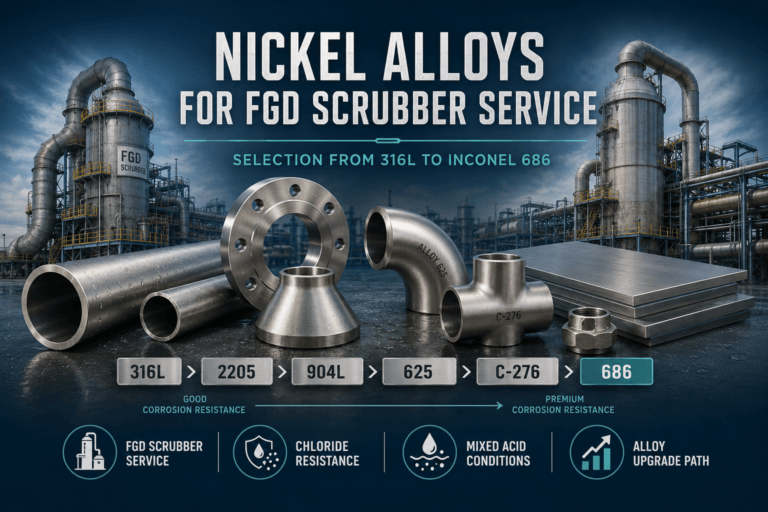
4. FGD (Flue Gas Desulfurization) Service
FGD scrubbers represent one of the most demanding corrosive environments in industrial practice. The combination of chlorides (from the coal), fluorides, sulfites/sulfates, and oxidizing biocides creates a mixed oxidizing-chloride environment that pushes even high-alloy materials.
FGD Environment Zones Revisited
| Scrubber Zone | pH | Cl⁻ (mg/L) | Oxidizing Species | 625 Performance | 686 Performance |
|---|---|---|---|---|---|
| Quencher / inlet | 2–4 | 5,000–20,000 | SO₄²⁻, ClO⁻ | Marginal (10–15 yr) | Excellent (> 25 yr) |
| Absorber sump | 4–6 | 20,000–40,000 | SO₄²⁻, ClO⁻, O₂ | Poor (5–10 yr) | Very good (15–25 yr) |
| Mist eliminator | 3–5 | 3,000–10,000 | ClO⁻ | Good (15–20 yr) | Excellent (> 25 yr) |
| Outlet duct | 3–5 | 1,000–3,000 | O₂ | Excellent | Excellent |
The Oxidant Effect
Modern FGD systems deliberately add oxidants (air blowers, hydrogen peroxide, or sodium hypochlorite) to convert SO₃²⁻ to SO₄²⁻ and control scaling. These oxidants also shift the electrochemical potential of the slurry into the transpassive region for lower-alloy materials. Inconel 686’s high Mo+W content keeps the alloy in the passive region even under these conditions.
In systems without deliberate oxidation (older FGD designs), 625 is often adequate in the mist eliminator and outlet duct. But as environmental regulations tighten and oxidant dosing becomes standard, the 625-to-686 upgrade is becoming a common specification change in FGD retrofit projects.
For a broader guide to FGD alloy selection across the stainless-duplex-nickel ladder, see our 254SMO vs 904L article for the stainless rung of that ladder.
5. Seawater with Oxidizing Species
Seawater itself (neutral pH, ~19,000 mg/L Cl⁻, ambient temperature) is adequately handled by Inconel 625. But modern seawater systems increasingly use oxidizing biocides to control biofouling:
- Sodium hypochlorite (NaClO) dosing — common in offshore platforms, desalination plants, and coastal power plants. Hypochlorite levels of 0.5–2.0 ppm free chlorine are typical.
- Copper ion dosing — some systems add copper ions (from copper-alloy heat exchangers) which act synergistically with chlorides to accelerate pitting.
- Ozone injection — emerging in some desalination systems as a non-chlorine biocide.
In chlorinated seawater, the critical crevice temperature of Inconel 625 can drop by 10–20 °C compared to clean seawater. This means that a flange in 625 that would survive 10 years in clean seawater may fail in 2–3 years in chlorinated seawater.
Inconel 686’s PREN of 76 provides adequate margin even in chlorinated seawater at temperatures up to approximately 50–60 °C. For this reason, 686 is increasingly specified for:
- Offshore topsides piping in chlorinated firewater systems
- Desalination plant RO modules and high-pressure piping
- Seawater-cooled condenser tubes in power plants with chlorination
6. Mechanical Properties
The mechanical properties of Inconel 686 are similar to 625 in the annealed condition, with slightly higher strength due to the solid-solution strengthening from Mo, W, and N.
| Property | Inconel 625 (annealed) | Inconel 686 (annealed) | Note |
|---|---|---|---|
| Density (g/cm³) | 8.44 | 8.73 | 686 slightly denser (more Mo+W) |
| Melting range (°C) | 1,290–1,350 | 1,300–1,350 | Similar |
| UTS (MPa) | 827–1,000 | 860–1,100 | 686 ~5% stronger |
| 0.2% YS (MPa) | 414–550 | 450–650 | 686 ~10% higher yield |
| Elongation (%) | 30–50 | 25–45 | 686 slightly less ductile |
| Hardness (HB) | 200–280 | 220–300 | 686 harder |
| Modulus (GPa) | 207 | 210 | Similar |
| Impact toughness (J, RT) | 120–180 | 100–160 | 686 slightly lower |
Elevated-Temperature Strength
At elevated temperatures (400–700 °C), Inconel 686 retains strength better than 625 because:
- Mo and W have high solid-solution strengthening effectiveness at intermediate temperatures.
- No Nb = no γ″ precipitation — Inconel 625 can over-age (γ″ coarsening) above approximately 650 °C, causing strength loss. Inconel 686 does not have this mechanism and maintains a flatter stress-rupture curve.
However, neither alloy is designed for long-term service above 700 °C. For high-temperature structural service, Inconel 600/601 or Incoloy 800/825 are more appropriate.
Cryogenic Toughness
Both alloys retain excellent toughness to cryogenic temperatures. Inconel 686’s impact toughness at −196 °C is approximately 60–100 J — lower than 625 but still fully ductile. For LNG and liquid-nitrogen service, 625 is preferred; 686 is acceptable but not optimal from a toughness perspective.
7. Welding and Fabrication
Inconel 686 is weldable by all common processes, but the higher alloy content demands stricter discipline than 625.
Filler Metal Selection
| Process | Inconel 625 | Inconel 686 |
|---|---|---|
| GTAW (TIG) | ERNiCrMo-3 | ERNiCrMo-14 (or ERNiCrMo-3 acceptable) |
| GMAW (MIG) | ERNiCrMo-3 | ERNiCrMo-14 |
| SMAW (Stick) | ENiCrMo-3 | ENiCrMo-14 |
| SAW | ERNiCrMo-3 + neutral flux | ERNiCrMo-14 + neutral flux |
ERNiCrMo-14 (UNS N06686 matching composition) is the preferred filler for 686. It has the same 16–18% Mo, 3–4% W, and 0.20–0.40% N as the base metal, ensuring the weld deposit retains the PREN 76 of the parent plate.
Using ERNiCrMo-3 (Inconel 625 filler) for 686 is technically acceptable but not optimal — the weld deposit will have PREN ~51 (from the 625 filler) rather than PREN ~76, creating a corrosion weak link in chloride service. This is analogous to the mistake of welding 254SMO with 904L filler — the weld becomes the “lowest common denominator” in the system.
Heat Input and Interpass Temperature
- Inconel 625: Heat input 0.5–1.5 kJ/mm; interpass ≤ 150 °C. Relatively forgiving.
- Inconel 686: Heat input 0.5–1.5 kJ/mm; interpass ≤ 100 °C. Stricter. Excessive heat input can cause microsegregation of Mo and W in the weld metal, creating locally depleted zones that pit in chloride service.
Post-Weld Treatment
Both alloys benefit from pickling after welding. Inconel 686 is more sensitive to weld tint — even light straw oxidation indicates Cr depletion at the surface. Pickling with HNO₃/HF is mandatory for 686 welds in corrosive service.
Unlike ferritic stainless steels, neither 625 nor 686 requires post-weld heat treatment for corrosion resistance. (PWHT may be required for stress relief in thick-walled pressure vessels, but this is a mechanical-design issue, not a corrosion issue.)
For a comprehensive guide to welding practices applicable to both alloys, see our welding Inconel 625 article.
8. Cost and Availability
Material Cost Differential
Inconel 686 typically costs 50–80% more than Inconel 625 per kilogram. The premium reflects:
- Higher molybdenum and tungsten content — Mo and W are high-cost alloying elements.
- Tighter composition control — The 16–18% Mo range requires careful melt practice (VIM-VAR or ESR) to avoid sigma-phase formation during processing.
- Smaller production volume — 686 is a newer alloy (commercialized in the 1990s) with lower global demand than 625, resulting in smaller mill runs and higher per-kg cost.
Total Cost of Ownership (TCO) Example
Consider a chemical reactor vessel in mixed-acid service (H₂SO₄ + HCl + Cl⁻), designed for 15-year life:
| Scenario | Material | Material Cost | Expected Life | Replacement Cost (NPV) | 15-yr TCO |
|---|---|---|---|---|---|
| A | Inconel 625 | $200,000 | 5–7 yr | $350,000 (2 replacements) | ~$550,000 |
| B | Inconel 686 | $320,000 | 15+ yr | $0 | ~$320,000 |
In this case, the 686 premium pays for itself within the first replacement cycle. The break-even point is typically 3–5 years in aggressive mixed-acid or FGD service.
Availability
- Inconel 625: Widely stocked globally in all product forms (plate, sheet, strip, bar, pipe, tube, fittings, flanges). Multiple global mills.
- Inconel 686: Stocked in plate and sheet; pipe and fittings available but with longer lead times (8–16 weeks typical). Fewer global mills produce 686; verify ASME and NACE compliance when sourcing.
9. Selection Decision Guide
| Service Condition | Recommended Choice | Rationale |
|---|---|---|
| Clean seawater, ambient, no oxidant | Inconel 625 | Adequate; 686 is over-spec |
| Seawater with NaClO (0.5–2 ppm) | Inconel 686 | 625 CCT drops 10–20 °C with oxidant |
| FGD quencher, Cl⁻ > 10,000 mg/L | Inconel 686 | 625 marginal in quencher zone |
| FGD mist eliminator, Cl⁻ < 5,000 mg/L | Inconel 625 | Adequate |
| Mixed acid (H₂SO₄ + HCl) | Inconel 686 | 625 pits in mixed acid |
| HNO₃ + HCl etching bath | Inconel 686 | Oxidizing chloride attacks 625 |
| Wet-process H₃PO₄, evaporator | Inconel 686 | Chloride impurities favor 686 |
| Pure H₂SO₄ (< 50%), no Cl⁻ | Inconel 625 | Adequate |
| Chemical reactor, T < 200 °C | Inconel 625 | Adequate (temperature not a factor) |
| Chemical reactor, oxidizing chloride | Inconel 686 | PREN 76 required |
| Offshore topsides, chlorinated | Inconel 686 | Industry trend for new builds |
| Retrofit of existing 625 equipment | Inconel 686 (clad) | Clad 686 on CS for cost control |
FAQ
Q1: Can I substitute Inconel 625 for 686 to save cost in mixed-acid service?
No, not if the mixed acid contains both oxidizing species and chlorides. Inconel 625’s PREN of ~51 is adequate for single-acid chloride service but not for mixed oxidizing-chloride environments. The cost savings on material will be erased by the first vessel or heat-exchanger failure. If your process chemistry is single-acid (e.g., pure H₂SO₄ with no chlorides), 625 is adequate and 686 is over-specified.
Q2: Does Inconel 686 require special welding procedures compared to 625?
Yes. The filler metal must be ERNiCrMo-14 (matching 686 composition), not ERNiCrMo-3 (625 filler). Using 625 filler on 686 plate creates a weld deposit with PREN ~51 — the same as 625 — completely defeating the purpose of specifying 686. Additionally, interpass temperature control is stricter for 686 (≤ 100 °C vs ≤ 150 °C for 625) to avoid Mo/W microsegregation in the weld.
Q3: Is Inconel 686 resistant to HCl (hydrochloric acid)?
Inconel 686 is more resistant to HCl than 625, but neither alloy is suitable for concentrated HCl service. In dilute HCl (< 10%) at low temperatures (< 40 °C), 686 may be adequate for short-term exposure. For sustained HCl service, specify Hastelloy B-3 (for pure HCl) or Hastelloy C-276 (for HCl with oxidizing species). The PREN advantage of 686 applies to chloride ions in neutral/oxidizing solutions, not to HCl as a reducing acid.
Q4: What is the difference between Inconel 686 and Hastelloy C-276?
Both are high-Mo nickel alloys. Inconel 686 has higher PREN (~76 vs ~69) due to its intentional nitrogen addition (0.20–0.40%) and slightly higher Cr (21% vs 16%). In practice, 686 outperforms C-276 in chloride pitting and crevice corrosion, particularly in oxidizing chloride environments. C-276 is more widely available and less expensive. For most FGD and chemical-processing applications, either alloy is adequate; 686 is specified when C-276 has been proven marginal.
Q5: Can Inconel 686 be clad-rolled onto carbon steel for cost control?
Yes. Inconel 686 clad plate (686 layer 3–5 mm on CS backing) is available from several global mills and is increasingly used for FGD absorber vessels and chemical reactor shells. The clad approach reduces material cost by 40–60% compared to solid 686, while retaining the 686 corrosion performance on the wetted surface. Clad construction requires qualified roll-bonding and weld-overlay procedures; consult ASME Section IX for cladding qualification requirements.
Summary
The choice between Inconel 625 and 686 comes down to a single question: is the service environment oxidizing-chloride, or neutral chloride?
- Neutral chloride service (clean seawater, single-acid chloride, no oxidants) → Inconel 625. PREN ~51 is adequate. The alloy is widely available, weldable, and 50–80% cheaper than 686. This covers the majority of nickel-alloy applications in offshore, marine, and general chemical processing.
- Oxidizing-chloride service (mixed acids, FGD with oxidant dosing, chlorinated seawater, hypochlorite service) → Inconel 686. PREN ~76 provides a step-change in resistance. The higher cost is recovered within 3–5 years in aggressive service through avoided replacement and downtime.
- In doubt? Do the TCO calculation. The material-cost premium for 686 is a one-time capital expense. The cost of a premature failure — lost production, environmental release, repair labor, re-certification — is typically 10–50× the material premium. When the service is genuinely aggressive, 686 is the lower-risk specification.
The most common specification mistake is treating 625 as a “universal” nickel alloy and specifying it for mixed-acid or oxidizing-chloride service where it will pit within months. The second most common mistake is over-specifying 686 in clean service where 625 would do the job. Both mistakes are avoidable with a clear-eyed look at the process chemistry — and that is what this article is for.