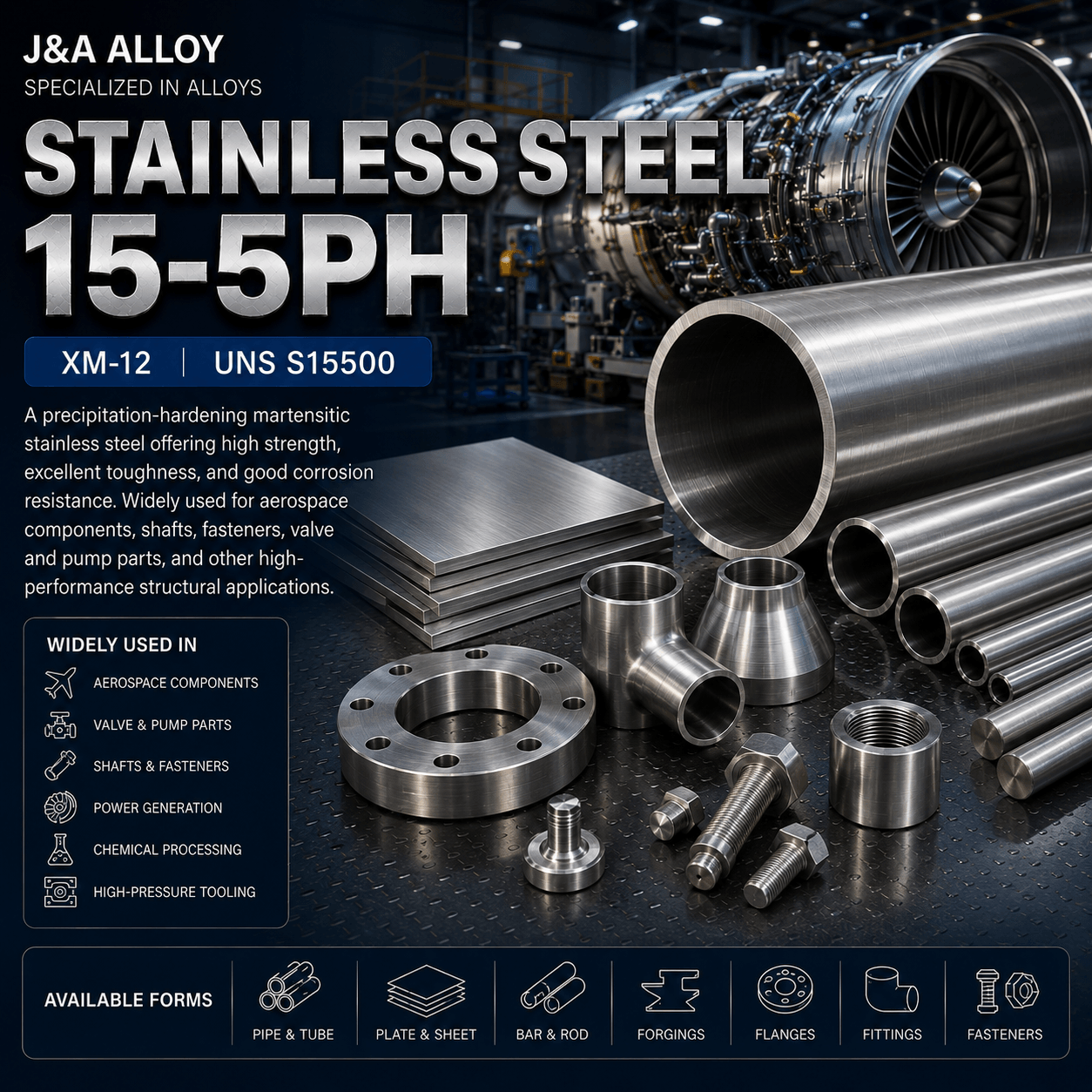
PH Stainless Steel 15-5PH 丨 XM-12
15-5PH stainless steel, also known as UNS S15500 or XM-12, is a martensitic precipitation-hardening stainless steel designed for high strength, good corrosion resistance, and improved transverse toughness compared with 17-4PH. J&A Alloy supplies 15-5PH in bars, plates, forgings, sheets, and custom-machined forms for aerospace, valves, shafts, gears, oil & gas, and high-performance industrial components.
Stainless Steel 15-5PH (UNS S15500)
15-5PH stainless steel is a chromium-nickel-copper precipitation-hardening stainless steel with a martensitic structure. It is widely used where high strength, hardness, dimensional stability, and better toughness than 17-4PH are required. The alloy is commonly identified as UNS S15500, XM-12, 15Cr-5Ni, and in European references as 1.4545 / X5CrNiCu15-5. Carpenter describes 15Cr-5Ni as a martensitic precipitation-hardening stainless steel with high strength, hardness, and excellent corrosion resistance, chemically balanced to reduce delta ferrite and improve transverse toughness and ductility.
Compared with 17-4PH, 15-5PH is often selected for parts requiring better transverse toughness, better ductility in larger sections, and reliable mechanical performance after single-step low-temperature aging. Service Steel Aerospace notes that 15-5PH offers high strength, high hardness, excellent corrosion resistance, better transverse toughness and ductility than 17-4PH, and is readily weldable.
15-5PH At a Glance
| Key Attribute | Value |
|---|---|
| Material | 15-5PH Stainless Steel |
| UNS Number | S15500 |
| Common Names | 15-5PH, PH15-5, XM-12, 15Cr-5Ni |
| EN / W.Nr. | 1.4545 / X5CrNiCu15-5 |
| Material Type | Martensitic Precipitation-Hardening Stainless Steel |
| Density | Approx. 7.75–7.82 g/cm³ |
| Main Advantage | High Strength, Good Corrosion Resistance & Improved Transverse Toughness |
| Typical Heat Treatment | Condition A, H900, H925, H1025, H1075, H1100, H1150, H1150M |
| Main Industries | Aerospace, Valves, Oil & Gas, Chemical Processing, Precision Engineering |
| Comparable Grades | 17-4PH, 13-8Mo, 304, 316L |
Features of 15-5PH
| Feature | Benefit |
|---|---|
| Precipitation-hardening stainless steel | Achieves high strength and hardness through aging heat treatment. |
| High tensile and yield strength | Suitable for load-bearing components, shafts, gears, valve parts and aerospace hardware. |
| Improved transverse toughness | Offers better toughness and ductility than 17-4PH in many applications. |
| Good corrosion resistance | Performs well in many atmospheric, mild chemical and industrial environments. |
| Multiple aging conditions | Allows engineers to balance strength, hardness, ductility and toughness. |
| Good machinability | Suitable for precision machining, CNC components and complex mechanical parts. |
| Good weldability | Can be welded with proper procedures and post-weld heat treatment when required. |
| Dimensional stability | Useful for precision parts requiring reliable performance after heat treatment. |
Chemical Composition of 15-5PH
| Element | Composition |
|---|---|
| Carbon (C) | ≤ 0.07% |
| Manganese (Mn) | ≤ 1.00% |
| Phosphorus (P) | ≤ 0.040% |
| Sulfur (S) | ≤ 0.030% |
| Silicon (Si) | ≤ 1.00% |
| Chromium (Cr) | 14.00–15.50% |
| Nickel (Ni) | 3.50–5.50% |
| Copper (Cu) | 2.50–4.50% |
| Niobium / Columbium + Tantalum | 0.15–0.45% |
| Iron (Fe) | Balance |
Physical Properties of 15-5PH
| Property | Typical Value |
|---|---|
| Density | Approx. 7.75–7.82 g/cm³ / 0.280–0.283 lb/in³ |
| Melting Range | Approx. 1404–1440°C / 2560–2625°F |
| Electrical Resistivity | Approx. 0.77–0.80 μΩ·m |
| Thermal Conductivity | Approx. 17.8–18.4 W/m·K |
| Specific Heat Capacity | Approx. 460 J/kg·K / 0.110 BTU/lb·°F |
| Modulus of Elasticity | Approx. 196–200 GPa / 28.5–29.0 × 10⁶ psi |
Mechanical Properties of 15-5PH
The mechanical properties of 15-5PH stainless steel depend strongly on heat treatment condition. H900 provides the highest strength and hardness, while H1025, H1075, H1100, H1150 and H1150M provide improved ductility and toughness with lower strength.
| Condition | Tensile Strength | Yield Strength | Elongation | Hardness |
|---|---|---|---|---|
| H900 | Approx. 190 ksi / 1310 MPa | Approx. 170 ksi / 1170 MPa | Approx. 6–10% | Approx. 388 HB / HRC 40 |
| H925 | Approx. 170 ksi / 1170 MPa | Approx. 155 ksi / 1069 MPa | Approx. 7–11% | Approx. HRC 38 |
| H1025 | Approx. 155 ksi / 1069 MPa | Approx. 145 ksi / 1000 MPa | Approx. 8–12% | Approx. 331 HB / HRC 35 |
| H1075 | Approx. 145 ksi / 1000 MPa | Approx. 125 ksi / 862 MPa | Approx. 9–13% | Approx. 311 HB / HRC 32 |
| H1100 | Approx. 140 ksi / 965 MPa | Approx. 115 ksi / 793 MPa | Approx. 10–14% | Approx. HRC 30–35 |
| H1150 | Approx. 135 ksi / 931 MPa | Approx. 105 ksi / 724 MPa | Approx. 11–16% | Approx. 277 HB / HRC 28 |
| H1150M | Approx. 115 ksi / 793 MPa | Approx. 75 ksi / 517 MPa | Approx. 14–18% | Approx. 255 HB / HRC 25 |
Corrosion Resistance
15-5PH stainless steel provides good general corrosion resistance in many atmospheric, industrial, and mildly chemical environments. Its corrosion resistance is generally comparable to 17-4PH and, in many media, close to Type 304 stainless steel.
For optimum corrosion resistance, the material should be properly heat treated, cleaned, descaled, and passivated after fabrication. Surface contamination, heat tint, scale, or embedded iron particles may reduce corrosion performance.
| Environment | Performance | Notes |
|---|---|---|
| Atmospheric Exposure | Good | Suitable for many structural and precision components. |
| Humidity | Good to Excellent | Clean and passivated surfaces provide better performance. |
| Mild Chemical Media | Good | Performance depends on concentration, temperature, and exposure time. |
| Salt Spray | Moderate to Good | Surface finish and passivation are important. |
| Seawater | Restricted | Not recommended for continuous seawater service where pitting and crevice corrosion are critical. |
| Nitric Acid | Good | Suitable in selected concentrations and temperatures. |
| Sulfuric Acid | Restricted | Corrosion testing is recommended before use. |
| Chloride-Rich Environments | Limited | Use with caution in severe chloride, stagnant or crevice conditions. |
High Temperature Performance
15-5PH stainless steel offers useful oxidation resistance and strength retention at moderate elevated temperatures, but it is not a dedicated high-temperature alloy. Long-term exposure to elevated temperatures may reduce toughness or change mechanical properties, especially when service temperatures approach or exceed aging temperatures.
| Temperature Factor | Performance Consideration |
|---|---|
| Oxidation Resistance | Good up to approximately 593°C / 1100°F in suitable environments. |
| Strength Retention | Good at moderate elevated temperatures, depending on heat treatment condition. |
| Long-Term Exposure | May reduce toughness or affect aged mechanical properties. |
| Short-Term Exposure | Can be considered if the service temperature remains below the aging temperature. |
| Engineering Recommendation | Evaluate service temperature, exposure time, load and required toughness before selection. |
Available Forms
J&A Alloy can supply 15-5PH stainless steel in standard and custom forms according to ASTM, AMS, ASME, EN and customer project requirements.
| Available Form | Supply Options |
|---|---|
| Round Bar | Hot rolled, forged, peeled, turned, ground and polished. |
| Flat Bar | Cut-to-size, forged or machined according to drawing. |
| Square Bar | Standard or custom dimensions available. |
| Plate | Solution treated or aged condition, custom thickness available. |
| Sheet / Strip | Suitable for aerospace, precision parts, and formed components. |
| Forgings | Discs, rings, shafts, blocks, and near-net-shape components. |
| Billet / Ingot | For conversion, forging, or special-size production. |
| Wire | Available for selected fasteners, springs, and special applications. |
| Custom Machined Parts | CNC machining, cutting, heat treatment, and inspection support available. |
Applications of 15-5PH
15-5PH stainless steel is used in industries that require a combination of high strength, good corrosion resistance, good toughness, and reliable heat-treated properties.
| Industry | Typical Components | Why 15-5PH Is Used |
|---|---|---|
| Aerospace | Structural parts, fittings, actuator parts, fasteners, and precision components. | High strength, good toughness, and aerospace specification availability. |
| Valve & Fluid Control | Valve stems, valve bodies, shafts, fittings, and high-strength valve parts. | High hardness, corrosion resistance, and dimensional stability. |
| Oil & Gas | Shafts, couplings, pressure-related components, and downhole parts. | Strength, toughness, and moderate corrosion resistance. |
| Chemical Processing | Pump parts, fittings, connectors and mechanical components. | Good corrosion resistance with high mechanical strength. |
| Nuclear | Reactor components and precision mechanical parts. | Reliable mechanical properties and good toughness. |
| General Engineering | Gears, shafts, fasteners, machine components and wear-resistant parts. | High strength-to-weight performance and good machinability. |
15-5PH vs 17-4PH
| Item | 15-5PH Stainless Steel | 17-4PH Stainless Steel |
|---|---|---|
| UNS Number | S15500 | S17400 |
| Material Type | Martensitic precipitation-hardening stainless steel | Martensitic precipitation-hardening stainless steel |
| Strength | High strength after aging | High strength after aging |
| Transverse Toughness | Generally better | Good, but usually lower than 15-5PH |
| Ductility | Generally better in critical sections | Good |
| Corrosion Resistance | Similar to 17-4PH in many environments | Good general corrosion resistance |
| Best Use | High-strength parts requiring better toughness and ductility | General high-strength PH stainless applications |
15-5PH vs 13-8Mo
| Item | 15-5PH Stainless Steel | 13-8Mo Stainless Steel |
|---|---|---|
| Strength Level | High | Very high depending on condition |
| Toughness | Good, better than 17-4PH in transverse direction | Excellent toughness for critical aerospace applications |
| Corrosion Resistance | Good general corrosion resistance | Good corrosion and stress-corrosion resistance |
| Cost | Usually more economical | Usually higher cost |
| Typical Selection | Valves, shafts, gears, aerospace parts and general high-strength components | Critical aerospace and high-performance applications |
15-5PH vs 304 Stainless Steel
| Item | 15-5PH Stainless Steel | 304 Stainless Steel |
|---|---|---|
| Material Type | Martensitic precipitation-hardening stainless steel | Austenitic stainless steel |
| Strength | Much higher after aging | Moderate |
| Hardness | High | Low to moderate |
| Corrosion Resistance | Good general corrosion resistance | Good general corrosion resistance |
| Weldability | Good with proper procedure and heat treatment | Excellent |
| Best Use | High-strength mechanical parts | General corrosion-resistant fabrication |
Welding & Fabrication
15-5PH stainless steel can be welded and fabricated using suitable procedures. For critical applications, welding should be performed using qualified procedures, and post-weld heat treatment should be selected according to the required final strength, hardness, and toughness.
For best corrosion resistance, scale, heat tint, oxide, and contamination should be removed after hot working, welding, or machining. Passivation is recommended for components exposed to corrosive environments.
| Process | Recommendation |
|---|---|
| Welding | Use qualified welding procedures. Post-weld heat treatment may be required to restore final mechanical properties. |
| Machining | Can be machined in solution-treated or aged condition. Rigid tooling and suitable cutting parameters are recommended. |
| Forging | Good forgeability. Controlled heating, working temperature and cooling are important. |
| Heat Treatment | Solution treatment followed by aging conditions such as H900, H1025, H1075, H1100, H1150 or H1150M. |
| Cold Working | Limited compared with austenitic stainless steels. Intermediate heat treatment may be needed for severe forming. |
| Surface Finishing | Pickling, polishing and passivation are recommended where corrosion resistance is important. |
Standards & Equivalent Grades
| Category | Designation / Standard |
|---|---|
| UNS | S15500 |
| Common Grade Names | 15-5PH, PH15-5, 15Cr-5Ni, XM-12 |
| ASTM | ASTM A564 Grade XM-12, ASTM A705 Grade XM-12, ASTM A484 |
| ASME | ASME SA564 |
| AMS | AMS 5659, AMS 5862, AMS 5826 |
| EN / DIN Reference | 1.4545 / X5CrNiCu15-5 |
| Aerospace Melting Route | VAR or ESR depending on specification requirement |
| Material Family | Precipitation-Hardening Stainless Steel |
Frequently Asked Questions
What is 15-5PH stainless steel?
15-5PH stainless steel is a martensitic precipitation-hardening stainless steel containing chromium, nickel, copper and niobium. It is designed for high strength, good hardness, good corrosion resistance and improved toughness compared with 17-4PH.
Is 15-5PH the same as UNS S15500?
Yes. 15-5PH stainless steel is commonly designated as UNS S15500. It is also known as XM-12, PH15-5, 15Cr-5Ni and 1.4545 / X5CrNiCu15-5.
What is the difference between 15-5PH and 17-4PH?
Both 15-5PH and 17-4PH are precipitation-hardening stainless steels. 15-5PH is generally selected when better transverse toughness and ductility are required, while 17-4PH is widely used for general high-strength stainless steel applications.
What is the best heat treatment condition for 15-5PH?
The best heat treatment depends on the application. H900 provides the highest strength and hardness. H1025, H1075, H1100, H1150 and H1150M provide lower strength but better ductility and toughness.
Can 15-5PH stainless steel be welded?
Yes. 15-5PH stainless steel can be welded with proper welding procedures. For critical components, post-weld heat treatment should be considered to achieve the required mechanical properties.
Is 15-5PH suitable for seawater?
15-5PH has good general corrosion resistance, but it is not normally recommended for continuous seawater service where pitting and crevice corrosion are critical. For severe marine environments, duplex stainless steel, super duplex stainless steel or nickel alloys may be more suitable.
What forms of 15-5PH stainless steel are available?
J&A Alloy can supply 15-5PH stainless steel in round bar, flat bar, square bar, plate, sheet, forgings, billets, rings, wire and custom-machined components.
Which industries use 15-5PH stainless steel?
15-5PH is widely used in aerospace, valve manufacturing, oil & gas, chemical processing, nuclear, marine-related equipment, precision engineering, and high-strength mechanical components.
Why Choose J&A Alloy
J&A Alloy supplies 15-5PH stainless steel for customers who need high-strength precipitation-hardening stainless materials with reliable documentation, flexible product forms, and engineering support.
| J&A Alloy Advantage | What You Get |
|---|---|
| Material Expertise | Support for grade selection, heat treatment condition selection, and equivalent standard comparison. |
| Multiple Product Forms | Bars, plates, sheets, forgings, billets, rings, wire, and custom-machined parts. |
| Specification-Based Supply | Materials can be supplied according to ASTM, AMS, ASME, UNS, EN, and customer project specifications. |
| Quality Documentation | MTC / EN 10204 3.1, chemical analysis, mechanical test report and inspection documents available upon request. |
| Custom Processing | Cutting, machining, heat treatment coordination, surface finishing and export packaging support. |
| Application-Oriented Service | Material recommendations for aerospace, valve, oil & gas, chemical processing and precision engineering applications. |
Contact J&A Alloy for 15-5PH stainless steel bar, plate, forging, sheet, billet or custom component inquiries. Our team can support material selection, equivalent grade comparison, heat treatment condition selection and export-ready supply.