Inconel 725丨UNS N07725
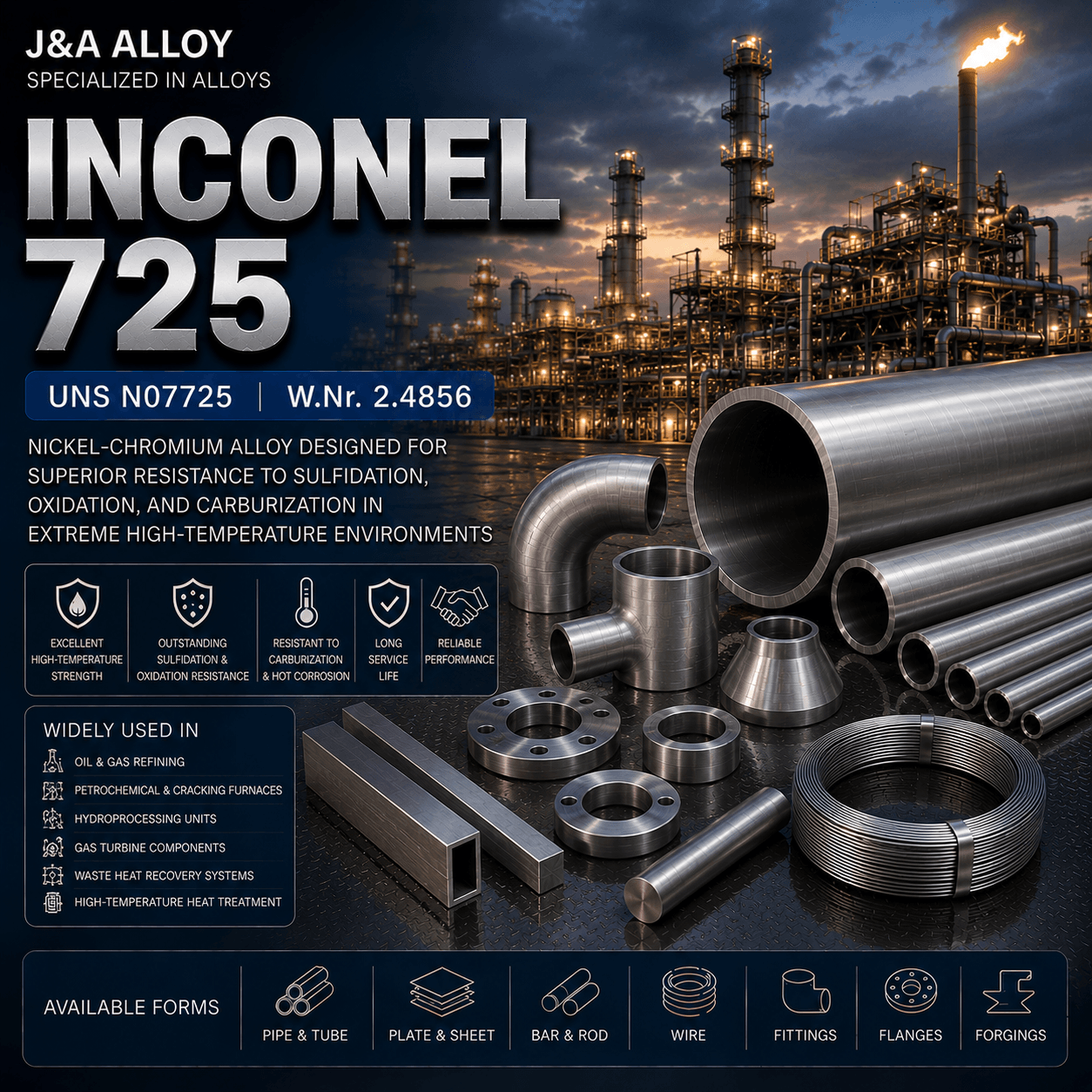
Inconel 725 (Alloy 725 / UNS N07725) is a precipitation-hardened nickel-chromium-molybdenum-niobium alloy derived from Inconel 625. By combining the outstanding corrosion resistance of Alloy 625 with age-hardening capability, Inconel 725 delivers significantly higher strength while maintaining excellent resistance to seawater, hydrogen sulfide (H₂S), carbon dioxide (CO₂), chlorides, and sour service environments. The alloy is widely used in subsea equipment, oilfield components, wellhead systems, fasteners, and offshore applications. J&A Alloy supplies Inconel 725 in bar, rod, forging, pipe, tube, flange, and custom-machined forms with full traceability and EN 10204 3.1 certification.
Inconel 725 (Alloy 725 / UNS N07725)
Inconel 725, also known as Alloy 725 or UNS N07725, is a precipitation-hardenable nickel-based alloy specifically developed for demanding oil and gas environments requiring both exceptional corrosion resistance and high mechanical strength. The alloy is based on the chemistry of Inconel 625 but incorporates controlled additions of titanium and niobium to enable age hardening.
Unlike conventional corrosion-resistant alloys that sacrifice strength for corrosion performance, Inconel 725 provides yield strengths exceeding 100 ksi (690 MPa) while retaining outstanding resistance to pitting, crevice corrosion, chloride stress corrosion cracking, and sour gas environments. These characteristics make it an ideal material for subsea hardware, wellhead equipment, downhole tools, completion systems, and marine engineering applications.
Because of its compliance with NACE MR0175 / ISO 15156 requirements, Inconel 725 is widely selected for critical oilfield and offshore projects where reliability and long service life are essential.
Features of Inconel 725
- Exceptional resistance to seawater corrosion.
- Excellent resistance to hydrogen sulfide (H₂S) environments.
- Outstanding performance in sour gas service.
- High strength through precipitation hardening.
- Excellent resistance to pitting and crevice corrosion.
- Superior resistance to chloride stress corrosion cracking.
- Excellent fatigue resistance.
- Good resistance to CO₂-containing environments.
- Suitable for subsea and offshore applications.
- NACE MR0175 / ISO 15156 compliant.
Chemical Composition of Inconel 725
| Element | Content (%) |
|---|---|
| Nickel (Ni) | 55.0 – 59.0 |
| Chromium (Cr) | 19.0 – 22.5 |
| Molybdenum (Mo) | 7.0 – 9.5 |
| Niobium (Nb) | 2.75 – 4.0 |
| Titanium (Ti) | 1.0 – 1.7 |
| Iron (Fe) | Balance |
| Carbon (C) | ≤ 0.03 |
| Manganese (Mn) | ≤ 0.35 |
| Silicon (Si) | ≤ 0.20 |
| Sulfur (S) | ≤ 0.01 |
Physical Properties of Inconel 725
| Property | Value |
|---|---|
| Density | 8.31 g/cm³ |
| Melting Range | 1271 – 1338°C |
| Electrical Resistivity | 1.29 μΩ·m |
| Thermal Conductivity | 10.5 W/m·K |
| Specific Heat Capacity | 435 J/kg·K |
| Modulus of Elasticity | 205 GPa |
Mechanical Properties of Inconel 725
| Property | Value |
|---|---|
| Tensile Strength | ≥ 1035 MPa |
| Yield Strength (0.2% Offset) | ≥ 725 MPa |
| Elongation | ≥ 25% |
| Hardness | ≤ 40 HRC |
(Age-Hardened Condition)
Corrosion Resistance
Inconel 725 provides outstanding resistance to a wide range of corrosive media encountered in offshore and oilfield environments. The alloy performs exceptionally well in seawater, chloride-containing solutions, sour gas environments, and acidic production streams.
Its high nickel, chromium, and molybdenum content ensures excellent resistance to pitting corrosion, crevice corrosion, and chloride-induced stress corrosion cracking. Inconel 725 also demonstrates excellent resistance to hydrogen sulfide (H₂S) and carbon dioxide (CO₂), making it a preferred material for subsea and downhole service.
Compared with conventional stainless steels and many high-strength alloys, Inconel 725 offers a superior combination of strength and corrosion resistance.
High Temperature Performance
| Property | Performance |
|---|---|
| Maximum Recommended Service Temperature | Up to 650°C |
| Oxidation Resistance | Excellent |
| Fatigue Resistance | Excellent |
| Stress Corrosion Resistance | Excellent |
Available Forms
| Product Form | Availability |
|---|---|
| Bar | Round, Flat, Hex |
| Rod | Available |
| Forgings | Available |
| Pipe | Available |
| Tube | Available |
| Flange | Available |
| Fasteners | Available |
| Custom Machined Parts | Available |
Applications of Inconel 725
- Subsea production systems
- Oilfield wellhead equipment
- Downhole tools
- Completion equipment
- Offshore platforms
- Marine engineering
- Fasteners and connectors
- Pressure control equipment
- Flow control systems
- High-strength corrosion-resistant components
Inconel 725 vs Other Alloys
| Property | Inconel 725 | Inconel 625 | Inconel 718 | Duplex Stainless Steel |
|---|---|---|---|---|
| Strength | Excellent | Good | Excellent | Moderate |
| Seawater Resistance | Excellent | Excellent | Good | Good |
| Sour Service | Excellent | Excellent | Limited | Moderate |
| Subsea Applications | Excellent | Excellent | Limited | Good |
Welding & Fabrication
Inconel 725 exhibits good weldability using conventional nickel alloy welding techniques, including GTAW, GMAW, and SMAW. Welding is typically performed in the solution-annealed condition, followed by aging treatment when high-strength properties are required. Proper heat treatment ensures optimal precipitation hardening and mechanical performance.
Standards & Equivalent Grades
| Standard | Designation |
|---|---|
| UNS | N07725 |
| Werkstoff Number | 2.4856 (Industry Reference) |
| ASTM Forgings | B805 |
| NACE | MR0175 / ISO 15156 |
| API Applications | Oil & Gas Equipment |
| Trade Name | Inconel 725 / Alloy 725 |
Frequently Asked Questions
What is Inconel 725?
Inconel 725 is a precipitation-hardened nickel-chromium-molybdenum-niobium alloy (UNS N07725) developed from Inconel 625. It combines the excellent corrosion resistance of Alloy 625 with significantly higher strength achieved through age-hardening heat treatment.
What is Inconel 725 used for?
Inconel 725 is widely used in subsea equipment, wellhead systems, downhole tools, completion equipment, offshore platforms, fasteners, hangers, valve components, and other critical oil and gas applications requiring both high strength and corrosion resistance.
What is the UNS number of Inconel 725?
The UNS designation for Inconel 725 is UNS N07725.
Is Inconel 725 suitable for sour service?
Yes. Inconel 725 is specifically designed for sour gas environments containing hydrogen sulfide (H₂S) and is commonly supplied in accordance with NACE MR0175 / ISO 15156 requirements for oil and gas applications.
Is Inconel 725 NACE compliant?
Yes. Properly processed and heat-treated Inconel 725 can meet NACE MR0175 and ISO 15156 requirements for use in sour service environments.
What is the difference between Inconel 725 and Inconel 625?
Both alloys offer excellent corrosion resistance, but Inconel 725 can be precipitation hardened to achieve much higher yield and tensile strength. Inconel 625 relies on solid-solution strengthening and is generally used where corrosion resistance is the primary requirement.
What is the difference between Inconel 725 and Inconel 718?
Inconel 718 is primarily designed for high-temperature aerospace applications, while Inconel 725 is optimized for corrosion resistance and sour service environments. Inconel 725 generally offers superior resistance to seawater and oilfield corrosion.
Is Inconel 725 resistant to seawater?
Yes. Inconel 725 provides outstanding resistance to seawater corrosion, including pitting, crevice corrosion and microbiologically influenced corrosion, making it ideal for offshore and subsea systems.
Is Inconel 725 resistant to hydrogen sulfide (H₂S)?
Yes. Inconel 725 exhibits excellent resistance to hydrogen sulfide attack and sulfide stress cracking, which is one of the reasons it is widely used in sour gas production environments.
Is Inconel 725 resistant to carbon dioxide (CO₂)?
Yes. The alloy performs very well in CO₂-containing production environments and is frequently selected for oil and gas fields where sweet and sour corrosion conditions coexist.
Can Inconel 725 resist chloride stress corrosion cracking?
Yes. The high nickel content provides excellent resistance to chloride-induced stress corrosion cracking, significantly outperforming many stainless steels and duplex grades.
What is the maximum service temperature of Inconel 725?
Inconel 725 maintains excellent mechanical properties and corrosion resistance at temperatures up to approximately 650°C, depending on service conditions and component design.
Can Inconel 725 be welded?
Yes. Inconel 725 can be welded using GTAW (TIG), GMAW (MIG) and SMAW welding processes. Post-weld heat treatment may be required when maximum strength is needed.
Does welding affect the strength of Inconel 725?
As-welded components may not achieve full precipitation-hardened strength. Appropriate solution annealing and aging treatments can restore optimum mechanical properties after welding.
What forms are available for Inconel 725?
Inconel 725 is available in bar, rod, forging, pipe, tube, flange, fastener, fitting and custom-machined component forms.
Is Inconel 725 available as fasteners?
Yes. Inconel 725 is widely used for high-strength bolts, studs, nuts and other fastening systems in offshore, subsea and oilfield applications.
Why is Inconel 725 preferred for subsea equipment?
The alloy combines high strength, excellent seawater resistance, outstanding resistance to H₂S and CO₂ corrosion, and long-term reliability under high-pressure offshore conditions.
Is Inconel 725 suitable for wellhead and completion systems?
Yes. Inconel 725 is commonly used in wellhead equipment, tubing hangers, packers, completion tools and flow control systems due to its excellent corrosion resistance and mechanical strength.
What industries use Inconel 725?
Major industries include oil and gas production, offshore engineering, subsea systems, marine engineering, energy generation, petrochemical processing and industrial fluid handling.
What standards apply to Inconel 725?
Common specifications include UNS N07725, ASTM B805, NACE MR0175, ISO 15156 and various OEM specifications used by major oil and gas operators.
Is Inconel 725 better than duplex stainless steel?
For highly corrosive offshore and sour service environments, Inconel 725 generally provides superior resistance to chloride stress corrosion cracking, sulfide stress cracking and localized corrosion, while also offering higher strength in many applications.
What are the advantages of Inconel 725 over stainless steel?
Compared with stainless steels, Inconel 725 offers significantly better resistance to seawater corrosion, hydrogen sulfide attack, chloride stress corrosion cracking and harsh oilfield environments, making it a more reliable choice for critical service conditions.
Why choose Inconel 725 instead of conventional high-strength alloys?
Many high-strength alloys lose corrosion resistance as strength increases. Inconel 725 is unique because it delivers both exceptional mechanical strength and outstanding corrosion resistance, making it one of the most versatile materials for demanding offshore and oilfield applications.
How does Inconel 725 compare with Super Duplex Stainless Steel?
Inconel 725 generally provides superior resistance to sour service cracking, deepwater corrosion and aggressive chloride environments. While Super Duplex Stainless Steel may offer lower material cost, Inconel 725 often delivers longer service life and lower lifecycle maintenance costs in critical applications.
Why Choose J&A Alloy
J&A Alloy supplies premium nickel alloys and corrosion-resistant materials for critical industrial applications worldwide.
We provide:
- EN 10204 3.1 Mill Test Certificates
- NACE-compliant material solutions
- Full material traceability
- Custom machining and forging capabilities
- Global logistics support
- Strict quality assurance procedures
With extensive experience serving the oil and gas, offshore and energy sectors, J&A Alloy is a trusted supplier of Inconel 725 products for the world’s most demanding environments.