Stainless Steel Custom 450 | UNS S45000
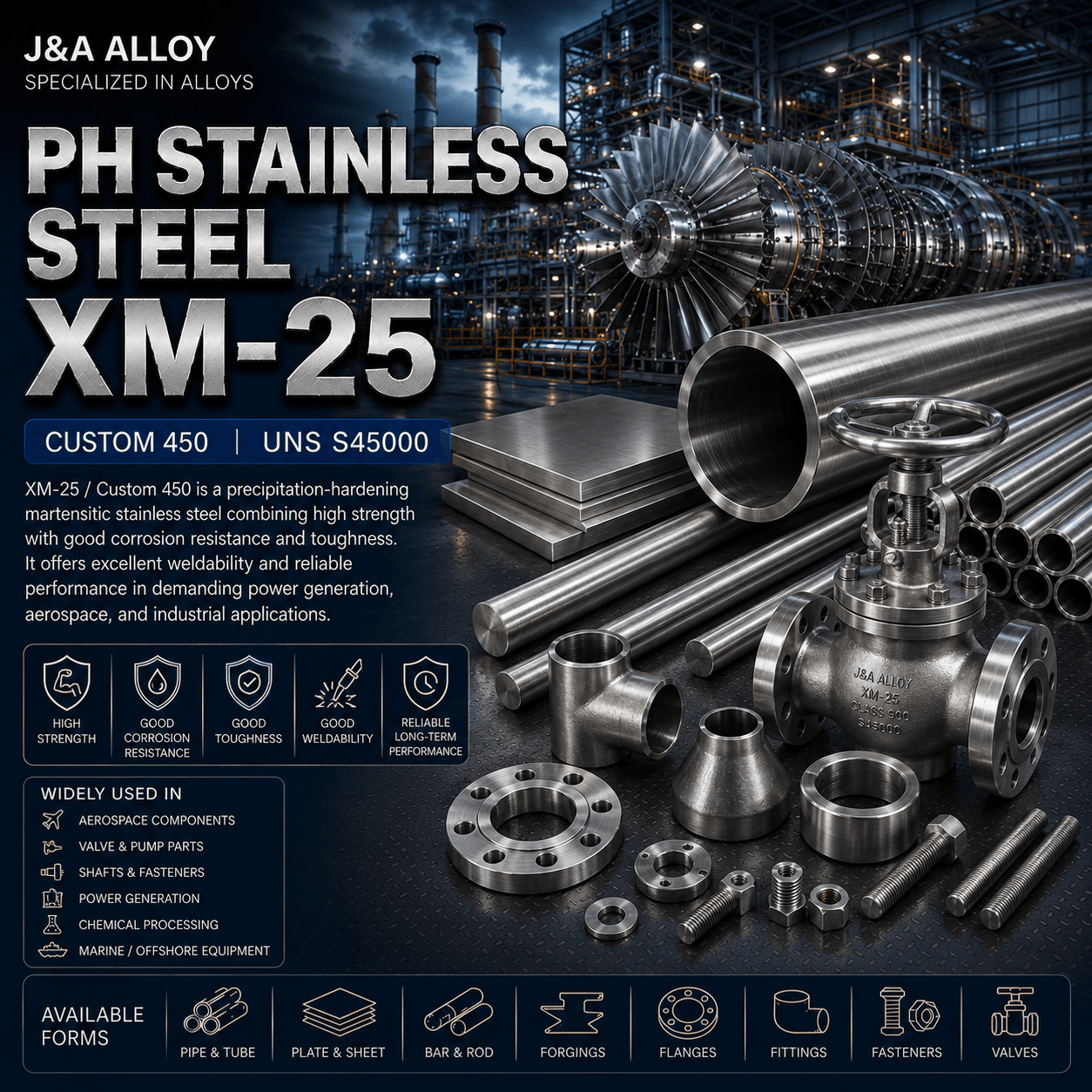
PH stainless steel XM-25, also known as Custom 450, Alloy 450, UNS S45000, and EN 1.4594, is a martensitic precipitation-hardening stainless steel combining good corrosion resistance, moderate-to-high strength, excellent weldability, and good fabrication performance. It provides corrosion resistance similar to Type 304 stainless steel with higher yield strength and can be used in the annealed condition or age hardened for higher strength. J&A Alloy supplies XM-25 stainless steel in bar, plate, sheet, strip, wire, forgings, rings, billets, and custom machined components.
PH Stainless Steel Custom 450 | UNS S45000 | XM-25
PH stainless steel XM-25 is a martensitic age-hardenable stainless steel designed for applications that require good corrosion resistance, useful strength in the annealed condition, improved strength after aging, and excellent weldability. It is commonly known as Custom 450 stainless steel, Alloy 450, UNS S45000, EN 1.4594, and X5CrNiMoCuNb14-5.
Unlike some precipitation-hardening stainless steels that must be aged before use, XM-25 can often be used in the annealed condition for applications requiring corrosion resistance, ease of fabrication, and moderate strength. A single-step aging treatment can further increase tensile strength, yield strength, and hardness while maintaining useful ductility and toughness.
The alloy contains chromium, nickel, copper, molybdenum, and niobium. Chromium provides stainless corrosion resistance, nickel improves toughness and corrosion behavior, copper supports age-hardening response and acid resistance, molybdenum helps improve localized corrosion resistance, and niobium contributes to precipitation hardening and stabilization.
PH stainless steel XM-25 is widely used in valve parts, aircraft components, power generation equipment, pulp and paper machinery, chemical processing components, nuclear-related parts, pump components, fasteners and precision machined parts. It is selected when Type 304 stainless steel does not provide enough strength and Type 410 stainless steel does not provide enough corrosion resistance.
XM-25 At a Glance
| Key Attribute | Value |
|---|---|
| Material | PH Stainless Steel XM-25 / Custom 450 Stainless Steel |
| UNS Number | S45000 |
| EN / W.Nr. | 1.4594 / X5CrNiMoCuNb14-5 |
| Material Type | Martensitic Age-Hardenable / Precipitation-Hardening Stainless Steel |
| Density | Approx. 7.80 g/cm³ |
| PREN | Approx. 17–19 |
| Main Advantage | 304-like Corrosion Resistance with Higher Strength and Excellent Weldability |
| Typical Service Temperature | Commonly used up to approx. 315°C / 600°F; short exposure may be considered below the aging temperature |
| Main Industries | Aerospace, Valves, Power Generation, Chemical Processing, Pulp & Paper, Nuclear, Precision Engineering |
| Comparable Grades | 304, 410, 17-4PH, 15-5PH, 13-8Mo, 17-7PH |
Features of XM-25
- Martensitic precipitation-hardening stainless steel with good strength and corrosion resistance.
- Corrosion resistance similar to Type 304 stainless steel in many mild environments.
- Higher yield strength than 304 stainless steel in the annealed condition.
- Can be used in the annealed condition for many applications without additional aging.
- Single-step aging treatment develops higher strength, hardness and good toughness.
- Excellent weldability and brazability compared with many martensitic stainless steels.
- Good machinability, hot workability and cold formability for an age-hardenable stainless steel.
- Suitable for valve parts, aircraft components, power generation equipment and chemical processing parts.
- Good resistance to atmospheric corrosion, salt spray and mild chemical environments.
- Available in bars, sheets, plates, strips, wire, forgings, rings and custom machined components.
Chemical Composition of XM-25
| Element | Content (%) |
|---|---|
| Carbon (C) | ≤ 0.05 |
| Manganese (Mn) | ≤ 1.00 |
| Phosphorus (P) | ≤ 0.040 |
| Sulfur (S) | ≤ 0.030 |
| Silicon (Si) | ≤ 1.00 |
| Chromium (Cr) | 14.00–16.00 |
| Nickel (Ni) | 5.00–7.00 |
| Molybdenum (Mo) | 0.50–1.00 |
| Copper (Cu) | 1.25–1.75 |
| Niobium / Columbium (Nb/Cb) | Approx. 0.40 or specification-controlled addition |
| Iron (Fe) | Balance |
Physical Properties of XM-25
| Property | Typical Value |
|---|---|
| Density | Approx. 7.80 g/cm³ / 0.282 lb/in³ |
| Melting Range | Approx. 1400–1450°C / 2550–2640°F |
| Electrical Resistivity | Approx. 0.71–0.80 μΩ·m |
| Thermal Conductivity | Approx. 15.9–16.0 W/m·K at room temperature |
| Specific Heat Capacity | Approx. 460 J/kg·K / 0.11 BTU/lb·°F |
| Modulus of Elasticity | Approx. 193–200 GPa / 28.0–29.0 × 10⁶ psi |
Mechanical Properties of XM-25
Mechanical properties of PH stainless steel XM-25 depend on product form, section size and selected aging condition. The alloy is commonly supplied in the annealed condition and can also be aged to conditions such as H900, H950, H1000, H1050 and H1150.
| Condition | Tensile Strength | Yield Strength | Elongation | Hardness |
|---|---|---|---|---|
| Condition A / Annealed | Approx. 979 MPa / 142 ksi | Approx. 814 MPa / 118 ksi | Approx. 13% | Approx. HRC 28 |
| H900 Condition | Approx. 1350 MPa / 196 ksi | Approx. 1295 MPa / 188 ksi | Approx. 14% | Approx. HRC 42 |
| H950 Condition | Approx. 1290 MPa / 187 ksi | Approx. 1270 MPa / 184 ksi | Approx. 16% | Approx. HRC 41 |
| H1000 Condition | Approx. 1190 MPa / 173 ksi | Approx. 1165 MPa / 169 ksi | Approx. 17% | Approx. HRC 39 |
| H1050 Condition | Approx. 1100 MPa / 160 ksi | Approx. 1048 MPa / 152 ksi | Approx. 20% | Approx. HRC 37 |
| H1150 Condition | Approx. 979 MPa / 142 ksi | Approx. 634 MPa / 92 ksi | Approx. 23% | Approx. HRC 28 |
Corrosion Resistance
PH stainless steel XM-25 provides very good general corrosion resistance in atmospheric, fresh water, mild chemical and industrial environments. Its corrosion resistance is often compared with Type 304 stainless steel, while its strength level is significantly higher than 304 and its corrosion resistance is better than many standard martensitic stainless steels such as 410.
For pitting and crevice corrosion, XM-25 performs well in clean, mildly corrosive environments and has useful resistance to salt spray and humid atmospheres. However, it is not a high-molybdenum stainless steel. In stagnant chloride solutions, seawater immersion, tight crevices or deposit-forming environments, 316L, 904L, 254SMO, duplex stainless steel or nickel alloys may provide better long-term localized corrosion resistance.
Stress corrosion cracking resistance depends on heat treatment condition, stress level, chloride concentration and operating temperature. As a martensitic precipitation-hardening stainless steel, XM-25 should be evaluated carefully for high-stress chloride applications, especially where elevated temperature and tensile stress are present.
In acid environments, the copper and molybdenum additions help support resistance to selected mild chemical media, but XM-25 is not intended for strong reducing acids such as hydrochloric acid or severe hot sulfuric acid service. For aggressive acid systems, J&A Alloy can help evaluate alternatives such as 904L, Alloy 20, Alloy 825, Hastelloy C-276 or Hastelloy C-22.
High Temperature Performance
PH stainless steel XM-25 offers useful mechanical performance at moderately elevated temperatures. It can resist oxidation at elevated temperatures, but the final service limit should be selected based on aging condition, mechanical load, exposure time and required toughness.
For many engineering applications, XM-25 is used at temperatures up to approximately 315°C / 600°F. Short-term exposure at higher temperatures may be possible if the maximum service temperature remains below the selected aging temperature and mechanical property changes are acceptable.
Long-term exposure near or above the aging temperature can change mechanical properties, reduce toughness or cause over-aging. XM-25 should not be used as a direct substitute for dedicated high-temperature alloys where creep strength, oxidation resistance or thermal fatigue resistance is the main design requirement. For severe high-temperature service, alloys such as A-286, Inconel 718, Inconel X-750, Inconel 625 or Alloy 800H may be more suitable.
Available Forms
- Round bar
- Flat bar
- Square bar
- Hex bar
- Sheet
- Plate
- Strip
- Wire
- Rod
- Tube
- Forgings
- Forged rings
- Billets
- Blocks
- Valve components
- Pump components
- Precision machined parts
- Custom heat-treated components
Applications of XM-25
Aerospace
- Aircraft components
- Structural fittings
- Fasteners and pins
- Precision machined hardware
- High-strength corrosion-resistant parts
Valve & Fluid Control
- Valve stems
- Valve bodies
- Valve seats
- Actuator components
- High-strength fittings
Power Generation
- Turbine-related auxiliary parts
- Power plant mechanical components
- Fasteners and connectors
- Pump and valve parts
- Precision corrosion-resistant hardware
Chemical Processing
- Pump components
- Process equipment parts
- Mechanical seals
- Fasteners
- Corrosion-resistant machined components
Pulp & Paper
- Paper mill screens
- Roller components
- Corrosion-resistant mechanical parts
- Pump and valve components
- High-strength wear-related parts
Nuclear & Precision Engineering
- Nuclear-related components
- Precision shafts
- Instrument parts
- Custom machined components
- High-strength corrosion-resistant assemblies
XM-25 vs 304 vs 410 vs 17-4PH
| Grade | Main Advantage | Strength | Corrosion Resistance | Typical Application |
|---|---|---|---|---|
| XM-25 / UNS S45000 | 304-like corrosion resistance with higher strength and excellent weldability | Medium to High | Good to Very Good in mild environments | Valves, aircraft parts, power generation, pulp and paper, chemical processing components |
| 304 Stainless Steel | Excellent general corrosion resistance, formability and weldability | Moderate | Good | General fabrication, tanks, food equipment, architectural and industrial components |
| 410 Stainless Steel | Economical hardenable martensitic stainless steel | Medium to High after heat treatment | Moderate | Blades, shafts, fasteners, wear parts and general hardenable stainless components |
| 17-4PH / UNS S17400 | High strength and wide availability in bars, forgings and machined parts | High | Good | Shafts, valve parts, pump parts, aerospace fittings and fasteners |
XM-25 vs 17-4PH vs 15-5PH
| Item | XM-25 / Custom 450 | 17-4PH | 15-5PH |
|---|---|---|---|
| UNS Number | S45000 | S17400 | S15500 |
| Material Type | Martensitic age-hardenable stainless steel | Martensitic precipitation-hardening stainless steel | Martensitic precipitation-hardening stainless steel |
| Main Advantage | Can be used annealed, good corrosion resistance and excellent weldability | High strength and broad industrial availability | Better transverse toughness and ductility than 17-4PH |
| Corrosion Resistance | Similar to 304 in many mild environments | Good | Good |
| Typical Use | Valves, aircraft parts, power generation, chemical and pulp/paper equipment | Shafts, valve parts, pump parts, fasteners and aerospace fittings | Aerospace parts, shafts, gears, forgings and critical machined components |
Welding & Fabrication
PH stainless steel XM-25 has excellent weldability and brazability compared with many martensitic precipitation-hardening stainless steels. It can be welded using common stainless steel welding processes such as GTAW, GMAW and SMAW when suitable procedures are followed.
GTAW is recommended for precision welds, thin sections, aerospace components and critical valve or instrument parts where heat input control is important. GMAW may be used for production welding of suitable sections when shielding gas, filler selection and heat input are controlled. SMAW may be used for repair or thicker-section welding where applicable.
Preheating is generally not required for many XM-25 welding applications, but actual procedure should be determined by section thickness, restraint, service condition and specification requirements. When optimum corrosion resistance and mechanical properties are required, annealing or aging after welding may be considered.
XM-25 can be machined, hot worked and cold formed using methods similar to other martensitic age-hardenable stainless steels. It is usually easier to fabricate in the annealed condition. After forming or machining, parts can be aged to achieve higher strength and hardness. For optimum corrosion resistance, surfaces should be cleaned, descaled, pickled or passivated after fabrication.
Standards & Equivalent Grades
| Category | Designation / Standard |
|---|---|
| UNS | S45000 |
| Common Names | XM-25, Custom 450, Alloy 450, Stainless Steel 450 |
| EN / W.Nr. | 1.4594 / X5CrNiMoCuNb14-5 |
| ASTM | ASTM A564 XM-25, ASTM A693 Type XM-25, ASTM A705 Grade XM-25, ASTM A959 UNS S45000 |
| ASME | ASME SA564, ASME SA693 and ASME SA705 equivalents may apply by product form and project specification |
| AMS | AMS 5763, AMS 5773, AMS 5863, AMS 5859 depending on product form and melting route |
| ISO | Equivalent ISO references may apply depending on product form and customer specification |
| NACE | Not a default sour-service grade; NACE / ISO 15156 suitability requires project-specific review |
| Material Family | Martensitic Precipitation-Hardening Stainless Steel |
Frequently Asked Questions
What is PH stainless steel XM-25?
PH stainless steel XM-25 is a martensitic age-hardenable stainless steel also known as Custom 450, Alloy 450 and UNS S45000. It combines good corrosion resistance, useful strength, excellent weldability and single-step age hardening.
What is the UNS designation of XM-25 stainless steel?
The UNS designation of XM-25 stainless steel is UNS S45000.
Is XM-25 the same as Custom 450 stainless steel?
Yes. XM-25 is commonly known as Custom 450 stainless steel or Alloy 450. It is a martensitic precipitation-hardening stainless steel.
What is the EN number of XM-25 stainless steel?
The EN / Werkstoff number of XM-25 stainless steel is 1.4594, with the material designation X5CrNiMoCuNb14-5.
What is XM-25 stainless steel used for?
XM-25 stainless steel is used for valve parts, aircraft components, power generation equipment, pulp and paper machinery, chemical processing components, pump parts, fasteners, precision shafts and machined components.
What is the main advantage of XM-25 stainless steel?
The main advantage of XM-25 stainless steel is its combination of Type 304-like corrosion resistance, higher yield strength, excellent weldability and the ability to be used in the annealed condition or age hardened for higher strength.
Can XM-25 stainless steel be used in the annealed condition?
Yes. XM-25 is commonly supplied and used in the annealed condition for many applications. It can also be age hardened when higher strength and hardness are required.
Can XM-25 stainless steel be welded?
Yes. XM-25 stainless steel has excellent weldability and can be welded using GTAW, GMAW and SMAW processes. Post-weld heat treatment may be selected when optimum strength, hardness or corrosion resistance is required.
Does XM-25 require post-weld heat treatment?
Post-weld heat treatment is not always required, but it may be recommended for critical parts or when final mechanical properties and corrosion resistance must be optimized.
Is XM-25 stainless steel corrosion resistant?
Yes. XM-25 offers very good corrosion resistance in atmospheric, fresh water, salt spray and mild chemical environments. Its corrosion resistance is often compared with Type 304 stainless steel.
Is XM-25 stainless steel magnetic?
Yes. XM-25 stainless steel is generally magnetic because it has a martensitic structure.
What is the difference between XM-25 and 17-4PH?
XM-25 can be used in the annealed condition and is known for good corrosion resistance and excellent weldability. 17-4PH is typically selected when higher aged strength and broad availability in bars and forgings are required.
What is the difference between XM-25 and 304 stainless steel?
XM-25 offers corrosion resistance similar to 304 in many mild environments but provides much higher yield strength. 304 offers better general formability and weldability for non-high-strength fabrication.
What standards apply to XM-25 stainless steel?
Common standards include UNS S45000, ASTM A564 XM-25, ASTM A693 Type XM-25, ASTM A705 Grade XM-25, ASTM A959, AMS 5763, AMS 5773 and AMS 5863.
Why Choose J&A Alloy
Global Material Solutions
J&A Alloy supplies stainless steels, precipitation-hardening stainless steels, duplex stainless steels, super austenitic stainless steels, nickel alloys, titanium alloys and high-performance corrosion-resistant alloys for demanding industrial applications. For PH stainless steel XM-25, we support bars, plates, sheets, strips, wire, forgings, rings, billets and custom processed components according to project requirements.
Strict Quality Assurance
J&A Alloy provides strict quality control for chemical composition, mechanical properties, dimensional tolerance and surface condition. Available inspection and documentation services include PMI, chemical analysis, mechanical testing, hardness testing, ultrasonic testing, dimensional inspection and EN 10204 3.1 / 3.2 certification when required.
International Standards
Materials can be supplied according to ASTM, ASME, EN, ISO, AMS and customer-specific specifications. For PH stainless steel XM-25, we support common standards such as ASTM A564 XM-25, ASTM A693 Type XM-25, ASTM A705 Grade XM-25, AMS 5763, AMS 5773 and AMS 5863 depending on product form and technical requirements.
Value-added Services
J&A Alloy offers cutting, CNC machining, heat treatment coordination, grinding, polishing, custom fabrication and export packaging. We help customers reduce processing time, control material waste and receive ready-to-use or semi-finished materials for manufacturing.
Worldwide Supply
J&A Alloy serves customers in aerospace, chemical processing, oil and gas, marine engineering, power generation, pulp and paper, nuclear, precision manufacturing and industrial equipment markets. With experience in international logistics and export documentation, we support global buyers with reliable material supply and responsive technical communication.